
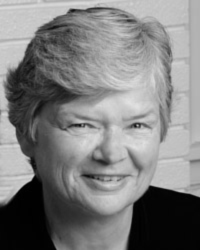
Professor Mab Segrest.
Coordinator of a prominent anti-racism group in the 1980s, author of three critically acclaimed books, celebrated speaker in front of 30,000 people at the largest conference ever sponsored by the United Nations, one of three parents in a rather unconventional family and a self-proclaimed lesbian-feminist seem like too many roles for one person to fulfill. Professor Mab Segrest is all of these things and more.
On Monday, December 5, Professor Segrest was the featured guest at a dessert and dialogue in Windham. For well over an hour, she captivated a common room full of students with stories of her personal and professional life before she became a professor and chair of the Gender and Women’s Studies Department in 2002. Segrest read excerpts from her many books in her distinctive, light Southern drawl, passed out various publications from her years as an activist, presented family photo albums and sung a few choice verses of a hymn to explain her vibrant past.
Growing up in Alabama during the 1950s and 1960s, Segrest was no stranger to the area’s rampant racism and violence. At age thirteen, she was sent to a segregated school, started by parents, including her own, who were concerned and angered by the racial integration of her public school. Her own grandfather was a member of the Klan, and one of her father’s cousins was known to have killed at least one activist in the civil rights movement.
Segrest was intent on fleeing this racist culture and, despite staying in Alabama for her undergraduate years, she finally “escaped” to Duke University in Durham, North Carolina. After graduating with an M.A. and Ph.D. in Modern British Literature, she taught at a nearby college into the early 1980s and became involved for the first time in political activism.
Her self-described career as “a teacher by day, lesbian-feminist activist by night” lasted until 1983 when she left her teaching position to help found the North Carolinians Against Racist and Religious Violence (NCARRV) and functioned as the coordinator for this group for the next several years.
During her time with the NCARRV, Segrest was responsible for publishing a weekly newsletter, compiling annual reports of hate-motivated crimes in the community and attending political rallies. Not surprisingly, her involvement in this line of work made her a target of threats as well as an internationally recognized inspiration.
At one political rally she was singled out of the crowd by an angry man who accused her of being responsible for putting a prominent racist in jail, to which she boldly thanked him for thinking she had that great of an impact. She was also the subject of neo-Nazi hate speech: Segrest was told to call a specified number and was greeted with a message that said, “Mab Segrest is a lesbian and will infect everyone with AIDS.”
Despite this adversity, Segrest has been celebrated in both the political and pop-culture spheres alike. In 1995, she was asked to speak at the fourth World Conference on the Women’s NGO Forum in Beijing, a non-governmental organization conference to discuss equality, development and world peace. She was also named in the Le Tigre song “Hot Topic” along with other women writers, artists, activists, musicians and feminists that the band idealized.
Segrest said that she was not able to become involved in any form of activism until the late 1970s, which is when she began the process of coming out. She explained that there was always something “different about me that made me sad,” but she was never sure what it was.
In graduate school, she was finally able to accept that she was gay, admitting to herself that she “had always gone to girl scout camp just to fall in love with my girlfriends.” Segrest feels strongly that finally “naming herself as a lesbian” is what allowed her to pursue her political activism.
As a lesbian, Segrest was part of a minority of people in a country where homophobia was rampant in both the social and political spheres. As a result, she and her partner were faced with the task of trying to “figure out how to have a life,” negotiate work, where one would most likely be fired for being openly gay, and to navigate a homosexual relationship in a largely intolerant society.
Segrest and her partner, Barbara, were also trying to figure out how to have a child. Not wanting to use an anonymous sperm donor, and wanting to provide their child with a father figure in her life, the two women contacted David, a gay man looking for a similar situation. Together they agreed that he would donate the sperm and Barbara would carry the child. After drawing up a contract to keep any disagreements out of the courts, the three successfully raised a healthy baby girl who is now twenty-five.
With her radical political career and unconventional family, Professor Segrest’s life is a story of success and courage in the face of all kinds of adversity. “It showed me how much you can do if you don’t let fear stop you,” she said.•








Wonderful article. Thank you for sharing – our stories are so important especially for women living in places where being out puts them in grave danger. I have shared this piece on LesbianVoices.com and, of course linked to this. I hope that’s alright.