One of the most common appliances in any household is the laundry machine and dryer. An average household of four uses about 15-40% of their water consumption on laundry. Furthermore, the average American family does about 400 loads of laundry a year. However, despite being such a common home appliance, what may not be known is the truly unsustainable fashion in which many laundry machines operate. A standard washer typically consumes between 40 and 45 gallons of water per load whereas today’s best washers still consume around 9 gallons per load. The water efficiency of laundry machines can be measured using the Water Factor which is the quantity of the water (in gallons) used to wash each cubic feet of the laundry.
The unsustainability of laundry machines is two-fold: the inefficiency of the machines themselves as well as the plastics present in the clothing that are ultimately washed away into the ocean. Around 60% of the material in our clothing is plastic due to its durability as well as it being relatively cheap. Simply by running a washing machine cycle, hundreds of thousands of plastic fibers ultimately will reach the ocean through the water supply. Microplastics are one of the most lethal threats to the oceanic environment today due to marine life mistaking it for food, ultimately leading to widespread death. Once consumed, the plastic gets passed on to other organisms as it moves along the food chain leading to a widespread effect. It was found that 73% of fish caught in the North Atlantic had microplastics present in their stomachs.
A study was conducted in 2016 by the Marine Pollution Bulletin looking at the release of synthetic microplastics from domestic washing machines and found that an average wash load of 6 kg yielded a release of 700,000 fibers per wash. The danger of microplastics is their ability for some to find their way through multiple barriers such as sewage treatment scree, making it virtually impossible to stop them from reaching the ocean. Moreover, the plastics take thousands of years to degrade, increasing the longstanding impact on the ocean.
An issue that often arises in relation to scientific discoveries is the ability of a scientist to properly synthesize the scientific information to the layman. The question that ultimately arises from this issue is what the average person can do to minimize the number of plastics reaching the ocean. Living in a world dominated by the consumer, however, it’s hard to tell someone not to buy more clothing. It’s even harder to convince people to buy clothing made of natural fibers. In other words, a solution needs to apply to the everyday person and make the everyday person a consumer that is environmentally conscious. Eventually, the technology needed to reduce the number of fibers being released will be designed but the two most immediate things we can do are cutting clothing consumption and running washing machines only when necessary and/or with a full load of clothing. •
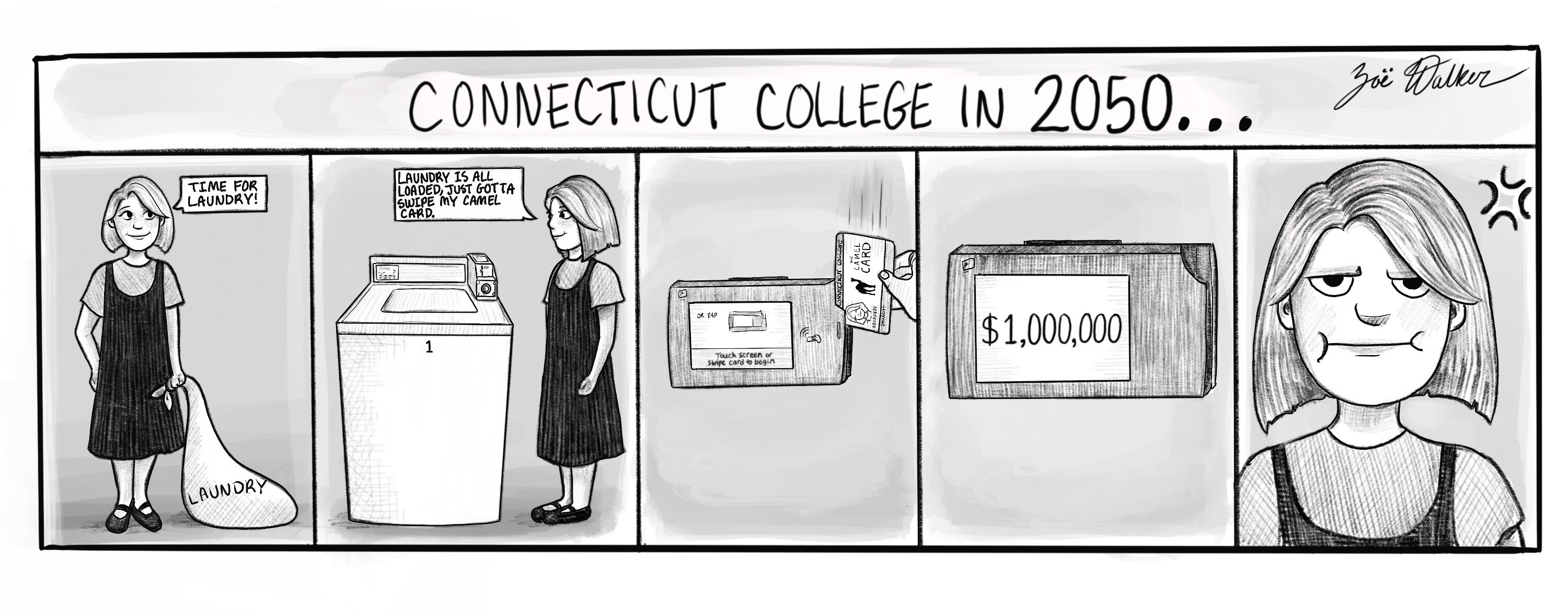
Comic by Zoë Walker