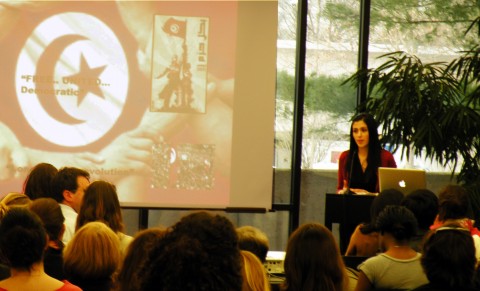
Professor Sayej speaks about revolutions in Egypt and Tunisia.
“This is the biggest moment of my career,” said Caroleen Sayej, professor of government, as she addressed the packed audience in the Charles Chu room. Students and faculty came to the talk titled “A New Middle East,” for a wide variety of reasons.
“I attended this talk because of the current developments in the Middle East,” said Jazmin Acuna Cantero ’11, “I believe that anyone who is interested in politics and international relations would have been as excited as I was while watching the uprisings in Tunisia and Egypt over the internet or the TV.”
Other students, like Abigail Stevenson ’14, went to the discussion for more personal reasons. “I am particularly interested in Middle Eastern politics, seeing as my dad is Arab himself and lives in Morocco. Seeing these events unfold in his neighboring countries makes me curious about the future of the surrounding nations.”
Sayej referred to the recent events in Egypt and Tunisia as a “breath of fresh air.”
“All we really talk about are negative developments, Middle East exceptionalism and why they are absent from discussions of democracy and civil society.” Talk of protest and uprising in the Middle East has always centered on radicals and extremists, however these new protests have finally shown the presence and power of the moderates.
“I teach about an area that is labeled ‘exceptional,’ ‘irregular’ and defies all patterns of development across the world,” explained Sayej. “More importantly, the area is too often ‘orientalized’ by scholars, foreign policy analysts and media. The region is treated as a monolith, all behavior is reduced to religious impulses, state level behavior is projected as true for society as well and there is a general disdain for ‘normalizing’ the people and culture of the Middle East. The changes in Egypt and Tunisia – even though they may not amount to much at the end of the day – shatter the myths about the region.”
Professor Sayej handed the microphone over to Ikram Lakhdhar ’13, an international student from Tunisia, to talk about the sociopolitical revolution that took place between December 2010 and January 2011, and resulted in longtime President Zine Al Abidine Ben Ali fleeing to Saudi Arabia.
“I wasn’t in Tunisia, I was in DC, which was a big mistake,” laughed Lakhdhar. “I didn’t know this was going to happen at all.”
“The roots [of the revolution] were years and decades of corruption, and unemployment, but the vehicle was definitely Facebook and Twitter, especially for the youth.”
Lakhdhar expressed her hopes for the future of the Tunisian government saying, “Hopefully next year I will be here discussing the Tunisian model of a democratic state.”
“What separates Egypt and Tunisian cases from others,” said Sayej, taking the floor once again, “is the degree to which they were premeditated.” The organizers of the uprising in Egypt had been collaborating for two years before people took to the streets.
“The Tunisia and Egypt examples ‘de-orientalize’ the region and usher in a new era for the Middle East. It unleashes the role of the youth, who make up more than half the populations of all these countries, and serves as a new way of state-society interaction – one that is unprecedented in the region. It is about personal freedom, institutions, transparency and elections. It is not anti-West or anti-American, and its weapon is Facebook, unity and youth.
“The outside world, such as the Cold War and the United States’ influence, greatly impacts the coercive capabilities of regimes in the Middle East. For most of history, the structural position of theses states on the power ladder has allowed for the propping up of powerful dictators and the expense of personal freedoms.”
Sayej also explained that 9/11 greatly influenced the perception of the Middle East by outsiders, as well as the citizens of Middle Eastern countries. Outsiders assumed that Islamic extremists and Islamic governments had the same agendas. The citizens of these countries chose to comply with their governments rather than stand against them for fear of an invasion, like the situation in Iraq.
“Egypt is going to have a long wait in building its state, and the role of the military will be the major factor here,” said Sayej, discussing the future of Egypt. “Will they entrench themselves after the media dies down and ensure that their institution stays intact? The future of Egypt is of great importance to the United States. Egypt is a “regional trendsetter, and an arbiter among conflicting nations, the holder of an important peace deal between itself and Israel, and the source of 1.3 billion in U.S. aid annually,” explained Sayej. “The stability of Egypt matters.”
The United States needs to tread carefully in involving itself in new democracies – they need to be seen as supportive, but not meddling. “The latter may unleash a new phase of anti-Americanism, reminding people of the region of classic British colonialism, or more recently, U.S. occupation of Iraq in 2003.”
“So far, Obama has made the right decisions in Egypt,” concluded Sayej. “It is not clear if he will be able to get it right on Yemen, Bahrain or future allies facing leadership crises.” •