
Derrick Roy gnoshes on bugs. Photo by Lilah Raptopoulos.
A group of about twenty people gathered in the Larrabee common room on March 30 to the smell of sweet brown rice cooking in a pot. A bespectacled, pepper-haired man sporting a fungi family t-shirt under a pale yellow button-down was organizing his materials: various packages of bug food products from around the world, a cooler with some frozen insects, various books on the subject, a rice cooker and a portable skillet. This man was David Gracer, a professor of composition at a community college in Rhode Island turned entomophagy enthusiast. He has made appearances on Animal Planet and the Colbert Report advocating that we Americans strongly reconsider our stance on eating insects. Although he is a self-proclaimed non-expert and a skeptic of his own ideas, his passion and knowledge of the field was evident and inspiring.
As I have become more aware of the effects of global warming and the countless other ecological crises that are bound to plague humanity in the future, alternative methods to daily living in the United States seem absolutely necessary to experiment with. I volunteered to write this article because for the past two years the concept of insect ingestion has intrigued me greatly. I love meat; in fact, I would consider myself a carnivore (I tried vegetarianism briefly my sophomore year less for ethical reasons and more because Harris cuts aren’t all that savory or satisfying). But if one has the slightest idea about any global issues then one knows that pig, cow and chicken products are costly to produce, cruel in every sense of the word and take a major toll on our earth and its natural resources (cattle are responsible for seventeen percent of carbon emissions in the atmosphere today). Not to mention that as more of the world starts to crave the affluent flavors of pork chops wrapped in bacon and KFC double downs and filet mignon, it will not be possible for all of us to eat meat six days a week. Simply put, we should start looking for other options now before it becomes a major global issue. That’s why I decided to hear what Mr. Gracer had to say about edible insects and stuffed my face with fried crickets, wax worms, cicadas and a bit of water bug.

David Gracer offers his bugs to anyone willing to try. Photo by Lilah Raptopoulos.
Some were squeamish; others were as eager as I to taste the foreign flavors of the insect kingdom, a food group long dismissed as savage and grotesque. Before dining, Mr. Gracer fielded our questions about his work with insects. “What’s your favorite?” “What are are your eating habits like?” “Are bugs kosher or halal?” “How do you prepare them?”
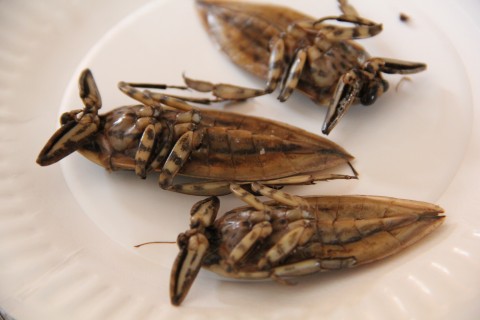
His answers were concise and informative sprinkled with a bit of fear mongering. He was a fan of large water bugs from, I believe, Thailand. He eats everything but sushi and fast food (apparently, much to my dismay, sushi is the least sustainable food to eat). Bugs are not kosher or halal, except for locusts. He prepares his bug meals in a myriad of different ways, though professes to not be a great cook. Also, bugs are currently expensive commodities on the world market since they are not farmed in a significant way yet. However, Mr. Gracer was sure that price would dip dramatically once we practiced such farming on a large scale. One phrase uttered during the course of the question and answer session struck me in a bad way: “I wouldn’t want to be living in your world when you’re seventy!”
Yum. Photo by Lilah Raptopoulos.
Once everybody was positive that eating these bugs would ultimately save the world and was the undeniable wave of the future, the taste test began. First, crickets were simmered on a portable skillet. Only the smell of the oil was evident at first. The savages began to circle around the table. Roughly twenty crickets were scooped onto a platter of brown rice for three people to share on a communal plate. They were very crunchy and didn’t have an overpowering taste. Insects are almost entirely protein, which humans cannot taste, so these bugs are probably the closest thing we can experience to pure protein. Excluding the antennas and legs getting stuck in my teeth, I thoroughly enjoyed eating crickets. My appetite was sufficiently whet. Next up on the skillet were wax worms – little larvae that feast on beeswax in hives. They were white and maggot-like and cooked very quickly. These were eaten without any rice accompaniment; we simply popped them in our mouth like little seeds. The taste was reminiscent of pine nuts – I was hooked. If shovels were utensils, I would have used a shovel to feed myself these wax worms. They, too, had a certain crunch but a delectable softness in the middle (must’ve been the beeswax!). Then the cicada and ant salad was dumped onto the pan. I noticed that the ant carcasses broke up more easily whilst being fried than the other bugs. Fact: cicadas are unable to be farmed due to their mating habits and thus I consider them a delicacy in the insect food realm. In terms of taste, ants were spicy but all together unimpressive, whereas the rare cicada tasted like smoked asparagus and had a wonderful texture. Finally, the bug that was hyped the most was picked apart and readied for consumption. This was the large Thai water bug, about the size of two quarters placed edge to edge. Mr. Gracer had told us from the start that the flavor provided by this bug would blow our minds. My head exploded. It had the consistency of crabmeat with flavors reminiscent of salty pear Jolly Ranchers. I had to alert my Twitter followers immediately due to my overwhelming excitement.
I am sold on the idea of eating bugs as a permanent institution in world dining. Grasshoppers are already used in Mexican cuisine and something like eighty percent of Laos’ population eats bugs. I believe that as long as we disguise bugs in American cuisine it could work, like making cricket burgers, water bug cakes or ant nuggets. We already have an amazing appetite for crustaceans, and they’re bottom-feeding scum that look even more unappealing than insects on the surface. Think about it, people. Next time “Taste of Harris” rolls around, wouldn’t you like to see some bugs in your food? •