In order for a sports team to be successful, there must be a strong team dynamic of camaraderie and support both on and off the field. Athletes need to know that when they are on the field, track, or rink, they have a coach and a team behind them every step of the way. Unfortunately, for many LGBTQ-identified athletes, this support is not there.
On Tuesday, November 1, the Diversity Peer Educators hosted a panel entitled “Homophobia & Athletics” to discuss the presence of discrimination against LGBTQ athletes on campus and in the general sports arena. Elena Rosario ’14, a member of the rugby team and the women’s track and field team, as well as an identified ally, developed the panel as part of her final project as a Diversity Peer Educator. Members of the panel included Dr. Jen Manion, assistant professor of history and director of the LGBTQ Resource Center and assistant professor of history, Courtney Dumont ’14, and Tyler Brice ’13.
Dr. Manion began the discussion with a presentation defining heterosexism and homophobia and providing a brief history explaining how gays and lesbians have been treated in athletics in recent history. Quoting heavily from Suzanne Pharr’s “Homophobia: A Weapon of Sexuality,” Manion offered a theoretical context for the discussion.
Heterosexism and homophobia are linked by the oppression and discrimination that they promote. Heterosexism, which is the presumption that everyone is heterosexual, may not be explicitly homophobic, but it allows for assumptions that place limitations on the LGBTQ community.
Brenner Green ’12, who was unable to attent the panel, is openly gay and is the co-captain of the men’s cross country team. In May 2010, Green had his film debut in Out For the Long Run, a documentary in which he shared his story of being an out athlete in high school and college. He stated that his coaches and teammates on the men’s track and field and cross country teams at Conn have supported him fully.
Green offered this statement about the role of heterosexism in sports: “The topic of heterosexism in athletics is largely overlooked. We talk about homophobia in athletics and with heterosexual athletes, but we do not look at the social phenomenon of heterosexism that affects the institution of sports. Heterosexism in the context of sports is both the presumption that all athletes are heterosexual and the implicit idea that heterosexual athletes are superior to non-heterosexual athletes. Coaches, athletic directors and athletes must work to end heterosexism in sports so that all sexual orientations and gender identities are both expected and accepted in athletics. Once the institution of sports is improved for athlete equality, we can then work towards tackling homophobia in athletics.”
“Sports, more than any other area of society, is still rigidly divided by gender,” stated Manion. “It is still persistently homophobic.” This inequity has been most visibly present in collegiate athletics. Women were often kept out of sports until the passage of Title IX in 1972, which rules in opposition to the discrimination against athletes on the basis of sex. Still, the LGBTQ community has not been offered the same level of protection.
Manion shared her own experience with homophobia in athletics, even before she came out in college: “I was very athletic when I was younger. I came from a community where women’s sports were really embraced, but I was subtly told time and time again that I should watch out for the lesbians who lingered on the softball field.”
Though the NCAA recently created a new policy that protects transgender athletes, there is much work to be done in eliminating homophobia from athletics.
After Manion’s presentation, Rosario showed a few clips from the documentary film Training Rules, which is about the former women’s basketball coach at Penn State, Rene Portland, known for her rules of “no drinking, no drugs and no lesbians.”
Before introducing panelists Dumont and Brice, Rosario pointed out that we still don’t have many out athletes on our campus, and praised the bravery of the students on the panel.
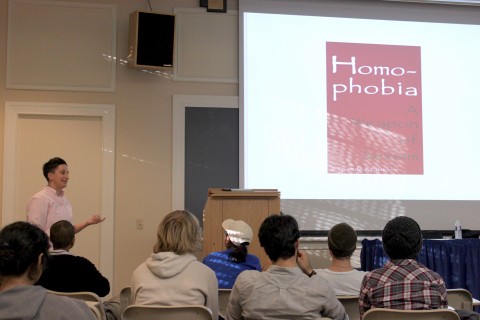
Doctor Jen Manion addresses students (Hannah Plishtin/Photo Editor)
Dumont, a member of the varsity women’s ice hockey team, shared her personal story of being out on her high school and college teams. “I see myself as an athlete who is also gay,” stated Dumont. “Being out and an athlete wasn’t something I really had to think about.”
Brice, a dance minor, “knew the second [he] got involved in dance, [he] would be labeled as not only gay, but [effeminate].” Nevertheless, he decided to join the dance program at Conn and has not regretted his decision.
The discussion then became more open-ended, as the panel’s attendees were invited to ask questions and participate in a conversation on the topic. Dumont expanded upon her views specifically pertaining to lesbian athletes.
“There is an assumption that if you’re really into sports and you’re a girl, you’re a lesbian. There is a fear about the team dynamic. The concern is that if you have lesbians on the team, they will all fall in love with each other and cause drama,” said Dumont.
This should not be an issue for athletic teams, however. The main focus should be on having a team that works well together on the field.
“Coaches have always been concerned with the team dynamic and with having a team that does what it’s supposed to do,” said Fran Shields, Director of Athletics at Conn. Shields went on to point out that heterosexual relationships off the field can also affect an athlete’s performance. He ended his statement by saying, “I know that there have been issues of homophobic slurs on campus and I want you to know that we are still thinking and talking about them.”
The conversation then transitioned to what we can do as a campus community to make homophobia in athletics less of an issue for our students. Manion began the discussion by posing a question to the audience: “We need to ask [closeted athletes]: what are they afraid they are going to lose? And then ask what we can do to change the community so that the fear is less real.”
One attendee pointed out that the fear often goes beyond campus, stating that there may be more to lose with one’s families and friends at home. Another student expressed a fear that he believes many athletes have about losing the camaraderie in the locker room if there is a discomfort with an LGBTQ-identified teammate.
Manion countered this idea with another thought-provoking question: “Concerns about the discomfort of the group is too often privileged over the isolation of that one individual. Why is the gay person the problem instead of the culture and the disrespect of the majority?”
Brice ended the conversation with some encouraging words: “What I’ve gained by coming out is the respect of my community. I want more people to respect themselves and who they are, and to be brave.”
The final comment of the event was from an attendee who had graduated from a college that did not have strong support for its LGBTQ community. Expressing her excitement about the panel, she stated, “It’s great that we are able to come together and have these kinds of conversations.” Still, though there has been much progress in combating homophobia in athletics, there is much work to be done. Therefore, we shouldn’t forget to keep these conversations going in the future. •