Two new exhibitions have recently been installed in the art galleries in Cummings, one by Sophie Kahn entitled “Shards,” and another by Alex Rubio called “Abstract Experiment.” Each is an excellent example of art’s human (and I don’t just mean that figuratively) and collaborative, communal nature.
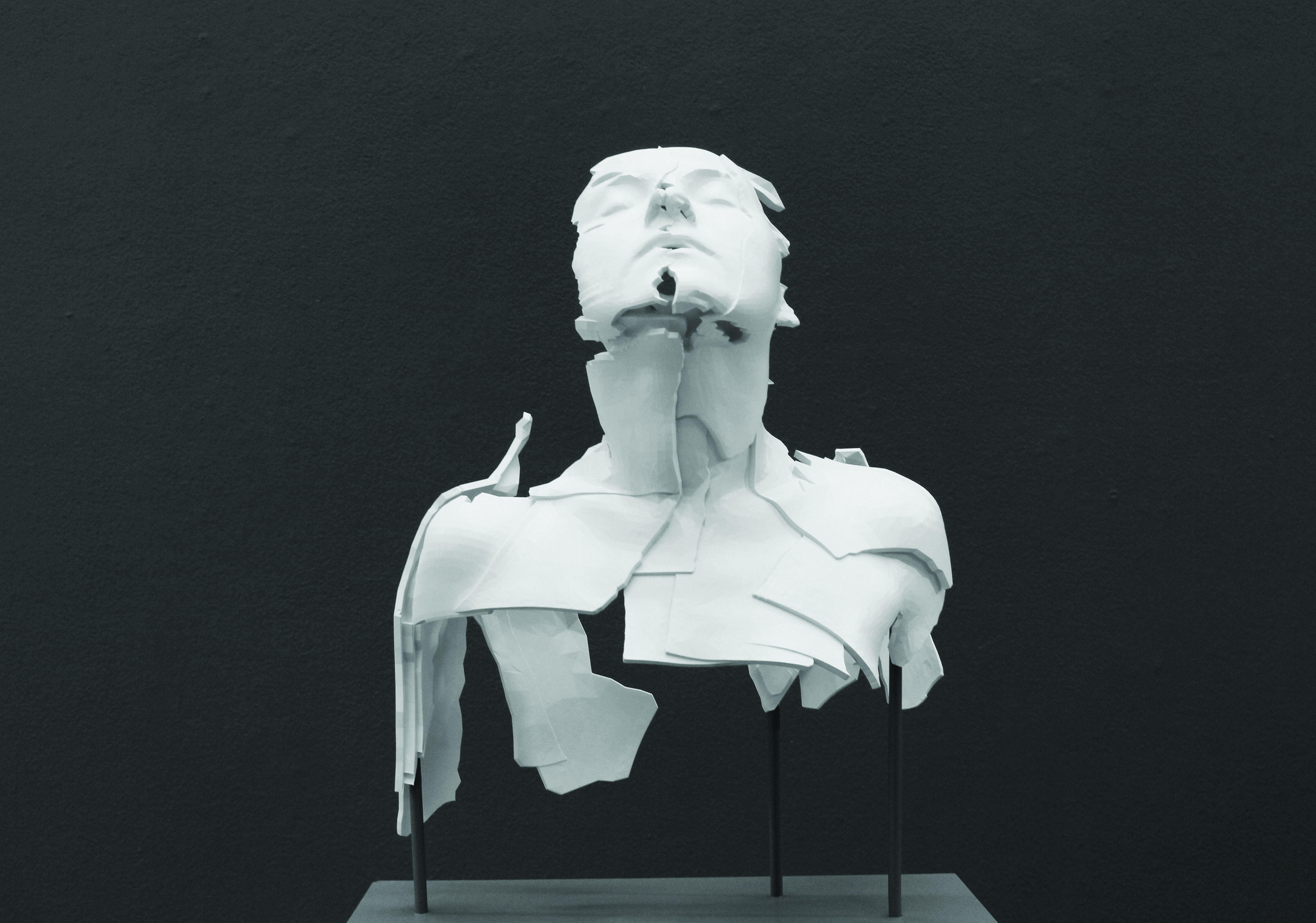
Kahn is a New York-based artist who explores digital media. “Shards” actually consists of two series of work: “Artifact” in the main atrium, and “Triple Portrait of Eavey” in a side gallery. “Artifact” consists of three 3-D printed sculptures derived from laser scans of the artist’s body. The laser scanning technology, however, wasn’t designed to capture the body, which is always in motion. As such, it generates conflicting data. The sculptures are a result of that imperfect representation of the body by the data.
In “Triple Portrait of Eavey,” Kahn did the same sort of thing, this time with a Conn student as her subject. She fashioned a sculpture from the 3-D laser scan, then used the data from the scanning process to create three blueprints. The sculpture reminded me, with its fractured appearance, of a pieced-together, reconstructed skull, perhaps found on an archaeological dig. Seen on an angle, it resembles a theatrical mask. It looked, in a word, like an artifact.
The three prints on the wall look almost like drawings of the bone structure. They are very geometrical, constructed predominantly of many triangles. As I was looking, I kept seeing more and more in the prints. The whole picture is based on divisions into geometric shapes, reminding me of Picasso. The combination of a lot of big shapes with many compact, busy, tiny little ones created a juxtaposition of openness or fluidity—a wide-open expanse—with something almost reminiscent of decorative scrollwork on a fancy railing. The busy little shapes reminded me as well of roses on a trellis, just snaking down the body.
Alex Rubio’s “Abstract Experiment” is technologically simpler—a series of murals of acrylic paint on paper—but is not less engrossing for that. Juan Flores ’16 describes the works as “minimal [abstract paintings that] … focused on … lines.” Each piece is composed of two colors, wound up like two fire hoses or enormously enlarged fingerprints in hypnotizing swirls. Perhaps more engrossing than the end result, however, was the process that led to these pieces’ display.
Rubio is intent upon creating works through collaboration, having, as Professor Chris Barnard said, “total faith in everyone.” In his native San Antonio, he works as Artist-in-Residence and Studio Manager of MOSAIC (Mosaic Of Student Artists In Community, an after-school arts program for high school students) at the Blue Star Contemporary Art Museum. He brought this same love of collaboration to Conn, where he worked with many students, including Flores (with whom he’s previously collaborated in their shared hometown) and Ariann Holden ‘14 to create the murals. The artists worked from Friday morning the week before the show opened through midday on Monday, sometimes with twelve to fourteen people working on a painting at one time—and each artist could leave his or her mark.
As Flores said, each “collaboration piece he does has a touch and feel of all of the people who participated in it. The painting and drawing students helped him make the three pieces you see in the gallery and he has welcomed them to choose the colors and give the titles. That way it becomes their own.” Holden noted Alex Rubio’s ability to inspire, saying, “Working with him … was not only enjoyable but it inspired me to branch out my ideas about my own work. Thinking about the meaning of art and what is the purpose of it— Alex Rubio answers this question in the most inspiring way. Art paired with community outreach is touching and really changes lives.” While working with Rubio, she thought more about what her work “say[s] to the surrounding community.”
The two installations are vastly different in their subject matter and choice of media, but it is in exactly the difference of each installation from the other “that students can be exposed to a really broad definition of what it means to be an artist,” as Professor Barnard put it. It’s through such a juxtaposition that we can consider, as Holden did, the meaning and purpose of art. There’s so much to think about in this exhibition, on display until Friday, Dec. 6. Spend some time with these works of art.
Photo by Miguel Salcedo