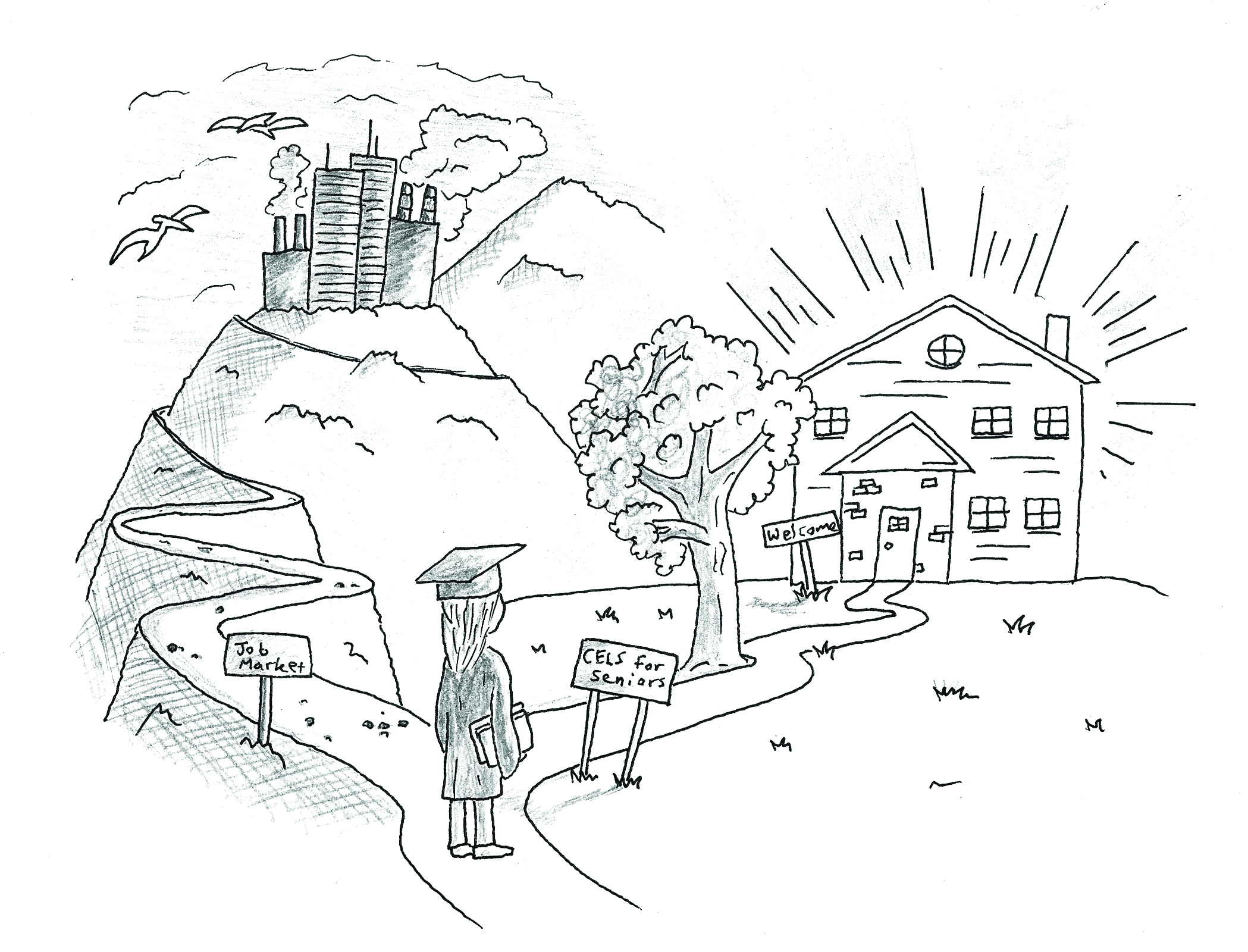
It’s become easy to spot seniors on campus: just look for the people with constant looks of anxiety and panic plastered across their faces, hands overflowing with applications and GRE preparation books on top of their normal homework load and extracurricular responsibilities (chances are, they’re the leader of six clubs minimum). For these upperclassmen, the real world is looming, and with just six months left before graduation, tears and fears abound. With so many potential post-graduation paths, it can be overwhelming to even begin thinking about our futures.
Senior year is when all the handholding seems to come to an end, and many seniors end up feeling stranded and helpless, even though they’re not as alone as they might think. Connecticut College has many resources available for students of any year, but some misconceptions regarding the Career Enhancing Life Skills office exist, and may prevent some seniors from seeking help.
“It’s hard to break the perception that CELS isn’t just the funded internship at the end of junior year,” said Christine Terry, Director of CELS. Many students believe that after their internship experiences, their relationship with CELS is terminated, and they’re left to their own devices.
But that’s not the case. The office is working on many workshops and projects aimed at seniors, and wants to spread the message that counselors are readily available to meet and offer guidance about post-graduation opportunities and paths.
“We’re in the process of developing a more comprehensive fourth year program,” said director and counselor Julia Browne. “After surveys that were done by alums of the program for the last ten years, they had wonderful things to say about CELS, but one of the things [they said] we could improve on was [our] fourth year focus.”
CELS has recently begun to partner with departments on campus to host workshops. This year’s CELS fellows are working with the residential house staff to put on a Power Series, which are mini workshops on relevant topics for seniors, including presentation skills, how to use LinkedIn, how to scrub one’s online profiles and how to use Microsoft Excel. There will also be a workshop aimed at financial literacy and another at sustainability. Another 5-day intensive workshop, called Backpack to Briefcase, will be co-run with the newly created Academic Resource Center.
“CELS is here to serve the students,” said CELS fellow Alia Roth ’14. “They really want to give students anything and everything to prepare them for a professional career. They’re working really hard to adjust and shift the program to meet the demands of the twenty-first century…and to redevelop the entire four-year program.”
Workshops are open for all students in any department and discipline.“It’s important for everyone to know that [CELS] is not just for students interested in business or economics because that seems to be a myth that’s always out there being perpetuated, just because of how heavily the business field recruits,” said Associate Director and counselor Deb Brunetti.
For many students who want to hop into the workforce right after graduation, there are many tips and tricks that CELS has to offer. Networking, for example, is key. “One of the things I found is that there’s a disconnect with seniors who would go through the funded internship process, start understanding the idea of a hidden job market, get to senior year, and then just start looking for jobs on Monster,” said senior associate director and counselor Lori Balantic.
For Balantic, exploring the hidden job mark through networking is still the way to go. “The students who have a job at the end of the year are the ones that put in the work.”
As seniors graduating from a liberal arts college in the twenty-first century, these services provided by CELS become especially helpful. It seems there’s a new article every other week about the effectiveness, or (perhaps more often) the ineffectiveness of a liberal arts education. Compound this with the entire adult world informing us of how terribly unemployable our generation is, and graduation becomes something to fear rather than something to look forward to.
“What the media has done to your generation is put additional pressure on an already high pressure situation. But there are jobs out there,” explained CELS Senior Associate Director and counselor Cheryl Banker.
Brunetti added that the jobs that many seniors will obtain after graduation are not likely to be the jobs that they will stick with for the rest of their careers. “It’s a step in the right direction to where you ultimately want to go,” she said.
Oftentimes, students return to Conn with knowledge from their funded internships about whether or not they are interested in that particular field or company. But even if they eliminate their internship as something that they would like to pursue in the future, the CELS counselors agree that that’s a positive step. “Sometimes [students] feel like they’re at square one again when in reality they’re very far from square one because they’ve eliminated so many things…That’s a big part of the individual appointment senior year. It’s scary, we know they’re all being asked what they’re doing after they graduate, and they all hate to answer it.”
Maybe more than anything else, all of these programs and opportunities offered by CELS provide some peace of mind for stressed seniors about to enter a less-than-flourishing job market. “I, like you, am completely lost and hopeless,” said Casey Dillon ’14, “But I refuse to drown in despair. I know my CELS counselor (Cheryl Banker) is always there to answer my questions, which helps set my mind at ease.”
After four years in the Bubble, it’s time to accept our fates. Graduation is just around the corner, whether we want to embrace it with open arms or run and hide in the Arboretum. And whether you’re seeking a career in a certain industry, applying to a graduate degree program, researching, traveling or moving back home to cry, CELS is here to support you through every step of this transitional process.
“You need to be on top of your game, and you’re coming from a school that gives you the resources to do that,” said Browne.“Looking at the whole picture, looking at the whole student, we’re fortunate enough to have a relationship with these students such that we can do that, which I think is really critical in helping them through a really challenging situation.” •
Art by Kristian Maestri