The first thing Julia* told me is that “emergency” is spelled wrong on the campus safety vans that escort her to class each morning. “How is it spelled?” I asked, scribbling furiously on the nearest napkin. “Emergengy,” she giggled. “On every single one.”
This isn’t the only detail she has noticed that would evade most people. Every time she walks around campus, she is aware of what she calls “flat spots” on a curb: the slope where some curbs merge into the road instead of dipping sharply like others. She knows that Knowlton has steps without railings. She can list places where electronic door openers were installed last year: Olin, the rotunda in the Plex and the side entrance to Blaustein. And she knows what it is like to live with cerebral palsy and difficulty in motor control from the hip down.
Students with disabilities account for 13% of the student population at Conn. That’s approximately 65 students per class year. When I asked the Director of Student Accessibility Services (formerly Student Disability Services, renamed because the main point is what they provide: accessibility) how “disability” is defined in this estimation, she tells me it is “any type of impairment that affects a major life function,” covering everything from ADHD to a wheelchair.
I had never thought of walking as a major life function,but as I listened to Julia describe the process of getting rides from Campus Safety in bad weather, something becomes apparent. “You must see a completely different Conn than I do,” I said, and she agrees. For Julia the world is split into “accessible,” “partially accessible” and “inaccessible” in her mental map.
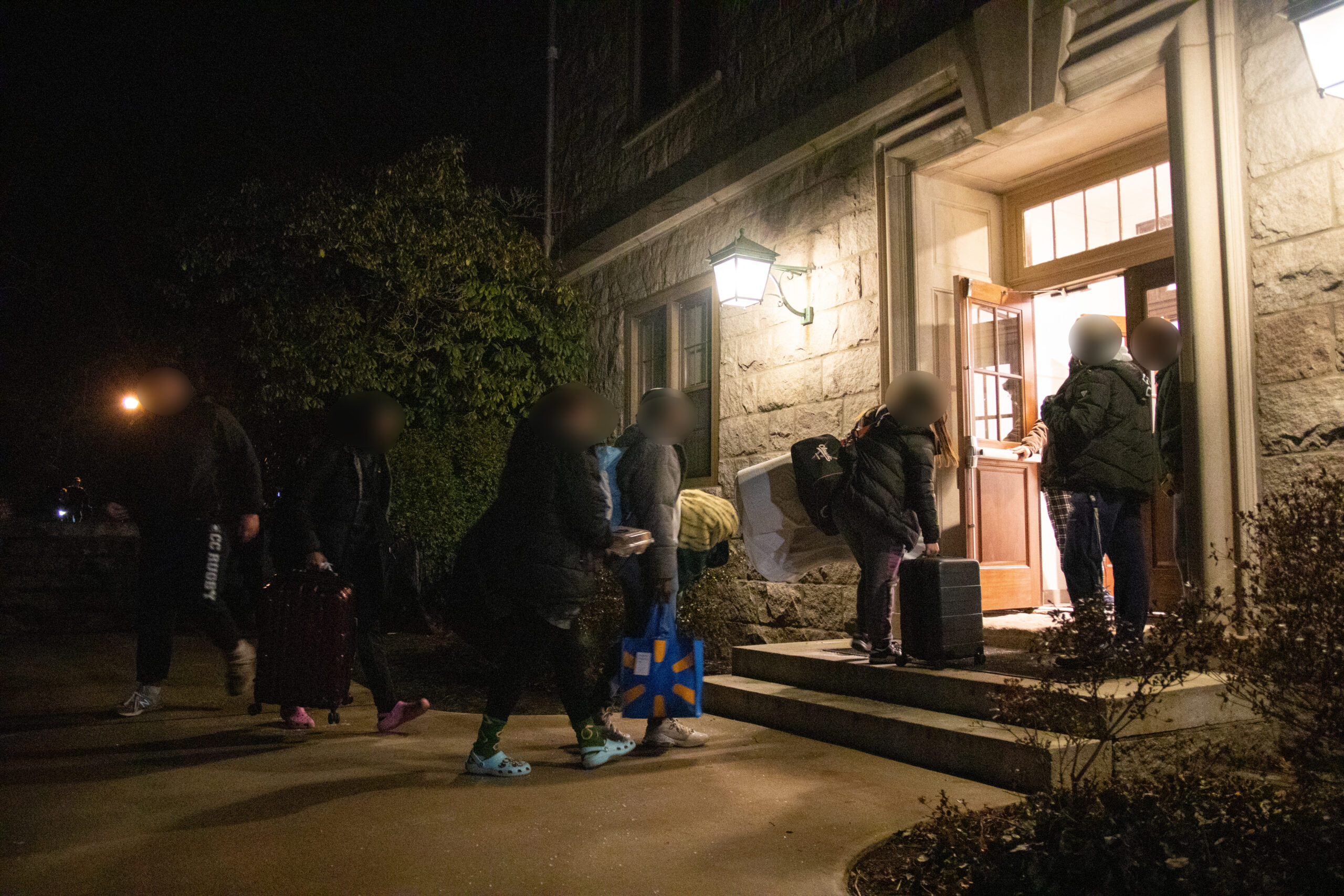
Because of her weakened depth perception, the presence of stairs is often a source of doubt (though she still always chooses stairs “…because I can take them. I still can.”) Non-flat curbs are a worry, and Tempel Green might as well be a rushing river for how traversable it is in January. One way in which Julia gets across campus is through escort rides from campus safety.
“Most of the time they are nice and friendly,” she said of the officers that escort her to class, “but sometimes it can get awkward.” There have been times where officers have treated the whole thing like a burden, she tells me. “I’ve had 8 am classes, and you have to call them 45 minutes in advance. Sometimes, they show up after an hour.”
When I ask her if they recognize her name when she calls, she says most do, but there have been times when they’ve acted suspicious. Why do you need a ride? What’s wrong with you? Do you have crutches? I was amazed at her calmness in relating this. I asked her how she responds. “I just tell them I have balance problems,” she says. “But most of them are really, really nice. I’m friends with them. We talk about our lives on the way.”
“Nice” is one of Julia’s favorite words. Professors are really nice when she is late to class, and all of her friends and most people are really nice and understanding about her disability. She talks about rare not-nice occurrences, things like people with temporary crutches telling her to look at their acute suffering and learn not to complain so much about her problems all the time. When I’m open mouthed at this, she talked about the relativity of pain. “Everyone hates the fall,” she said smilingly.
We were walking out of the library at this point, and I debated out loud whether or not to go to burrito night in Freeman, and quickly decided it’s too much effort to do the walk. I immediately slapped my forehead as she laughed. “This is what I’m talking about. I’m not bothered when people around me complain about falling and slipping in the ice, or about distance, because my problems don’t discount or trivialize theirs. But what I’d like is for them to not trivialize mine.”
Barbara McLlarky, the Director of SAS, is the next person I talked to. She told me about the work her office does in ensuring students like Julia have their needs met. Collaborations with Housing (for preferential housing lottery to make sure students have their access needs met), Admissions, Health Services and many other departments abound. Efforts like allocating note-takers to students and making sure any documentation needed by professors is provided on time form a big part of the day to day at SAS. She talked about SAS being all about “leveling the playing field,” a very positive if slightly ironic image of the equal opportunity that at least in theory exists at Conn.
When I asked about how Conn stacks up against comparable schools, McLlarky told me it stacks up pretty well. I asked about the admissions process at Conn and how students’ decision is affected by the disability friendliness of the campus, and she told me that the application is disability-blind and that students should make sure to visit the campus before deciding. Somewhere along the way, I began to feel my feet trip in the red tape of confidentiality, delicacy and propriety I knew I’d walk into at some point when researching this topic. Not to mention that talking about students with disabilities is hard when disability looms over us as an-almost-maybe offensive word.
Luckily for me, my next interviewee had no confidentiality to uphold, and lacked any excess of delicacy and propriety. She introduced herself and her disease frankly: “My name is Emma* and I have CP. It’s a neurological disorder I was diagnosed with at birth. I have a walking disability and use crutches.”
Bathing and laundry were added to my list of unexpected major life functions when Emma said she thought about things like “Is there a chair in the shower? Am I gonna be able to carry my laundry basket without help?” when she was picking a school. I think of the list of selection criteria on the College Board website I’d often used last year: club options, housing choices, city size. I wonder what I would have done if flat walkways were a criterion I’d needed to sort by.
The “lucky” thing about CP is you get what you get, and it doesn’t get better or worse, Emma told me. “The only thing is, you have to be your own advocate. I once got a ride from the library to Blaustein when it was really bad outside. I have no shame. It is about growing into your own shoes.” This time, it is not so ironic.
Still, Emma is no fan of getting rides. “If you were walking to Harris, you could stop on your way and pick up your mail without thinking about it. I can’t do that if I’m being driven around. It all has to be very planned.”
Emma echoed Julia in that for the most part, people have been very accepting, but expanded on the topic: “People always ask me, and it’s a pattern I’ve seen my whole life: people don’t know how to react.” I nodded vigorously, because I don’t either. “You don’t have to worry about opening the door for me, I actually appreciate it!” she says. “It makes it much easier for me. It’s that simple. It’s just a door.”
Not knowing what to say isn’t the only problem. For “How does Conn stack up?”, she was point blank. “In terms of disability awareness, there is work to be done here. There isn’t enough recognition of disability and how it impacts a person’s identity, and their life. What we need is willingness on the community’s part to learn.” She mentioned steps like the Disability Symposium as being steps in the right direction. As a side note she added, “And the walkways need to be cleaned better.”
“Are you excited about the snowstorm this week?” I ask Emma jokingly, closing my notebook. She answered immediately. “Yes! If it means a snow day. No, if we have class.” It is the standard response, but there’s so much more behind it, now that I can hear. Once you open your eyes to it, the stick figure with the wheelchair is much harder to overlook, and so is the awareness of sharing this campus with people who are seeing a completely different Conn.
*Editor’s note: Names of students have been changed for this article.