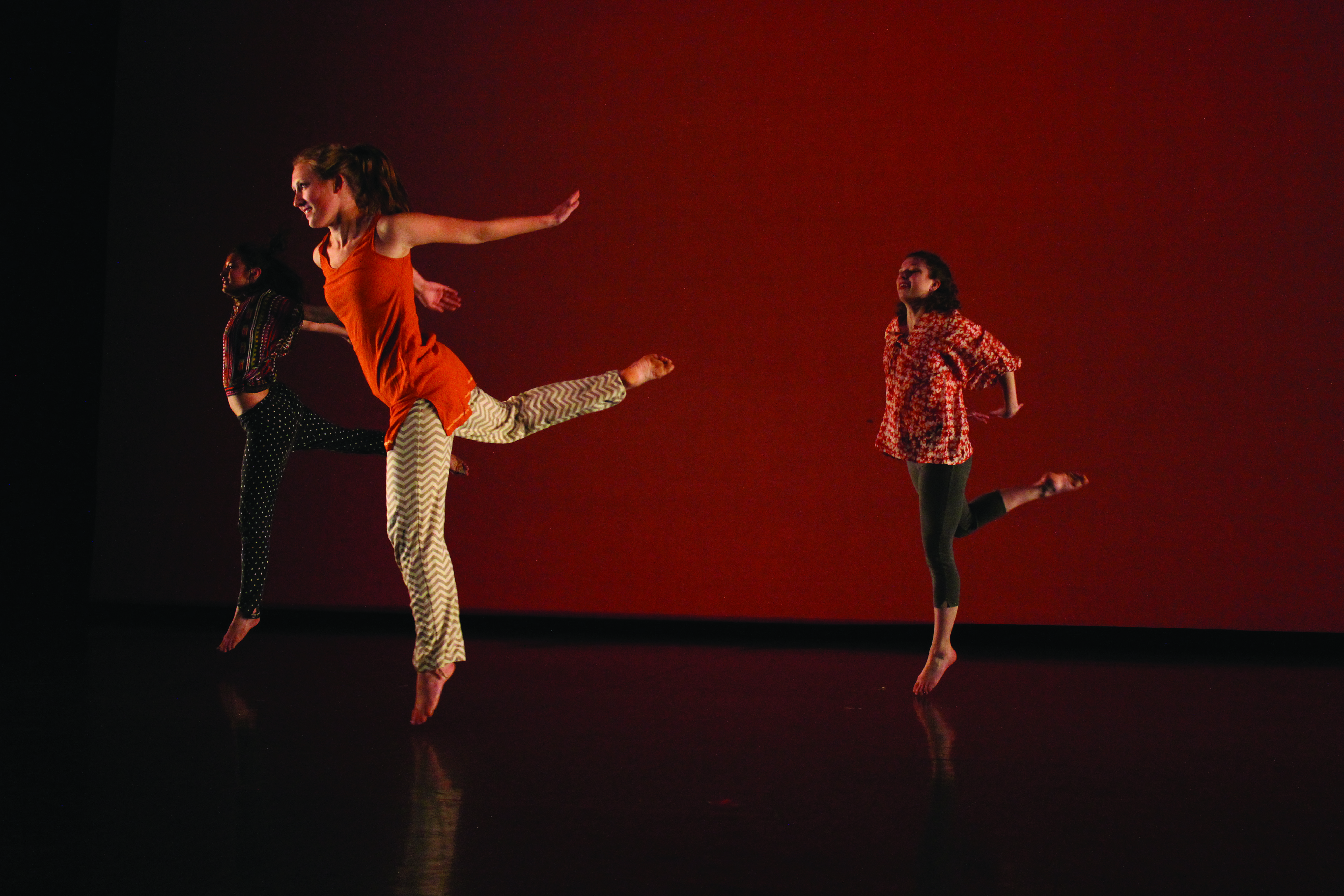
On Thursday, Feb. 20, Friday, Feb. 21, and Saturday, Feb. 22, Connecticut College’s Dance Club showcased its spring performance, entitled “Moving Company” in Myers Studio. The performance was approximately an hour and a half in duration, and showcased the technical ability and choreographic visions of dance department students.
“Moving Company” offered its audience an eclectic mix of quirky post-modern and modern dance. Emily Ryan’s “D.O.R.M” introduced a series of connected tableaus, her dancers engaging in an ebb and flow of movement across the stage. They paused in clusters, one dancer sticking her tongue out with a pout. The dancers deadpanned the audience, much like Allynn McInerney ’14 in Maia Draper-Reich’s “Seems to go nowhere.”
Both of these pieces provided the audience a sense of comic relief in the contrast between the lack of facial expression and the humor of the gestures. The image of Draper-Reich’s soloist giving up on exercise and casually wandering around the stage with a bag of Cheetos for the duration of “Tainted Love” is not an easy one to forget.
The statement was both bold and relatable, and McInerney’s performance was subtle and unapologetic. We watched her embrace her own disinterest in anything but her snack; she was not even concerned with the audience. While many post-modern works emphasize audience engagement, this piece offered us a window into the dancer’s world, but no obligation to become a part of it.
Similarly memorable images could be found in the works of Meg Robbins ’15, Aurianna Lajaunie ’15 and Christophe Desorbay ’15. Robbins’ “a little to the left” incorporated the constant replacement of cardboard boxes on the stage as dancers took individual moments to enjoy brief and controlled solos within this chaos. The piece was an ode to the “joys and struggles of exploration,” and Robbins’s choreographic choices left wonderful space for the audience to interpret this theme in a way that carried personal meaning.
Lajaunie’s “bohoflo,” set to the song “Jubel” by Klingande, seemed to be a dance of celebration. The dancers, dressed in vibrant and warm tribal prints, created beautiful silhouettes against an orange cyclorama. This choice presented us no specific narrative or deeper implication, but rather an inviting aesthetic.
One of the beauties of dance is its versatility of intention. It has the ability to tell a story, evoke a meaning or to simply be lovely to look at. The most successful dance works are those that do not require the audience to take anything specific with them. Lajaunie created a piece that gave us dance in its simplest, most unassuming form – the treat of pure movement in space.
“The Usual,” choreographed by Desorbay, closed the show with a bold dedication to coffee. His dancers took a starkly lit stage in business attire and moved through an array of coffee cups. The most stunning visual came when the seven ladies on stage gathered in a clump and began throwing the cups, filled with water, in various directions through the space. There was a fantastic element of surprise in this, and it was almost as if the stage had become a three-dimensional canvas. The water seemed to scatter in a series of photographable images. It was beautiful and memorable, and a smart finish to a fabulous performance; as an audience member, I was satisfied with the dance I had experienced, but left craving more.
These works fell among six others, all of which brought unique facets to the performance. We got to take a peek into the choreographic worlds of eleven individuals; we got to watch their thoughts translate tangibly onto bodies. “Moving Company” was a fulfilling hour and a half and certainly was not a show to miss. •