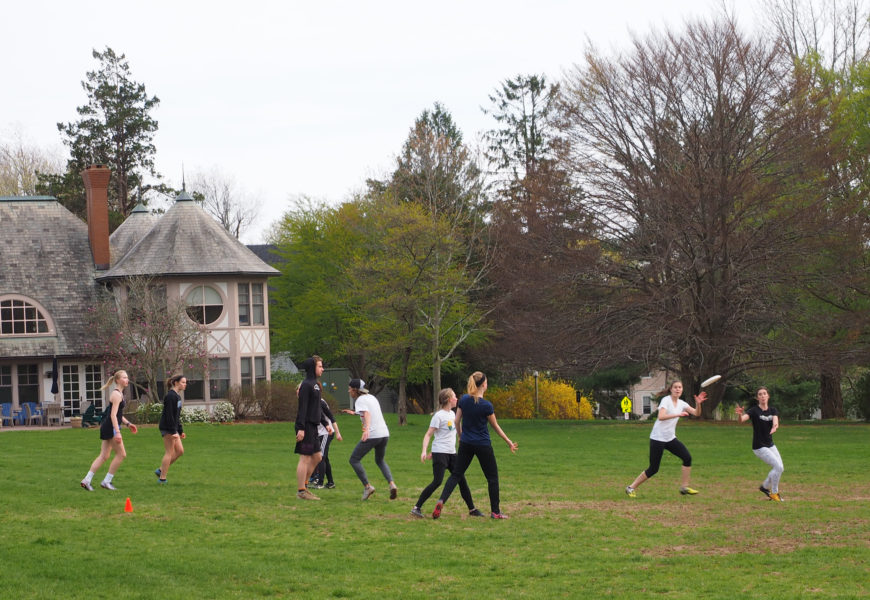
Connecticut College Ultimate Frisbee Team. Photo courtesy of Sophia Angele-Kuehn.
Before I arrived at Conn, I had my own expectations about what the social scene here would be like. I expected an exuberant group of theater kids, a group of potential Ivy League grad school candidates studying in Shain until 2am every night, a group of people living vicariously through their continuously growing number of Instagram followers, and a group of “daddy money Chads” who spend their parents’ money on obnoxiously low quality drugs. However, I never quite realized just how intertwined athletics would be with the social scene here at Conn. From as early on as the first couple days of college, I noticed the infamous cafeteria divide, as well as the packs of athletes moving from building to building, and became quite intrigued by this dominant aspect of social life. Being a three-sport varsity athlete in high school, I was aware of the ins and outs of team life, but throughout my years in high school I never experienced such a stark divide between athletes and non-athletes.
KK Patterson ‘21 claims that “the social scene at Conn revolves around sports to a point where it makes it feel like high school 2.0.” Patterson goes on to say that “since small schools like NESCAC schools have such a big proportion of varsity athletes per class, many people who aren’t on a sports team can feel lost and not know what to do with themselves.” Patterson is a student who felt somewhat lost when she originally arrived at Conn and started toying with the idea of walking onto the track team, fully aware of the possibility that it would help find her people. But, instead she chose to join ultimate frisbee, a club sport that served as a vehicle for her to discover many of her close friends.
The prominence of club sports and the common practice of people deciding to walk-on to varsity sports teams, most likely surpasses many Conn students’ desire to play a sport and suggests an inclination to be a part of a bigger community that will provide a sense of family at the College. It also depicts a slight inability of our overall student body to overcome the barrier of sports and find a family aside from using athletics as a shortcut.
Logan Kilfoyle ‘22 on the field hockey team describes how her “entire social life at college is my team, and aside from seeing my roommates go in and out of our dorm, I am just around people from field hockey.” Although for Kilfoyle being a part of a sport has the benefit of feeling part of a group bigger than herself, she notes that “field hockey has limited my ability to meet new people, because my entire life revolves around field hockey and I barely have time to get my work done, let alone meet new people or join other clubs.”
Although many athletes like Kilfoyle would be interested in meeting people outside of their sport, because of how consuming playing a collegiate sport can be; it is easy and comfortable for athletes to stay within their circle. By being merely exposed to your teammates for hours every day, it isn’t unusual that most athletes prefer spending their free time with their teammates because these are the people they are most familiar with.
However, there are many non-athletes and athletes who feel unaffected and apathetic toward the intersection of athletics and social life. Melanie Fournier ‘22 has noticed the preeminent presence of athletes on campus but claims she is “very used to not being a part of a sports team,” and that this “isn’t something new for [her] nor something that bothers [her].” Fournier believes that because sports teams are a group of people with a common interest, she understands why they want to hang out with each other and spend most of their time together.
Due to the amount of time athletes spend together–from practicing together, eating together, partying together and possibly even living together– it isn’t a mystery why teammates are usually very close to one another. However, although sports can help many people form their identity, find friends, feel a sense of belonging, and fit into a role; it’s important for athletes and non-athletes alike to break their routine and challenge themselves once in a while to meet new people outside of their preexisting circle.
Personally, after joining ultimate frisbee in the first week or so of college, I have definitely felt as if I was just another player in a game perpetuating the athlete-dominated social scene here at Conn. However, I also felt that many of my teammates truly brought me joy; cognitive dissonance at its finest. Even if I may be seen as another compliant participant in the system, hopefully we all will continue to search for friendships that are rooted in something of more depth than just the passing of a ball or puck. Although it is quite normal and in no way bad to develop strong relationships over superficial things like athletics, it should be your connection with each individual person that prevails over the ability to just relate to one another over one single common interest, such as a sport. •