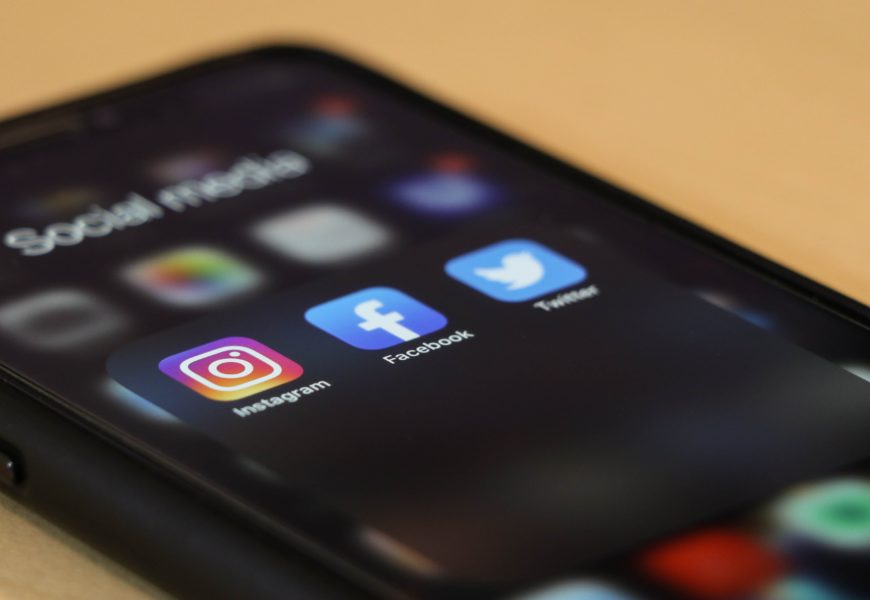
For hours each day, people of all ages around the world fastidiously maintain their virtual presence. From posting pictures, to liking pictures, to retweeting, to keeping snapchat streaks, to updating profile pictures, being up-to-date on social media can easily became a vicious cycle. The power of social media ranges from fostering a virtual existence where one can form a community outside their “real lives,” to having the potential to “live” even after death– the social media of the deceased often become virtual shrines. As we live in the age of technology, some believe the continued presence of social media is inevitable, while others believe social media is a fad and we will see communication return back to what it was in the years before social media.
Although social media can be traced all the way back to 1997, with the website Six Degrees, many people think that the rise of Myspace in 2003 marks the beginning of social media. Myspace even received more website visits than Google in the year of 2006. In 2004, Mark Zuckerberg launched Facebook as a Harvard-only social network that later evolved into use by the general public; and up until very recently Facebook has been the reigning social media app. However, a 2018 study by Pew Reports showed that YouTube, Instagram, and Snapchat have all surpassed the once-powerhouse Facebook in use and popularity among teens, which was an essential demographic of social media users. Some people attribute Facebook’s decline to the recent Cambridge Analytica scandal, while others attribute it to the platform’s increasing focus on business and politics. The flatlining of Twitter, the more visual and image centered app, may also play a role in the diminishing popularity of Facebook.
Flora Morrison ’22 (@floragmorrison on Instagram) believes the visual aspect of Instagram and Snapchat keeps the teen audience hooked. It is easy to express yourself in a picture, and Facebook and Twitter just don’t allow their users to be as expressive. Morrison appreciates many aspects of Instagram such as how it fosters the democratization of information and spreads powerful movements such as #blacklivesmatter. Although Instagram also gives her the ability to communicate and stay up to date with her cousins who live in Scotland; currently Morrison is very frustrated with social media. She claims “lately, I don’t like social media, the younger generation of kids entering the social media world are running polls every night, and are obsessed with people liking their ‘recents’ and Instagram is moving away from its roots.” Morrison reminisces of the time “when Instagram was new and people posted pictures as an art form, and no one cared about how many likes they got, or followers they had.” However, now as more people have joined Instagram, it has become a place that fosters a hierarchy with likes and followers and makes it very easy to categorize and standardize people within numerical values. Even though Morrison is tired of constantly checking up on Instagram every ten minutes, she uses social media as an escape method when she feels awkward in public. She consults Instagram and other social media to find out about someone, and often notices the standard, unoriginal “conn coll ___” in everyone’s bio. She believes that technology is still the future and it is okay to use Instagram. In her words “we should just try to engage in Instagram in the best way.”
Unlike Morrison, Kevin Fellows ‘22 (@kevin_fellows on Instagram) believes that the trend to be on social media is dipping and the amount of people joining social media is slowing down. Fellows claims “social media has hit a peak and it’s the biggest it will be right now.” He goes on to say that “I can’t imagine social media getting more popular than it is now, and I don’t think there will be a point in time where it will be more influential than it is currently.”
Although some people predict social media is going to fade out, and others imagine its popularity only increasing with time, one thing is for certain: social media platforms, and the ways in which we use social media, are changing. The emergence of “finstas” or “fake-Instagrams” over these last couple years reflects a shift away from many of the superficial aspects of Instagram associated with gaining followers and likes, and having to follow certain expectations of what you can and cannot post to your general Instagram audience. Finstas are usually a much more accurate depiction of someone’s mental state than normal Instagrams, but this brings up questions concerning why people even have to depict this online, why can’t they just tell their friends and family what’s going on in their lives in person? Additionally, Snapchat is most popular social media platform among American teenagers in 2018, slightly edging out Instagram. This might represent a shift away from using social media to post something for public liking, but rather to use an app for the enjoyment of communicating with people on a more personal, private level.
However, to some, no social media app compares to just texting or calling someone if the option of face to face communication isn’t possible. Taylor Chafey ‘20 doesn’t use or have any social media, besides Linkedln, because “first off its distracting, and secondly [not having social media] encourages me to interact with people face to face.” Chafey sees social media as another form of communication that’s extremely convenient to use, but she has noticed more people deciding to get off social media and get back to the basics of simply talking to someone in person.
Whether more people are going to pull the plug and delete all their social media, or keep using social media and consuming more content, Morrison believes that the healthiest answer to the social media debacle is to simply coexist with social media. “You don’t have to delete social media and rebel against it, it is an app that is [as] valid as a calculator, we need to take it into our own hands to just learn how to coexist with social media apps, because they are going to be here for a while.”
So before it’s too late, follow @icecold.cameryn on Instagram because at some point in time, all of our lives may once again become tangible and not virtual.