
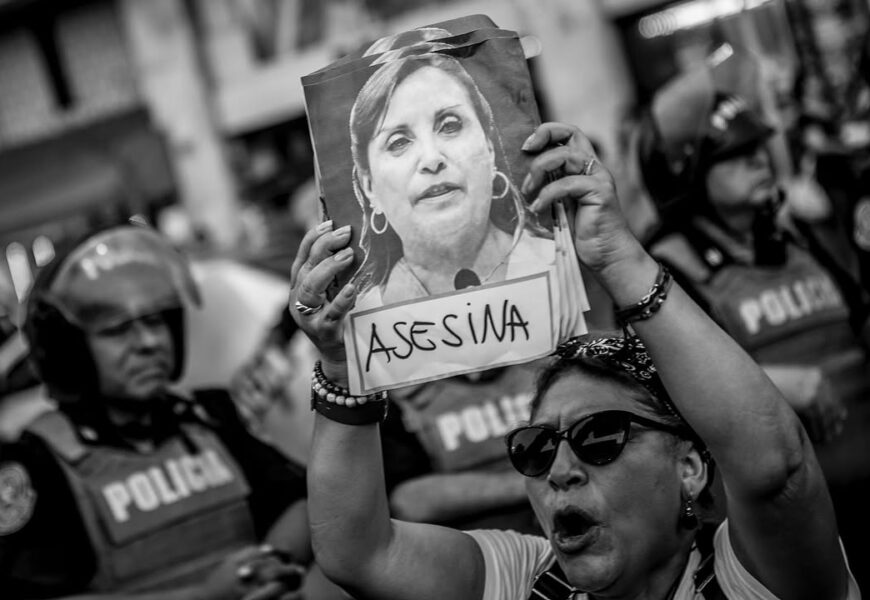
Courtesy of Stifs Paucca
As a Peruvian, I have watched with growing alarm as my country slides ever closer to the authoritarian abyss. The warning signs are everywhere, if only we care to look. Under President Dina Boluarte, Peru’s fragile democracy is being hollowed out from within, not by tanks in the streets, but by the slow, methodical suffocation of dissent and the normalisation of impunity. The ghost of Alberto Fujimori haunts the halls of power, and the so-called “first female president” is presiding over a regime that looks less and less like a republic, and more like a club for the corrupt and the richest, which these days end up being more or less the same people.
Boluarte’s approval rating has collapsed to a historic low, around 4% according to the latest polls. In the interior of the country, as people continue to be killed by organised crime and the lack of action by the government, her support is virtually nonexistent. Yet, she clings to power, propped up by a Congress riddled with criminal investigations and dominated by the shadowy influence of Keiko Fujimori’s ‘Fuerza Popular’. The Fujimorista playbook—authoritarian, lobbyist, cynical, and allergic to transparency—has become the operating manual of the state. The result is a government that legislates not for the people, but for its own survival.
Consider the so-called “anti-cinema law,” a measure so draconian it would make even the most hardened censors blush. Under its vague mandate, any film deemed “political” or “contrary to state interests” is denied public funding. The chilling effect is immediate and profound: documentaries on Indigenous rights, LGBTQ+ issues, and government corruption are quietly shelved, while filmmakers whisper about a return to the dark days of state censorship. The message is clear—art that questions power has no place in Boluarte’s Peru.
The assault on civil society doesn’t end there. The new “anti-NGO law” criminalises organisations that “advise or finance” lawsuits against the state. In the name of national security, the government has declared open season on human rights defenders, environmental activists, and anti-corruption watchdogs. The law’s true purpose is transparent: to silence those who would hold the powerful to account. This is not democracy—it is the architecture of a soft dictatorship.
Meanwhile, impunity for the elite has become the rule, not the exception. The recent escape of former First Lady Nadine Heredia to Brazil, facilitated by a presidential “salvoconducto,” is a case study in how the system protects its own. Heredia, convicted of laundering millions from Odebrecht and the Venezuelan regime, was allowed to flee justice with the full complicity of the government. While the powerful are whisked to safety, ordinary Peruvians are left to fend for themselves as the state guts social programs like Qali Warma. After a scandal revealed that children were being fed dog food and horsemeat, the government’s response was not to prosecute the guilty contractors, but to slash the program entirely, leaving thousands of the poorest students in Peru hungry and abandoned.
The rot runs deepest in Congress, where 67 out of 130 lawmakers face criminal investigations. This is a legislature so brazen in its corruption that it recently tried to shield itself from prosecution by narrowing the legal definition of “organised crime.” When a prostitution ring implicating several congressmen was exposed, the response was not accountability, but a misogynistic dress code banning miniskirts for female staff. The message from the political class could not be clearer: rules are for the little people.
The economic picture is no less grim. With new U.S. tariffs set to hit Peruvian exports, and inflation eroding what little purchasing power remains, the government’s only answer is austerity and more repression. For ordinary Peruvians, the so-called “never-ending crisis” is not a headline—it is daily life. In the seven years from 2016 to 2023, Peru had five presidents. I was born after the end of the Fujimori dictatorship, into a democracy my parents and their friends fought for. I never imagined I would see its slow strangulation in my own lifetime.
Yet, in the face of this onslaught, resistance endures. We call it “the guinea pigs against the rats”—los cuyes contra las ratas. The cuyes are the people: resilient, underestimated, and stubbornly alive. The rats are the political class, gnawing away at the foundations of the republic, protected by criminal circles in Congress and a government that sees justice as optional. From Indigenous defenders and student activists to artists screening censored films in university basements, the cuyes refuse to surrender the country to the rats.
Is Peru becoming authoritarian? The evidence is overwhelming. The question is not whether we are on the road to dictatorship, but how much longer it will take for people to recognise it as the true problem it is. The world should pay attention, not just because Peru matters, but because its story is a warning: democracy does not die in a day. It dies in decrees, in 5-hour meaningless and populist speeches, it dies in the silence of censored artists, and in the hunger of children. It dies when the rats are allowed to rule unchecked, and the guinea pigs are left to fight alone.







An insightful and informative piece that uses powerful imagery and humor to denounce the kind of democratic decline that faces Peru and so many other countries as the author rightly asserts. This kind of op-ed is important to make us think, study more, and take action. I applaud the author’s work to bring these cases to the readers of THE COLLEGE VOICE.
Knowledge of a political system’s modus operandi and understanding how systematic corruption arises are powerful weapons with which to combat authoritarianism. As college students, the readers of THE COLLEGE VOICE have access to an excellent library, classes on Latin America, guest speakers and events, and academic journals like NACLA Report on the Americas with which to arm themselves. Heed your classmate’s call!
Acompaña muy bien a este artículo informativo el presente cómic independiente. https://www.instagram.com/panka_comics/ Aquí se narra visualmente una breve y compleja historia de las contínuas batallas por la ansiada “libertad” y la preservación de la riqueza nacional, lucha que sigue hasta ahora. En este cómic, publicado originalmente en 2021, la rata disfrazada de cuy representa a la izquierda hipócrita que se sirve del pueblo, para lograr sus propios intereses.