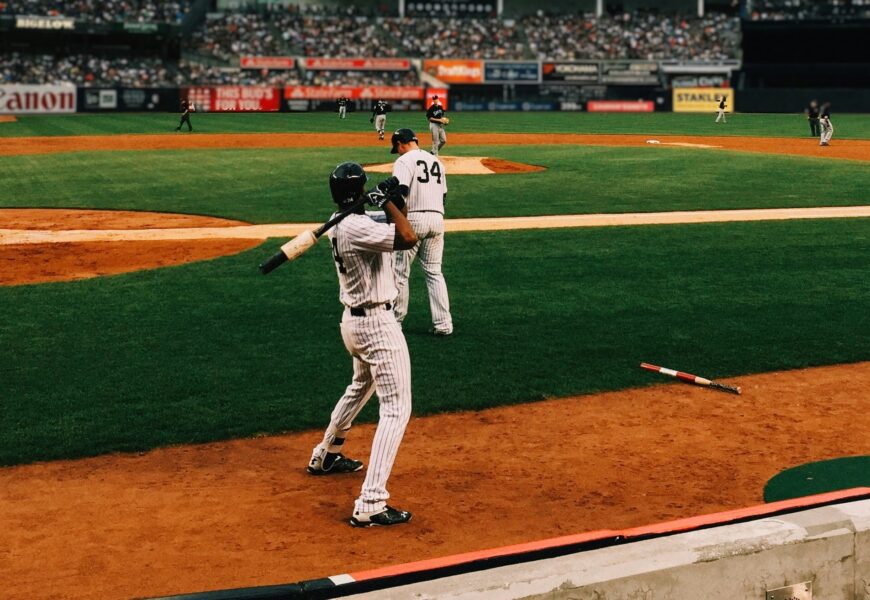
Courtesy of Chanan Greenblatt
Discord has been stirred up throughout the baseball world following the reigning American League Champion New York Yankees’ 20-run thrashing of the Milwaukee Brewers in their second game of the season. Besides the dizzying little league-like score of 20-9, what caught commentators, players, and fans alike was the near unanimous fielding of a specialized bat called the “torpedo bat” which debatably contributed to the Bronx Bombers’ whopping nine home runs that game; a franchise best for a team that first took to the field in 1903. So what exactly are fans up in arms about, and just how effective are these bats that have, in fact, been around and readily available for longer than their newfound popularity?
The torpedo bat is a uniquely shaped baseball bat wherein a portion of the mass of wood at the end of the barrel is shifted slightly downwards towards the sweet spot; the part of the bat where hitters are more likely to make contact with the ball. It is largely because of the increased mass and surface area in the sweet spot that some hitters who have taken to using this bat have been making noticeable improvements at the plate, such as Yankees 2B Jazz Chisholm Jr., who has hit six home runs in his first 75 plate appearances of the season. As of the writing of this article, this bat does not break any of the MLB’s regulations regarding the composition and dimensions of a bat, including barrel diameter.
Former MIT physicist Aaron Leanhardt, who now serves as the field coordinator for the Miami Marlins, is the man to whom this innovation is attributed. Recognizing the part of the bat that hitters are more likely to make contact with, he set out to design a baseball bat that would maximize the surface area and mass of this particular spot. Although this particular style of bat gained the immense notoriety that it did following the Yanks’ very successful usage of it, it has been available to buy for anyone, even outside of the majors, who wanted one from a variety of popular bat manufacturers such as Marucci and Victus. The bat saw use in the Bigs before their infamy, such as via, then Chicago Cub (now Yankee), Cody Bellinger, who would use it in batting practice, and Yankees Anthony Volpe and Jose Trevino, who started using the bats from the 2024 Spring Training through the regular season. It wasn’t until their near-uniform fielding in 2025, however, that the bat showed up on the radar of the baseball world.
So what exactly do baseball fans have to say? It is a mixed bag to be sure, with initial reactions as polarizing as they were passionate. Almost immediately following the 20-run tragedy that befell the Brew Crew, the majority of the fiery back-and-forth was between Yankees fans who were defending the bat’s usage and fans of other franchises, making claims of cheating and rule-bending. Individuals within the League have also had strong takes on the introduction of the torpedo bat. Left-hand pitcher Trevor Megill of the Brewers, for example, believes in the notion that the bats should not be legal and that the League has a bias towards the Yankees, saying that he’s “…never seen anything like it before…it might be bush league. It might not be. But it’s the Yankees, so they’ll let it slide.” The Brewers’ own 2024 National League Manager of the Year thinks otherwise, stating about the controversy, “my old a** will tell you this for sure: it ain’t the wand, it’s the magician.” It has been several weeks since the blowout in the Bronx and since then numerous players across the League have adopted the torpedo bat, including superstar shortstops Francisco Lindor of the New York Mets and Elly de la Cruz Cincinnati Reds, thereby dispelling any claims of exclusivity in the Yanks’ usage of the bats that floated around social media at the onset of their broad introduction.
With an already incredibly talented lineup, the New York Yankees certainly did not need the torpedo bat in order to reach the World Series last year, but it is absolutely useful in making already skilled players just that much better. Owing to its widespread availability and the apparent competitive advantage that it brings to the table, it would not be surprising to see the torpedo bat become a mainstay in Major League baseball for years to come.