Courtesy of Theo Andres ’27
Secrecy and the Invisible may be one of Conn’s most… obscure? secret? courses. We study the manipulation of secrecy, power, and knowledge, and connect concealment and invisibility to art and photography, voyeurism and surveillance, magic and religion, museums and other institutions, death and dark tourism, and more—it’s Art, Art History, Museum Studies, and a whole lot more. Some course highlights have included a visit from magician and mentalist Nevin Sanchez, several film screenings (yes, including “The Invisible Man” (1933)), and our two exhibits we curated as a class—one on hidden mother photographs, and another on trick photography that’s on view outside the Linda Lear Center.
Arguably, though, the highlight of the course for all of us was the thrilling field trip we took into New York City three weeks ago to investigate secrecy and invisibility through the city’s museums and galleries. We visited five different museums, galleries, and installations total, and wandered Manhattan from Chelsea to the Lower East Side.
The first stop on our trip, and my favorite, was at the International Center of Photography to see the exhibition “Weegee: Society of Spectacle.” Weegee, named after either a squeegee or after Ouija boards, was a photojournalist and photographer most active in the 1930s and 40s. His pseudonym’s association with the Ouija board may have been because of his uncanny ability to be the first to arrive at crime scenes, which comprised most of the photos on display in this exhibit. My favorite of the photos is one taken at the scene of a car crash: it’s titled, plainly, “Young man smoking cigarette in crashed car while waiting for ambulance.”
In the photo, a bloodied and injured young man, only his head visible from our vantage point through the passenger window, rests his head on the arm of another boy (ostensibly not injured from the crash) who is holding a cigarette to the other boy’s bloodied mouth. His wrecked face is reflected in the side mirror of the car’s door. On the other side, just peeking at us over the driver’s window, another boy is barely visible as he watches the moment unfold. It’s a crisp black and white, and is a perfect encapsulation of the point of the exhibit—what is truly more of an American spectacle than a car crash and its bloody victims?
Weegee’s ability to capture both the frightening realities of fires, crashes, and murders alongside the terrified crowds and bystanders witnessing them is a shocking kind of voyeuristic feeling for the exhibit’s viewer to contend with. Some other sections of the exhibit included his photographs of newly apprehended criminals—caught on charges of murder, fraud, crossdressing or otherwise—either shamefully hiding their faces or gleefully posing for the camera; infrared photos from within the dark of the movie theatre; stunning captures of crowds witnessing great tragedies or great thrills; and distorted, caricature-like self portraits and photographic critiques of celebrities.
After a delicious dim sum lunch and some ice cream, we moved on to our next museum of the day. At the Lower East Side Tenement Museum, our tour guide—a former Conn Museum Studies student—took us on a tour of two of the tenements in their historic building, where we learned about the hidden and underrepresented lives of Jewish immigrant women in the turn-of-the-century New York City, and the work they put into keeping the tenements, as well as their entire community, running and functioning.
Our next stop was perhaps one of the more mysterious—as well as hidden and secretive—and controversial sites we visited. Not controversial as in radically political or even particularly provocative: the New York Earth Room is, truly and honestly, a room full of dirt. Despite its complicated reputation, a great many people, most of our class included, were shocked at how much we enjoyed it, and how much meaning we could find in something that seems, superficially, so simple. If this raises questions for you—particularly, angry questions—then I’d challenge you to take it as it is and see how you feel once you remove that anger. And I know people hate to hear it, but there’s a reason photos aren’t allowed, and I won’t say anything more here: you have to see it to understand it.
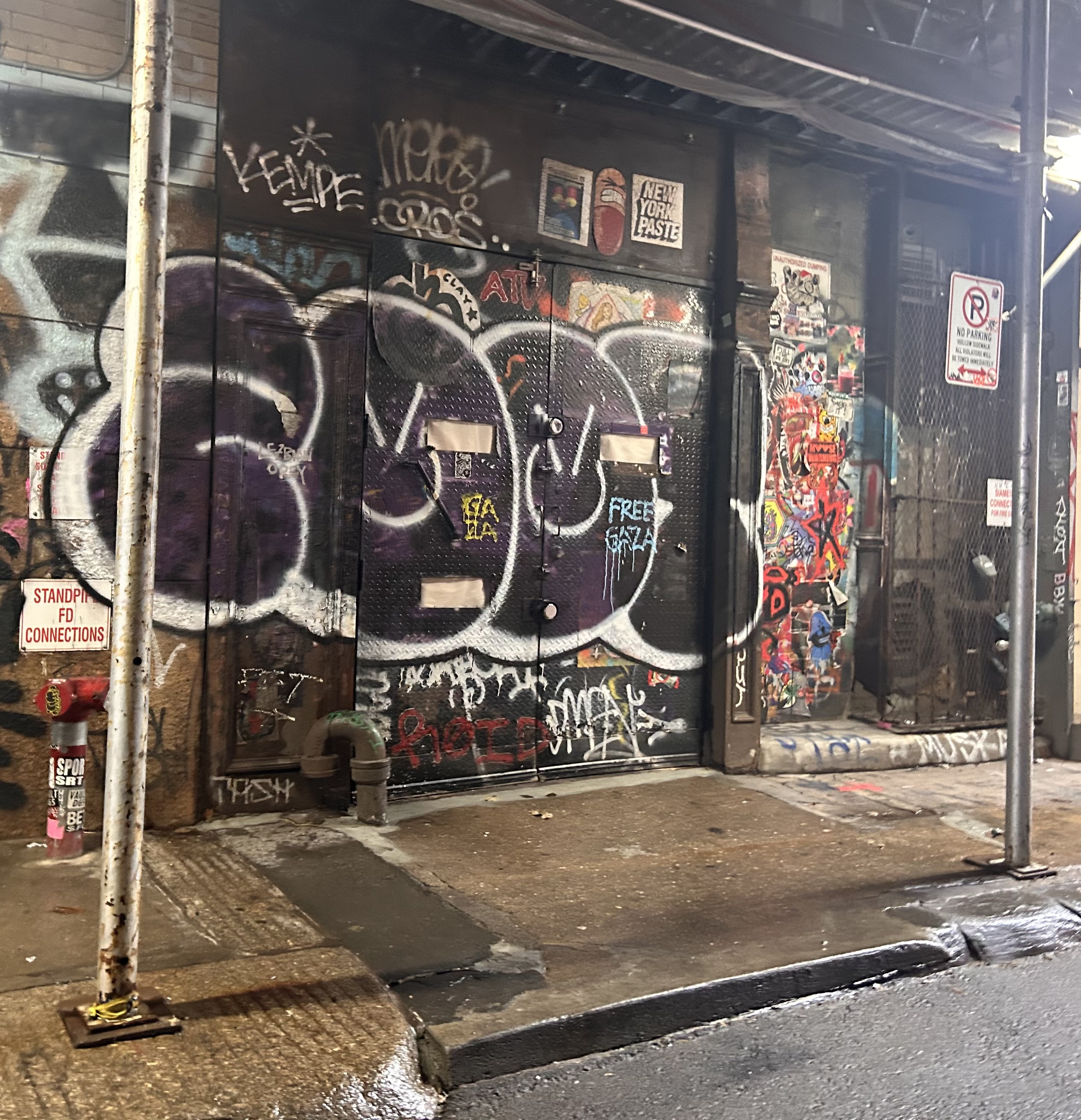
Though we didn’t get to see inside (as it has not opened yet for the season) we also got to visit the exterior of the Mmuseumm, an exhibition inside a freight elevator in one of NYC’s most random alleyways, which can be seen in the attached photo. Had you walked past our class as we all huddled together taking our photo in front of it, you would’ve shaken your head and kept walking past the tourists crouched on the pavement in front of just another graffiti-covered wall.
Last, but certainly not least, we finished our day in Chelsea with a visit to two galleries. First, we saw an exhibition of the works of Julio Galán, a Mexican artist whose works take, leave, and blend neo-expressionist and neomexicanismo ideas, and explore gender, culture, tradition, sexuality, and binary of all kinds. Second, we went to see an exhibition on Laura Owen’s works, which featured large, towering pastel paintings, and interactive thrills of discovery, with moving panels, doors, and illusions. A secondary gallery next door held rows of patterned boxes, each holding compartments filled with art, journals, and revelations. Though both exhibitions are now closed, it was most of our classes’ first time exploring the galleries of NYC, and a very thrilling experience.
Despite having to pull each other through the pouring rain around the city, we had the times of our lives exploring a taste of NYC’s artistic take on secrecy and invisibility through investigating some of the city’s most secret galleries and exhibitions.