Courtesy of Claire Hlotyak
“We got a picture of a gorge, with farm surpluses on one cliff and under-nourished city folks with outstretched hands on the other. We set out to find a practical way to build a bridge across that chasm.” Milo Perkins, the administrator of the first Food Stamps Program in 1939, paints the picture of a land rich with resources that its citizens cannot access. This imagery is all the more striking 85 years later, where, in one of the wealthiest countries in the world, accessing affordable fresh food has never been more difficult.
It is 2025, and people are struggling to afford the ability to eat. SNAP, or Supplemental Nutrition Assistance Program (formerly known as Food Stamps), is on the chopping block due to Donald Trump’s draconian “Big Beautiful Bill.” The bill is expected to cut $186 billion from SNAP funding by 2034, the largest cut ever in SNAP’s 50-year history.
It is difficult to put into words the essential role SNAP plays in aiding people to afford food. The program is mainly utilized by low-income individuals, senior citizens, and people with disabilities, according to the USDA. SNAP has always been federally funded, and works by delivering electronic benefits to people’s SNAP cards to purchase food, just like using cash. SNAP is accepted in most grocery stores and even farmers’ markets.
Trump’s bill will force individual states to bear a percentage of the costs for these programs. According to the Massachusetts Law Reform Institute, a 25% state responsibility would cost MA about $53 million a year. As a result, some states may axe their food assistance programs altogether.
I have worked at my local farmers’ market for six years, holding different roles each year. Each year, I discover a new layer of what they mean to a community. This market season began with a heavy ambiance, as SNAP cuts loom on the minds of shoppers and vendors. Farmers’ markets often go above and beyond, matching SNAP benefits to help stretch customers’ dollars. Managers and volunteers work tirelessly to raise this money for shoppers who are often also our friends and neighbors.
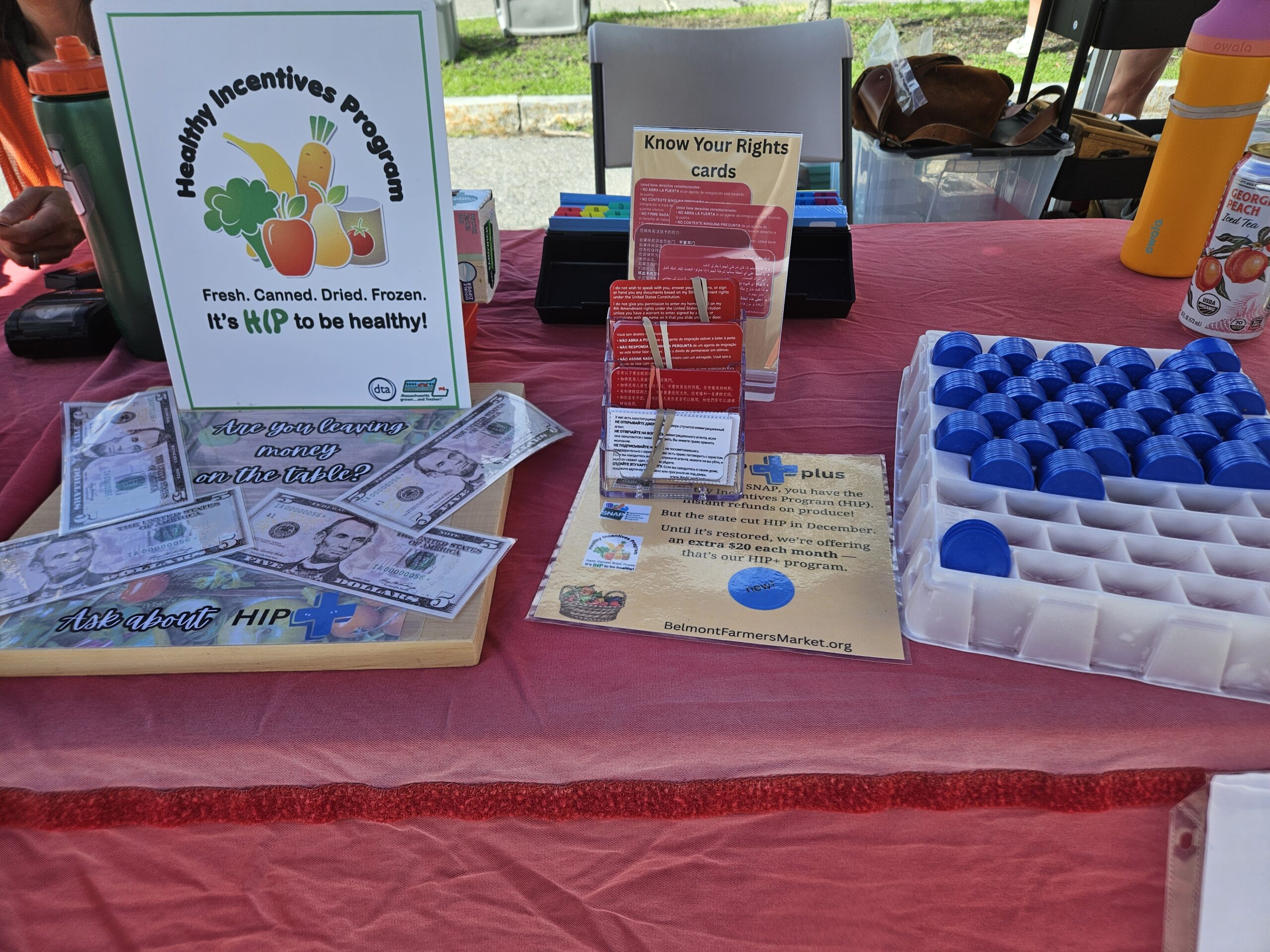
SNAP is not the only food assistance program struggling. This season, Massachusetts farmers’ markets have dealt with significant cuts to HIP, or the Healthy Incentives Program. A Massachusetts program, HIP, provides an instant rebate on your SNAP card when you use SNAP to buy produce from participating vendors. Individuals used to receive $40, $60, or $80 a month of HIP funding, depending on their household size.
In December, that amount was slashed to $20 for everyone, regardless of household size. Suddenly, purchasing healthy food became even more of a luxury, less of a right. I recently attended a meeting for a campaign to secure HIP funding. There, farmers market managers mentioned that attendance rates have dropped significantly. For many, $20 is simply not worth the trouble of traveling to the market. As a result, farmers are struggling to sell their produce.
The HIP cuts are simply a foreshadowing of a truly dystopian series of events likely to play out. For example, Trump’s bill will revoke SNAP benefits from immigrants with Official Humanitarian Protections (for example, refugees, those seeking political asylum, survivors of domestic violence, sex trafficking, etc.)
On July 1st, Massachusetts raised HIP funding to $40/month for everyone. It was just announced that for the current fiscal year, funding will be reinstated at $40, $60, or $80 per month soon. A small win in the vast landscape of losses.
Still, when SNAP cuts officially hit, food justice advocates are expecting to see a hunger problem long absent from Massachusetts.
This summer at the market, I am working as a food assistance coordinator, facilitating a program that offers shoppers additional HIP dollars to supplement what was cut. Without the generous donors sponsoring this program, it would not exist. That is the reality for most markets and customers who are forced to adjust to a system that has never been in their favor, yet balk when you question its methods.
The deluge of disastrous news we receive every day is unhealthy. A lot of it may go in one ear and out the other. So I say this not as an accusation, but a timely reminder: issues like food insecurity are no less real because you cannot see them or are not experiencing them personally. This mindset is a contributing factor to the misinformation about food assistance programs, leading to beliefs that participants are “gaming” the system or are too “lazy” to work. This is recycled rhetoric, used time and again to place unnecessary and cruel blame on marginalized and struggling communities.
We should not be politicizing whether or not someone should have access to food.
Playing even a small role in the fight against food insecurity has been eye-opening. I see firsthand how the food assistance programs are almost intentionally confusing. They require users to jump through hoops, make calculated purchases, and even hold off buying certain items to save for something else. This is not to mention that for many SNAP and HIP recipients, English is not their first language.
On an individual level, one of the only ways to meet these present challenges is with empathy. Spending a few extra minutes explaining our SNAP program to recipients can make all the difference. Walking shoppers to the farmstands where they can use their HIP balance saves them from confusion. In this unbelievably dark moment, we only have each other. So why not take that extra minute?
I continue to think of this chasm that Milo Perkins describes. It seems we are living in it, and it is vast and ever-expanding. People are trying to close it with all their might. It is an admirable fight, one that is far from over and anything but new.
While we examine this deep pit of despair, or whatever you wish to call it, while we prepare to scale its walls, I urge you to question why it even exists. Why does this void of inequity persist? Why do the powerful and endowed want it gone? Why has the bridge we’ve built faced constant destruction?
SNAP, HIP, and all the other programs serve as our bridge to a future where these programs are no longer needed. Is it such a radical wish that, for the time being, this bridge remains? I certainly don’t think so.