
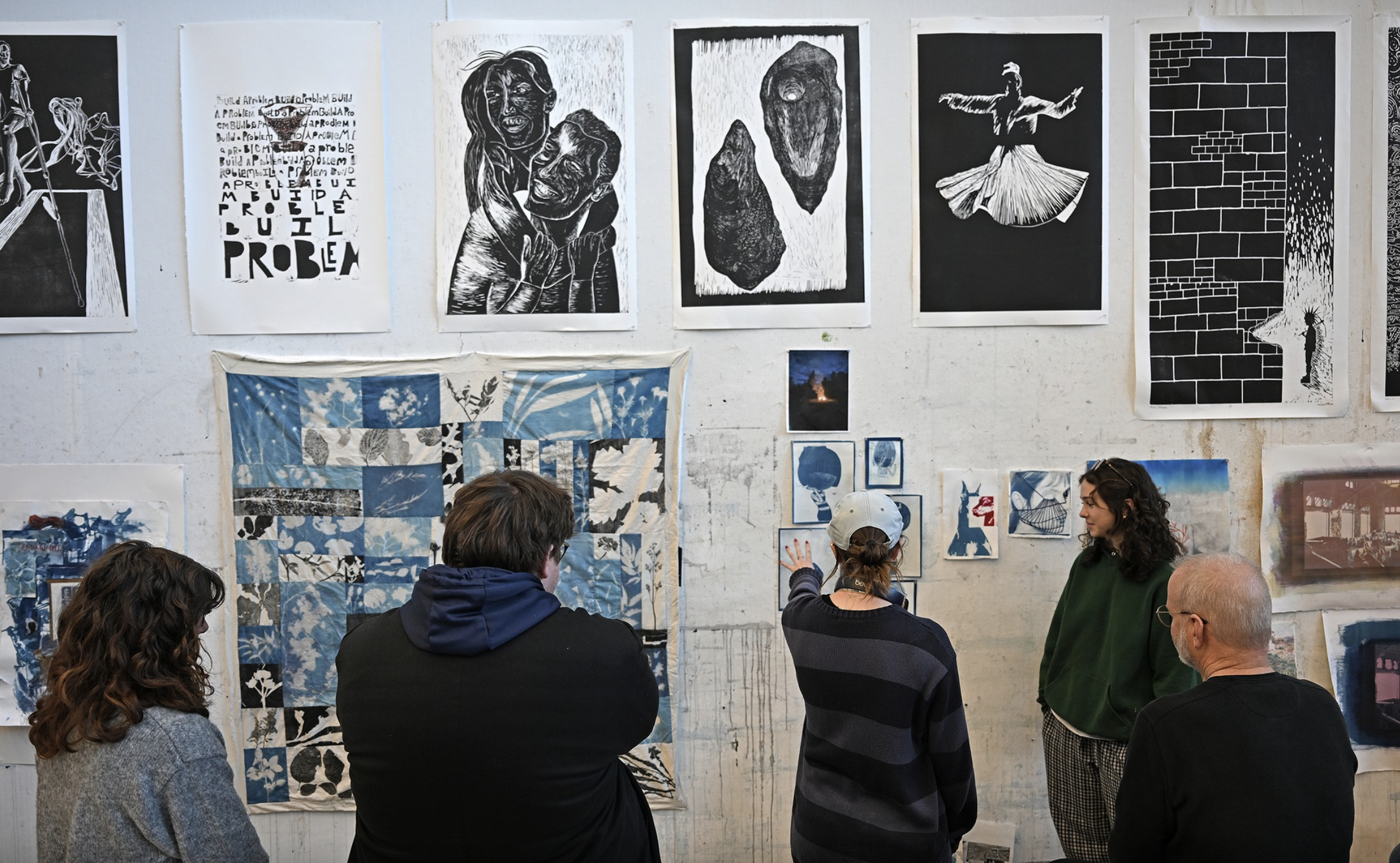
Courtesy of Connecticut College
The challenges facing higher education today are not just about curriculum or enrollment numbers. They are about survival, adaptation, and the ability of institutions to uphold their mission in a rapidly shifting landscape. Few know this better than Professor Tim McDowell, Interim Chair of the Connecticut College Art Department, who has taught at the college for forty-two years. In a recent conversation, he offered both sobering assessments and hopeful reflections about academia, art, and the role of students in turbulent times.
Across the campus, departments are being asked by the Dean’s Office to present staffing plans; strategies outlining how they will replace, initiate, or restructure positions in order to remain viable. Such planning has been made all the more difficult because of limited opportunities for growth. According to McDowell, there are only five tenure-track openings across all departments at the college this year. Who receives these positions is determined through what he described as “a rotating lottery.” In an era where colleges are contracting rather than expanding, there is little room for long-term growth. “We all know that the student-age population is shrinking,” he said. “There’s never going to be as many young adults, and colleges have to retract.”
That retraction leaves its mark on faculty as much as students. McDowell, who has spent around four decades teaching at Connecticut College, reflected candidly on his own situation. “I may not be able to retire, and I’m holding on until things get better, because I know they might not replace me,” he admitted. For him, and for many faculty members across the college, retirement is no longer a personal milestone but a decision tied to institutional survival. If senior faculty retire too soon, positions could be eliminated rather than refilled. Entire programs risk fading away.
It is not just the arts that feel pressure. McDowell noted that many language departments have begun to regroup and consolidate in order to “self-preserve.” These adaptations reflect the financial and demographic pressures weighing heavily on liberal arts institutions nationwide. “Education has to keep up with society as a whole,” he said. “We are going through hard times in academics because of the current U.S. administration. We have to navigate that difficulty as faculty, and with that comes finances. Conn College is heavily reliant on tuition. If there are fewer students, they have to compensate for that.”
The picture he painted is not one of comfort or stability but of constant adjustment. “We are searching, trying different things, so that we are financially stable,” McDowell explained. “It’s not a carefree time to be in academia like it was thirty years ago.”
Yet despite these challenges, there are bright spots of resilience and even resistance. McDowell pointed out that two years ago, Connecticut College students helped lead the charge for presidential change at the institution. Art students, he said, were not only engaged but instrumental in that movement, demonstrating that activism has not disappeared from campus life.
Still, he cannot help but compare the present generation of students to his own. When McDowell was in school during the Vietnam War, the stakes were painfully immediate: remain in school or face the draft. “You had to stay in school or go to battle,” he remembered. “You couldn’t be average, or the army got you.” In those years, the Art Department became an outlet for protest, producing posters and work that directly confronted national issues. “The art department railed against what was happening,” he recalled.
When asked about student political engagement today, McDowell sounded both understanding and cautious. “I don’t see that happening with your generation,” he said, referring to large-scale artistic movements aimed at resistance. “You are dealing with it quietly, ignoring it. But hopefully more students speak up. That’s what democracy does best. But it’s looking very scary.”
This concern is less about apathy and more about the way social and political expression is channeled. While students continue to use art as an outlet, McDowell worries that current crises are being met with silence rather than a groundswell of visible, collective resistance. Reflecting on the Reagan administration, he recalled previous waves of student pushback. “As conservative policies took hold, we had a lot of students resisting that. When you see the generation of your parents do something you don’t agree with, you pick a direction that is not contributory to that effort to oppress.”
McDowell insists that his role is not to politicize students, but to support their ability to express themselves should they choose to do so. “I don’t push politics on my students—that wouldn’t be fair. You have to come to these conclusions yourself. But I will support and help students express it in a viable way.” At the heart of his philosophy lies a commitment not only to free thought but to artistic merit. “Protesting something doesn’t mean it has to be bad art. If a student wants to make political art, I would hope it’s good art that stands out regardless of its message. If a student wants to do that art, it is honorable, it should show some merit.”
McDowell’s reflections position art as both shield and spear: a form of protection in times of uncertainty and a tool to pierce through political and cultural stagnation. “Good art inspires, informs, and consoles,” he said. It is, in other words, a vital part of navigating instability, whether financial, political, or generational.
For faculty and students alike, the challenges are steep. Shrinking demographics, reliance on tuition revenue, and the unpredictability of institutional planning all cloud the future. Yet if McDowell’s perspective carries a lesson, it is that the liberal arts, and particularly the arts, must persist as spaces of resistance, resilience, and renewal. Even as academia contracts, the act of creating art remains expansive, offering a means to both critique and imagine.
In a world where higher education is in flux, the Art Department stands as a reminder that transition, while difficult, need not mean decline. For McDowell, the task is simple but urgent: support students, sustain community, and ensure that the spirit of art remains a space where democracy, however fragile, can still be voiced.



Tim and I came to CC the same year. I know Tim well. He’s a person of great integrity and wisdom, as well as a talented artist. I respect and understand his fear that if he retires, then the Art Department may lose that tenured position. Every department faces such consequences. I will say to him from the perspective of being retired now 6 years, that ultimately, CC doesn’t really care about your accomplishments, and the health of any individual department due to its severely limited resources. The College will do what ever to survive. I’d say, go ahead and retire. You will find there is life outside of CC that you can enjoy. And as someone who has just went through a major health issue, one finds that the time to enjoy retirement is much more limited than one can imagine.
Mike Monce, physics emeritus