Courtesy of Connecticut College
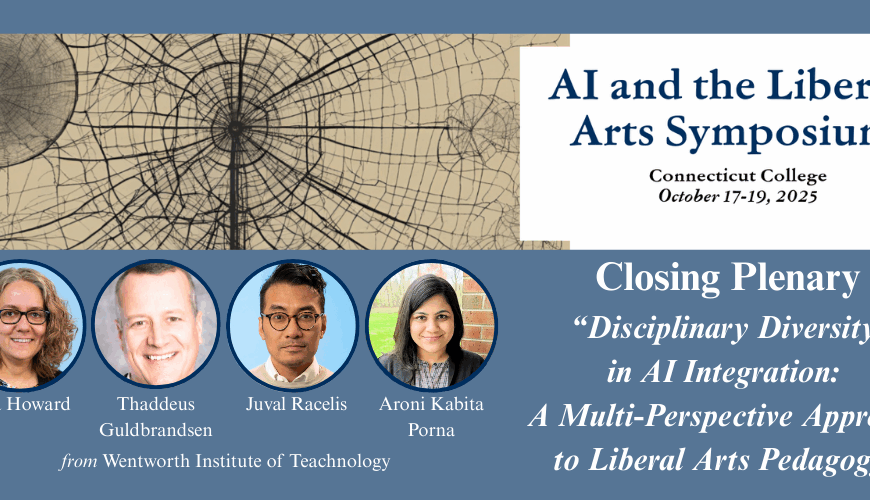
In the new age of Artificial Intelligence, it’s fair to say that higher education institutions have been scrambling to meet the conflicting demands and desires of students, faculty, and employers. The conversation is complicated, to say the least—students disagree, faculty disagree, but AI’s presence in our world demands conversation. Conn is answering that call this semester, and taking charge of the conversation with the inaugural AI and the Liberal Arts Symposium.
The panels, workshops, and discussions of the symposium— scheduled for the weekend of October 17-19— present a series of arguments, solutions, and developments that investigate where innovation and pedagogy can meet within the liberal arts. Several themes for submissions include AI and Pedagogy, Ethics and Equity, Interdisciplinary Innovations, and the Future of Liberal Arts.
Due to the generous donors Harold F. Wiley and Diane Y. Williams, the College has this year introduced a collection of programs and conversations entitled ‘AI at Conn.’ Susan Purrington, one of the lead organizers of the symposium and our Harold F. Wiley AI Teaching and Learning Fellow, is committed to using these grants, which she says places Conn “way ahead of other campuses,” as an opportunity to put Conn at the center of the conversation on AI in liberal arts education.
Dr. Purrington has been working this semester not only to gather feedback on AI initiatives from factually and students, but to help the College navigate a rapidly expanding technological world. For her, the symposium is the perfect opportunity to expand and refine these conversations on the direction that Conn and all liberal arts colleges should go.
“This conversation has to happen– why not be the leaders?” asked Dr. Purrington. “This symposium means inviting our peers in liberal arts education to discuss and shape the future of AI in higher education…it doesn’t mean we’re the leaders in AI integration, but we can be the leaders in conversation.”
Many students have welcomed the presence of AI in the classroom, while others have vehemently opposed it—and classroom tensions over AI, as many students and faculty alike have noted, have only heightened as we enter into the new school year. Without a specific college-wide policy on AI, which Dr. Purrington intends to discuss, many professors have wildly different opinions and policies for their classes on AI, from implementing outright bans to adapting whole units to its usage. When the AI at Conn initiative was announced this spring, the reactions were loud, and varied, as Dr. Purrington fully understands.
“A lot of people are confused by it, or think that because we’re having a symposium, we’re focused on AI integration. We’re only focused on doing the hard, critical thinking and making the most ethical decisions moving forward,” she emphasized. “My role, and AI at Conn, is not a mandate…it’s a resource that doesn’t exist at other colleges, and without [the gift] these conversations couldn’t be happening at this scale.”
The symposium itself, as stated, invites a large range of opinions and perspectives, with the panels exploring both ethics and implementation, and workshops to help faculty, staff, and students alike to navigate the often-controversial but ever-present world of AI. Faculty and staff from other institutions, including other NESCACs and universities across the country, will share their own campus’ approach, and discuss where higher education as a whole should move next.
Within the panels, the question of integrating the effects and values of AI usage into the values of liberal arts institutions stays central. Dr. Purrington highlighted the importance of integrating these values by posing the question of, “what is the role of critical thinking and analysis in AI integration? What does it mean to sit back and think when we can get instant answers?”
One panel that Dr. Purrington pointed out was “Presentations on the Future of Liberal Arts,” this Friday at 2:25 p.m., which includes Connecticut College professor and student, Dr. Priya Kohli and Alsacia Timmerman ‘26, presenting on NESCAC responses to AI, and Dr. Anand Rao and Dr. Stefan Bauschard, two leading voices in the national conversation on AI and higher education.
Another workshop comes from Boodlebox AI, an educational AI platform and program that Conn has adopted, which Dr. Purrington emphasizes provides equitable and ethical AI access, on personalized learning experiences using AI. Besides the symposium, Boodlebox is coming back to Conn for a Q&A session on October 16 at 4 p.m., and interested students should keep and eye out for more information.
Moving forward, even after the symposium, Dr. Purrington is remaining committed to whole-college conversations, and figuring out together how to move forward.
“I’m always asking, ‘where is the student voice in this?’” she said, and reinforced her and the College’s intentions to get more students involved in the conversation on how to meet the AI era. “I’m always truly committed to ethics and responsibility.”
“In higher education, we dropped the ball with social media, because we didn’t see any connection or purpose in helping shape it, or how future generations’ use of it might affect our classrooms. This is an opportunity: AI is everywhere and in everything, and we can play a role in actively shaping what that looks like,” Dr. Purrington said. “Developing healthy dialogue with people is just as important—we all have to have an understanding about how it works so we can have a healthy, productive, academic environment. We have an opportunity now to address it, and continue to support the values of liberal arts education. This symposium is an opportunity to start these conversations, and so that no one feels shamed or stigmatized to be using AI in an appropriate and responsible way.”
The symposium will take place the weekend of October 17-19, Friday through Sunday– visit their website for more information on registration.