Courtesy of Lexie Dixon ‘27
It’s October at Connecticut College, and we can finally breathe in the crisp autumn air. It is our last time to soak up the remaining sun and warmth before winter sets in and we feel like holing up in our rooms to hibernate through the cold. It’s fall, the season prior to hibernation, where we soak up the remaining sun and warmth before winter sets in. Many plants do the same, blooming and producing fruits well into the fall.
Lawns are yellowing as leaves leap off the deciduous trees on campus, but things are still growing in the Sprout Garden. As I took a walk recently around Sprout, which I recommend all curious students do, I noticed fruiting plants and abundant flowering. There were green strawberries, vermillion nasturtiums, and tall shoots of dill with light yellow inflorescences. I also spotted some plants past their prime: the beans have brown, crispy vines, and the corn plants have been reduced to wilting stalks. These are two of the Three Sisters crops: beans, corn, and squash, which when planted together, are all beneficial to each other (nativeseeds.org). Bean plants increase the nitrogen content in the soil, an important nutrient for all plants, corn plants provide stable stalks for the bean plants to climb, and the squash plants shade the ground with their leaves to prevent the growth of weeds. Sprout grows these three plants to pay homage to local indigenous knowledge, as indigenous peoples have practiced this planting method, with some slight variations, for millenia. Walking through the garden, I realized the substantial amount of work needed to generate such growth. I knew there was something to dig into further.
Sprout is an on-campus garden run by students, initially founded about 20 years ago, according to the school’s website. For those who have not visited, the garden is located on the northwest side of campus, behind the newly renovated Crozier-Williams building. Here, there are several small plots covered with in-ground and raised garden beds, picnic tables, a compost area, and two high tunnel structures.
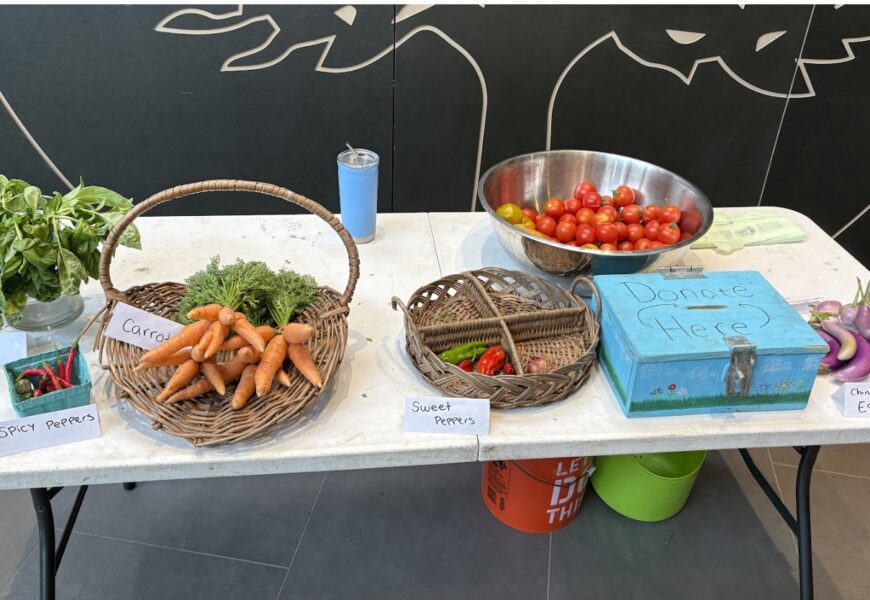
Aside from being a campus landmark, Sprout has both social and educational significance. It not only provides a space to learn about agriculture, sustainability, and collaboration, but also gives students access to fresh foods. Sprout holds a weekly market stand in Crozier-Williams from 12:30 to 4:00 pm on Mondays, offering a variety of fresh produce with a box available for optional, pay-what-you-can donations. In my visits to the market stand, I have picked up tomatoes, some basil, peppers, and flowers. Students can feel confident knowing how these plants are grown, because the process takes place right on campus.
The compost area previously mentioned is an integral part of the Conn-posting program, where students who elect to have small compost bins in their rooms can deposit organic matter from select food waste to decompose. One Sprout farm manager, Paloma Doyle ‘26, gave me a comprehensive explanation of how composting works on campus. There are three sections of compost determined by the level of decomposition, and once the organic material has been fully reconstituted into dirt, it can be added to Sprout’s garden beds before planting for extra nutrients. Transparency and clarity are key at Sprout, and so is community involvement.
Sprout has an important collaborative relationship with FRESH New London, a “food justice non-profit located in New London, CT” with a primary objective of food sovereignty (freshnewlondon.org). FRESH makes a substantial positive impact on the New London community, inciting food system change, revitalizing local spaces, and even involving youth through community-based agriculture. They hold numerous events, have local “pay what you can” farmstands, and even provide access to agricultural education materials, zines, and recipes on their website. FRESH has three community gardens throughout New London, and also partners with the Sprout Garden through Community Supported Agriculture (CSA).
I spoke with Abdou-Latifou Dare ‘27, a Sprout farm manager, at a recent Sprout market stand event about the inner workings of Sprout’s current program. He told me that as a part of a CSA collaboration, Sprout provides 18 shares of produce each week to FRESH New London, which are prepaid for, to be distributed throughout the community. Abdou-Latifou emphasized the importance of this initiative, as “Groton and New London are places where fresh produce is not as accessible,” so Sprout’s contribution to local food systems is not a small deal. It’s crucial. In addition to Abdou-Latifou, there are 4 other farm managers at Sprout, all of whom have experience and education in farming and agriculture. He told me that these managers continue the work of Sprout’s summer interns and also coordinate with student volunteers. Botany and sustainable agriculture professor Eric Vukicevich is the faculty manager of the Sprout garden.
As a gardener myself, I know that each year has its triumphant crops and its unsuccessful bunches. I asked Abdou-Latifou about the challenges that Sprout has faced this harvest season. He said that they had “a hard time with cucumbers and watermelons,” and other types of “curcurbits” that were targeted by some hungry beetles. But, he let me know that they are still expecting more plants to be ready for harvest well into the fall, likely including carrots, lettuce, cabbage, bok choy, and spinach. This is exciting for students who frequent the market stand each week, and perhaps even more exciting for students who haven’t visited yet.