Courtesy of NESCAC Athletics
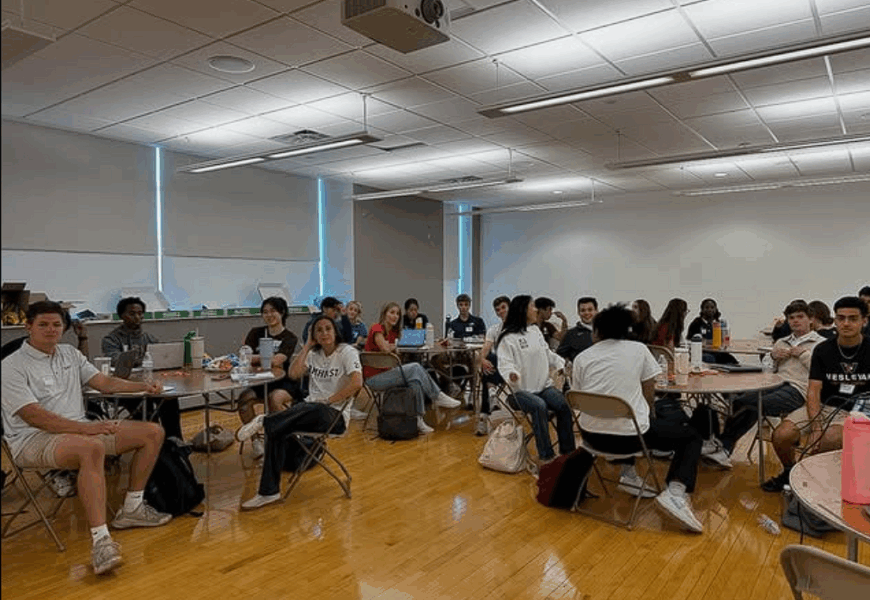
On Sunday, October 5th, Tufts University hosted the annual joint all-New England Small College Athletic Conference (NESCAC) Student-Athlete Advisory Committee (SAAC) and Coalition of Student-Athletes of Color (CoSAoC) meeting. In the multipurpose room of the Steve Tisch Fitness Center, SAAC and CoSAoC representatives from the conference’s eleven institutions (Amherst, Bates, Bowdoin, Colby, Connecticut College, Hamilton, Middlebury, Trinity, Tufts, Wesleyan, and Williams) gathered, many of them having carpooled for several hours that morning to make it to Boston.
The meeting, hosted by NESCAC Associate Director for Championships and Compliance, Adele Burk, opened at 11:45 a.m. with brief introductions in which athletes introduced themselves, their sport, and graduation year.
After going around the room, student-athletes dove into what would constitute the bulk of the conference, in-depth discussion about the most relevant of 16 legislative proposals currently on the table for the National Collegiate Athletic Association (NCAA) Division III.
Athletes opened the discussion with what would become one of the more divisive pieces of legislation, a proposal to bring back redshirting for DIII. Redshirting, a practice currently employed in Divisions I and II, is a process by which a student athlete can retain a year of eligibility if they do not participate in any athletic competitions for their team. In other words, an athlete may play for another year on the team if they did not play in any games the previous year. Currently, the rule in DIII is that a student is “charged with” or uses a season of eligibility if they compete or practice after the first formal date of competition. This proposal was a difficult one to grapple with, as one of the core principles of DIII and the NESCAC as a conference is a four-year undergraduate education: in fact, some institutions within the conference only allow students to be on campus for eight semesters. Representatives also brought up the financial consideration that only certain student-athletes would be able to afford another year at their institution, as tuition rates increase at NESCAC schools especially. The room was divided when athletes voted, and responsibility now falls on individual institutions to continue the discussion on the proposal.
The next piece of legislation proposed was a change to the automatic qualifier (AQ) model currently in place for deciding participation in all NCAA postseason tournaments. This proposal would allow multisport conferences with 12 or more institutions to gain two AQs instead of the singular currently allotted to all conferences, regardless of total membership. As a consistent 11-member conference, with many schools that receive at-large bids regardless of the course of the conference championship, the NESCAC as a whole is largely against this proposal, as it would take away at-large bids from our nationally-ranked teams.
Athletes then discussed proposals that included permissioning authorizations for unofficial recruit visits, adding a mandatory one-week break for the winter season, changing the transfer process for Division III, and authorizing funds for conference all-star contests in the postseason.
Institutional SAACs are now responsible for meeting within the next few weeks to decide on school-by-school votes for these proposals, which will then be taken to the January DIII National SAAC Conference by RJ Casey ‘26 of Connecticut College, the NESCAC Representative for NCAA DIII National SAAC.
The group then turned to the ’25-’26 #NESCACCares Campaign, this year’s rendition of the conference’s annual initiative for student athletes. Representatives agreed that each institution would act independently to promote this initiative, with schools sharing institutional efforts to their social media accounts and the NESCAC Athletics Instagram (nescacathletics). The group then shared recent events organized by their respective SAAC and CoSAoC groups, with the Connecticut College delegation highlighting their annual dodgeball tournament, which raised money for the mental health organization NoSolo, and the upcoming Camel Madness event hosted by the Athletes of Color Coalition (AOCC).
Representatives then discussed plans for each institution to take over the NESCAC Instagram account from Apr. 6-16, 2026, for Division III week, as well as acknowledging Officials Appreciation Weeks for each competition season. The fall season’s Officials Appreciation Week took place the week after the conference, from October 5 to 11, with the winter season’s equivalent occurring from Jan. 27 to Feb. 2, 2026.
The group then broke up into smaller SAAC and CoSAoC meetings to engage in more informal discussion regarding institutional processes for each group, upcoming events, and areas of improvement for greater efficiency for each organization.
The conference concluded around 4 p.m., with delegates setting off on long drives back to their institutions. The next all-NESCAC SAAC and CoSAoC meeting will take place virtually on Jan. 25, 2026, where legislative decisions and updates from the DIII National SAAC will be shared with representatives.
The Connecticut College delegation consisted of Elias Espinosa ‘26 and Dylan Watson ‘27 from AOCC, as well as RJ Casey ‘26, James Brennan ‘26, and Evie Lockwood Mullaney ‘27 from SAAC. Upcoming events for the campus community include Camel Madness, sponsored by AOCC, on Monday, Oct. 13th at 8 p.m. in the Luce Fieldhouse.