Courtesy of Clarus Multimedia
Camel of the Edition is a series that seeks to highlight extraordinary Connecticut College athletes who have stood out from the herd due to their recent performances or as a leader on campus or their team.
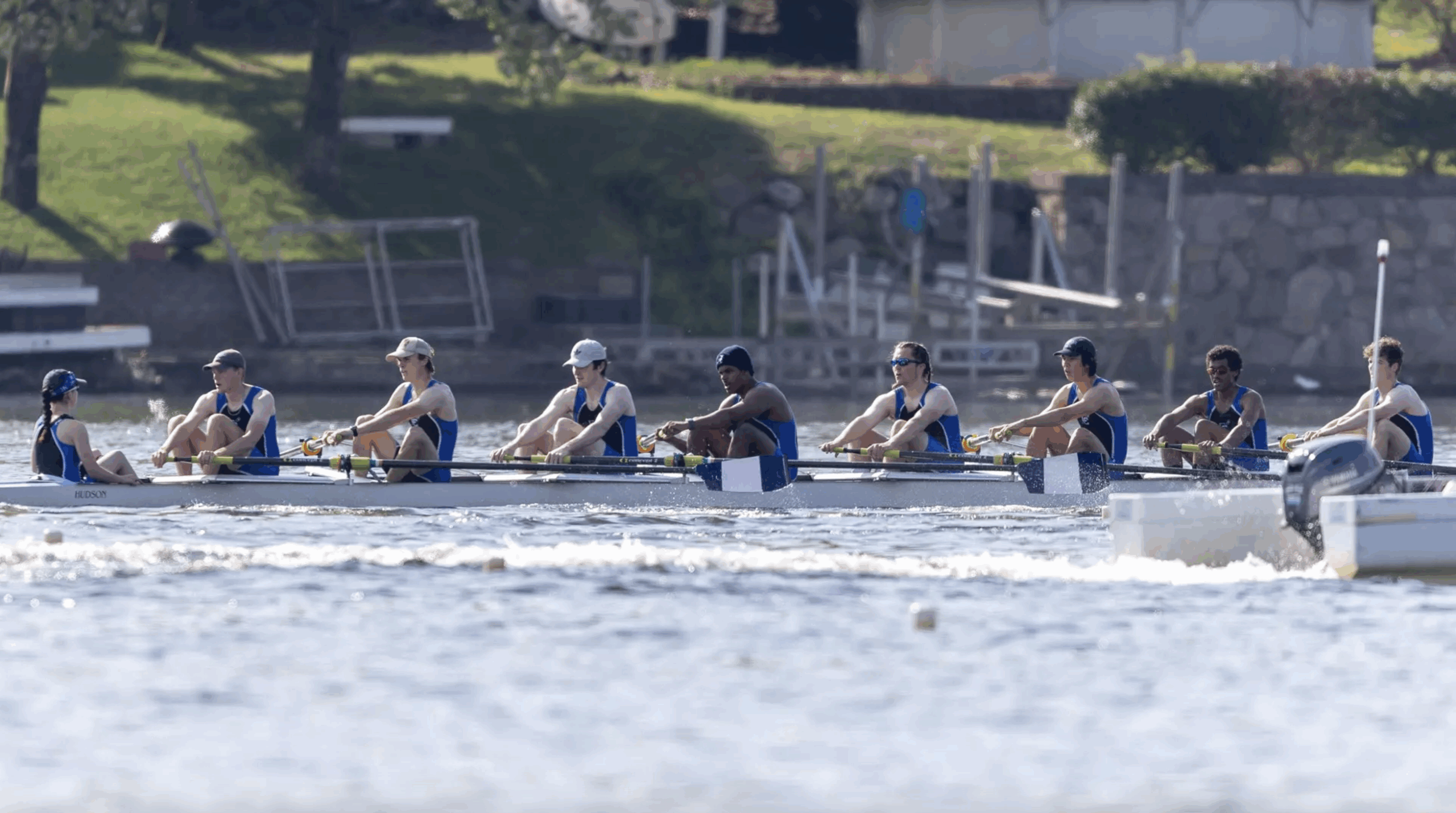
This installment features two Camels from the Connecticut College Men’s Rowing Team, John McCormack ’26 and Jake Cataldi ‘28.
John McCormack ‘26 is the Captain, 7-seat of the 1st Varsity Eight, and 3-seat of the 1st Varsity Four. He represented Connecticut College at the prestigious Head of the Charles Regatta this year. The Senior from Lunenburg, Massachusetts, plays a crucial role in team organization and translating timing through the boat.
Jake Cataldi ‘28 rows stroke seat of both the 1st Varsity Eight and the 1st Varsity Four. He also rowed in the Head of the Charles regatta this year. The Sophomore from East Providence, Rhode Island, is vital to setting rhythm and rate during practice and races.
Recently, The College Voice caught up with McCormack and Cataldi to discuss their roles and responsibilities on the rowing team, this year’s Head of the Charles, and the CC rowing team culture.
Can you please introduce yourself?
JM- Hi, my name is John McCormack. I’m double-majoring in biology and environmental studies here at Conn. In addition to being the captain of the men’s rowing team, I’m also the captain of the club alpine ski team and an officer on the environmental studies SAB.
JC- I’m Jake Cataldi. I’m a biochemistry, cellular and molecular biology major here at Conn on the pre-med track. In addition to being on the rowing team, I’m also on the men’s club hockey team and I’m a student advisor and a chemistry tutor.
What initially drew you to rowing, and what does rowing at Conn mean to you?
JC- I had never rowed before November last year. Actually, [I’m only] coming up on a year. Coach Cian [Noone] was nice enough to reach out to me and ask if I wanted to continue athletics at Connecticut College, despite not being on the men’s hockey team. I said yes, obviously. I was extremely ecstatic. Ever since then, I’ve learned the ropes. Thank you to John and all of the seniors who have helped me along the way. It’s been great. There’s a huge support system and rowing at Connecticut College, to me, means representing the school with integrity and dignity. Being able to compete at a high level against some of the best athletes around. And obviously, holding ourselves accountable with sportsmanship. And just representing the school to the best of our ability and racing to the best of our ability as well.
JM- I did not come to Conn with rowing experience. I spent my freshman year running on my own, so I had a base, then was convinced to join my sophomore year by a friend who thought I could be good at it. I gave it a shot, and I’m extremely happy I did. It was the best choice I made at Connecticut College. It seriously opened up just a new part of myself that I don’t think I would have discovered otherwise. Rowing at Connecticut College means competing at an extraordinarily high level with schools that are not only very competitive but also out of our division. It gives us a pretty legendary challenge and being able to push the program further and further each year is a pretty amazing opportunity.
What is your position in the boat, and what are your responsibilities?
JM- In the boat, I am [in] the 7th seat. This is the seat closest to the stroke, or the one who sets the timing. In terms of my responsibilities, I row on the starboard side which means my oar comes out of the boat on the left. I’m translating the rhythm that’s produced by the stroke down the entirety of the starboard side. I need to make sure that I’m on time and very well synced up with the stroke to ensure that my side is on time.
JC- My position in the boat is the stroke seat. If you’re looking at the boat, I am the last rower to cross the finish line. I am face-to-face with the coxswain at the front of the boat. I’m on the port side, so my oar comes out of the right side of the boat. My responsibility is to set the pace. We’re thinking in terms of strokes per minute so, when racing, we want to keep it high and also maintainable during the entirety of the race. I also work with the coxswain to make sure that the rate is on point and press is on point, which determines how fast we’re going in the boat. It’s wanting to set an appropriate rhythm so my 7th seat, John, can properly follow me. And then going down the whole port side, making sure that everyone can sync up hand-height-wise and rate-wise.
For readers who might not know, can you give a brief overview of what rowing is?
JM- Rowing is a very team-oriented sport, but at the same time, it’s also very individual. You’re taking eight different people and turning them into one machine. The individual training is extremely intense and very important, but even if you have eight people who are very fast but are disconnected, your boat’s not going to be successful. So, it’s combining high-intensity training with technical mechanics on the water that gets the boat to go fast.
What does a typical week of training look like, and how do you stay motivated during a tough piece or workout?
JC- In the middle of the season, when we’re at our peak, we are mostly doing steady state and trying to sync up [with] everyone in the boat, as well as doing high-rate pieces that simulate a race. Those will be typically twice a week, maybe three, depending on whether we have a race at the end of the week or not. But a typical week with a race would be steady, getting our form right, getting our cardio right, Monday, Wednesday, and Friday. Maybe a little bit of piecing on Friday just to simulate races, but Tuesdays and Thursdays are a little bit harder. We try to push the pace and test our cardio to see how far we can really push it. In the off-season, it kind of emulates the same thing. Right now, we’re in the ERG room five times a week. The sixth day, Saturday, is typically cross-training, so people can choose to ERG or run. We will be piecing on Tuesday and Thursday, so those are hard pieces that we can set a standard for ourselves. Monday, Wednesday, and Friday are typically steady, so we’ll go for an hour, sometimes breaking it up into three pieces, sometimes going all the way straight and just trying to maintain cardio and fast legs.
JM- It can definitely be hard to stay motivated at times. Rowing itself is definitely a grind, and I’d say when it comes to the sport itself, having a really good supportive team that holds each other accountable is huge, only because when everyone is suffering, when everyone is in excruciating pain on the ERG, you know the guy next to you is experiencing the same thing, it’s easier to push through. Additionally, we train so unbelievably hard just for a few minutes of competition, but then when you are competing and pass boats, it’s genuinely an indescribable feeling.
What inspired you to take on the role of captain, and what responsibilities come with it?
JM- I saw it as a great way to push myself out of my comfort zone. Having been asked to run the team the same year I joined was intense. However, I’d say my passion and love for it and the team is what drove me to immediately accept it. In terms of developing the team, I think I get the most enjoyment out of seeing everyone around me progress and seeing the team truly develop into something that’s competitive and to be proud of. I try to just lead by example, and hold myself accountable when it comes to pushing myself on the ERG or pushing myself out on the water or being there when no one wants to and getting the work done, because that’s what it’s all about. But at the same time, a big part of it is the amazing team culture we have. I’d say that’s probably the thing that I’m most proud of on the team, the team culture that we’ve developed over these past few years.
What lessons will you take with you, and what plans do you have for after graduation?
JM- I think when there’s a goal in mind, and you focus on that goal and pour yourself out into it, especially a communal one, you can really reap the benefits when hard work is applied. It’s less about controlling people and more about helping people find the same passion for the process. Post-grad, I’m planning on working for a year and then attending a grad school program for biology or ecology.
As the only sophomore racing among seniors in the Head of the Charles (HOTC), what has that experience been like?
JC- To be honest, I went down a very deep, dark, mental road the night before the race. I found myself questioning whether I had really earned it or not. I had to remind myself of the work that we accomplished in the fall, going from the off-season last year to the spring season to the summer, staying with it and staying motivated. I think it really paid off. I really want to echo John’s point in terms of a communal goal and that paying off. It is real and I want to take individual accomplishments out of it as much as possible, but at the end of the day, I really did work hard for it. When it came to racing in the Head of the Charles and racing all year, it was really about representing the guys behind me because I know that I’m nothing without them. Sure, I set the pace and sure, I can go pretty fast myself, but it doesn’t matter if I’m not setting an appropriate rate and something that the guys behind me can follow and push through with me. I had unbelievable and never-ending support from everyone. I never felt out of place. I didn’t feel like I was the youngest guy in the boat or the least experienced. It felt like we were in tandem and truly together. So thank you to everyone. Thank you to John, Parker, Ryan, and Samira for backing us up. The Head of the Charles was truly an unbelievable experience.
Have you always rowed in the stroke seat, or is it something you have worked towards?
JC- I had sat in the four and five-seat all last spring in the 2V. I really had no concept of keeping a rate and setting it for a boat myself — the first time I did was in September. I was put in the exact four that we had in the Charles for the first time. I was stroke seat and I really tried to focus and lock in. Ever since then, I kind of switched my mentality and I was able to obviously keep that seat and bring us forward.
What is the Head of the Charles and why is it such a big deal among the rowing community?
JM- The Head of the Charles is the largest regatta or rowing competition in the world. You see representation from thousands of boats in more than 50 events. You see mass representation from Olympic teams, collegiate teams throughout all divisions, club teams, and high school teams. It’s a massive deal because it takes place in Boston, which is the rowing Mecca of the United States. It’s also a pretty legendary course that’s known for its difficulty.
How do you prepare for a regatta, mentally and physically?
JC- When it comes to race week, the mentality is very different. I would like to say that we emulate the type of intensity at the beginning of the year when there are no races. The harsh truth is, when you know that you’re going to represent your school at the end of the week, it feels a little bit different. Mentally, it’s all about making sure you’re locked in. Physically, it’s about making sure you eat well, practice well, and practice how you want to compete. It’s all about being able to simulate that intensity throughout your training, not only right before a race but every time you step on an ERG, in the tank, or on the water. It really is a year-long preparation, but it all comes down to seven or fourteen minutes.
Could you describe the team environment this season, and one moment that’s made you proud?
JM- From my perspective as captain, the team environment is one of the most important components to me. Only because, without focus and without inter-team accountability, there frankly is nothing. One thing that I’ve really focused on is building everyone up and pushing people farther than they think they can, because that is what truly drew me to rowing when I first started. One moment that made me extremely proud was seeing our novice four freshman boat flying down the Wormtown Chase this fall. They’ve all worked really hard to get to where they are. It’s amazing to see how rowing has brought that group of guys together.
JC- I think the team environment is very wholesome and inclusive. It’s honestly something that I wasn’t really used to, so coming into rowing, even as a novice and as someone who had never rowed before, I felt I was treated like I had rowed my whole life. I’d been on the team as long as everyone else. That was really the biggest thing that kept me coming back, because sure, I can get on an ERG and push myself as hard as possible, but if I don’t feel the support of the people around me, it’s really not as enjoyable. I’ve only felt support from everyone and that’s really what’s important. One moment that made me proud this year was probably the medal. It was the silver medal at the head of the snake, my first medal in rowing. It was great to see the team come together and rally around us at the end of the day and to be happy for us. You don’t really feel that sense of your shoulders dropping and the sense of enjoyment until it’s over. That was something I’ll never forget: being able to see us fly past boats, be rewarded, and get that reassurance that the work we’re doing is really paying off.
What’s a funny or memorable moment from this season that stands out?
JC- One of the funniest moments of the season was when Coach Cian told us how old he was and I said, “That’s it?” Everyone erupted into laughter and it’s a moment I’ll hold close to me for a while.
JM- One of my top funny moments from this season was at the very start of our welcome barbecue, where the men’s and women’s teams were supposed to intermingle. The women’s team had a very nice barbecue and the entire men’s team decided that they wanted to catch crabs using strings with chicken legs attached to them.
Is there anyone you want to shout out or any final statements you’d like to make?
JM- I definitely want to shout out Coach Cian and Coach Charlie [Berman] for their unwavering support and their dedication to the team. I know I wouldn’t be here without Cian’s support and without his coaching. He’s truly shaped me into the rower that I am today, and I’m incredibly thankful for it. I also just want to shout out the entire team because we’re really grinding this year and raising the bar. As someone in a leadership role, I could not be happier to see people truly getting after it.
JC- Obviously, I want to start by shouting out Coach Cian and Coach Charlie for their giant support and for giving me the opportunity to become a rower. It is the best decision I’ve ever made at Conn, and I couldn’t be more thankful. Shout out to the team and definitely shout out to John. He’s been the best captain I’ve ever had, and he’s really pushed me, and I couldn’t be happier to be leading them in the boat.