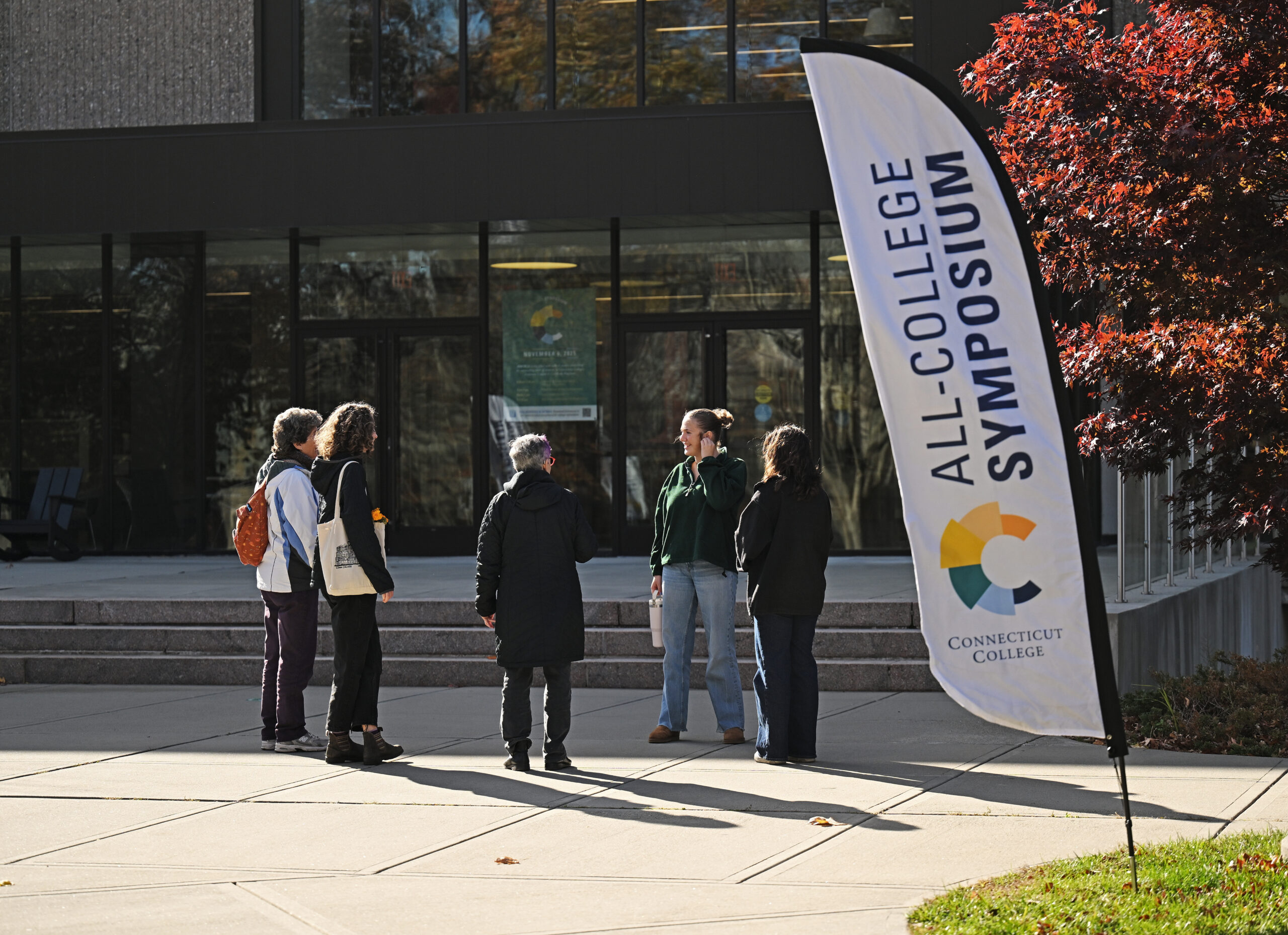
Images Courtesy of Sean Elliot
The seventh annual All-College Symposium at Connecticut College took center stage on November 6, 2025, creating a day-long celebration of integrative student scholarship and creative inquiry that brought the campus community together. Seniors showcased the culmination of their interdisciplinary research from the college’s centers, pathways, and certificate programs, an event fully embraced by students, faculty, families, and community members alike.
The day stood out as a hallmark of the Connections curriculum, unique to college and present since the early 2000s, which encourages students to explore their academic, civic, and global interests through multifaceted lenses. Conn suspended its usual classes to accommodate the symposium, giving space for students to engage audiences either in panel discussions, poster presentations, or engaging performances. Over 190 students participated, presenting in front of peers, mentors, and visitors in the atmosphere of spirited intellectual exchange that defines the college’s liberal arts ethos.
A festive gathering at 4 p.m. in Cro ’41 Room at the end of the day offered moments to cheer on classmates, friends, and family members. The Holleran Center’s now-traditional afterparty continued the celebration, fostering camaraderie and connection beyond the formal presentations.
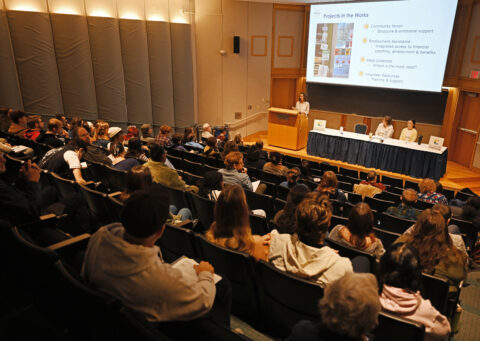
Lucy Koester presents “Ethical Participation in an Unethical System: Partnering with the NLHHC” during the Holleran Center panel session “New London Engagement and Beyond.” at the Seventh annual All-College Symposium Thursday, November 6, 2025.
The Ammerman Center for Arts & Technology, moderated by Professor Rachel Boggia and Director Steve Luber, launched the day’s innovative tone with projects blending art and technology. Joseph Gendron’s ‘26 animated exploration of autistic development, “Au-nimation,” combined personal narrative with digital artistry, while Maria Girgis’s cutting-edge inquiry into AI’s role in creativity asked provocative questions about future artistic collaboration. These presentations made palpable the center’s mission to fuse technology with human expression.
At the Center for the Critical Study of Race and Ethnicity (CCRE), Professor Leo Garofalo moderated students whose research confronted pressing issues of race, identity, and justice. Priscilla Ameyaw’s ‘26 “Reflections in Black” swept across continents to reveal deep histories of racialization and resistance. Gaby Henao’s study of colorism in Latinas revealed how historical biases continue to shape identity today. Meanwhile, Nina Bakum’s ‘26 analysis of maternal mortality spotlighted healthcare inequities grounded in the built environment, urging critical reflection on systemic barriers.
Environmental concerns took center stage at the Goodwin-Niering Center for the Environment, where Professor Doug Thompson moderated presentations on the ecological threats of PFAS contamination and innovative community partnerships in urban forestry. Students like Caitlyn Rodeo ‘26 and Paloma Doyle ‘26 blended scientific rigor with community engagement to chart sustainable futures for New London and beyond.
The Holleran Center’s Program in Community Action (PICA), moderated by Andrew Lopez, Rebecca McCue, and Deb Brunetti, featured projects that delivered real-world impact. Dina Isakov’s ‘26 work on expanding pathways to STEM education and Sophia Williams’s ‘26 historical policy analysis on midwifery, among others, spotlighted a profound commitment to social justice and community activism, framing academic inquiry as a tool for transformative change.
The Toor Cummings Center for International Studies and the Liberal Arts (CISLA) showcased research that crossed borders and disciplines. Stephanie Reyes Bravo ‘26, presenting her project “Más que madres: maternal health and the invisible struggles of motherhood,” combined her academic work with firsthand experience from her pediatric internship in Barcelona. She reflected, “Being abroad has shaped the way I want to practice medicine,” exemplifying the power of experiential learning.
In the Museum Studies Certificate Program, moderated by Professors Christopher Steiner and Jenifer Ishee, students explored cultural narratives and preservation. From Isabella Welch’s ‘26 inquiry into Puerto Rican diasporic identity in Connecticut to Samantha Chapin’s ‘26 study of iconoclasm, these projects illuminated the intersections of history, memory, and cultural stewardship.
Across the campus, the nine academic Pathways formed the pillars of the symposium’s inquiry. The Creativity Pathway, under Professor Greg Bailey, inspired deep engagement with artistic processes and technological frontiers. Palmer Okai’s ‘26 provocative presentation, “The Death of Human Thought? What AI Could Mean for Human Creativity,” questioned how artificial intelligence might reshape the very nature of creativity, kindling dynamic conversations about the future of human imagination.
The Data, Information, and Society Pathway focused on using data ethically and effectively in fields as varied as social good, energy markets, and sports analytics. The Entrepreneurship Pathway linked business acumen with social responsibility, showcasing projects that engaged with financial literacy, generative AI in finance, and community-centered business models.
In the Food Pathway, moderated by Professor Jeff Cole, presentations ranged from the cultural significance of Parisian boulangeries highlighted by Kendall Ziady ‘26 in “Daily Bread, Daily Life” to Sophie Colbert’s ‘26 attention on improving nutrition in New London. These projects encapsulated the ways food intersects with culture, health, and community well-being.
The Global Capitalism Pathway, moderated by Professor Sarah Queen, tackled systemic economic inequalities and social ramifications worldwide. Presentations interrogated the socio-economic impacts of tourism, asset management’s global power, and persistent poverty in the United States, underscoring the way global systems sculpt local realities.
In the Media, Rhetoric, and Communication Pathway, moderated by Professor Jeff Strabone, students examined how media shapes public discourse, with Caroline Snyder’s ‘26 study of weather education during the Trump administration and Peyton Lusk’s ‘26 analysis of U.S. immigration rhetoric underscoring media’s power in societal narratives.
The Peace and Conflict Pathway, moderated by Professor MaryAnne Borelli, surveyed the ethics of international relations, refugee protections, and leadership. Students interrogated historic U.S.-Iran relations and how media coverage influences human rights, offering vital perspectives on contemporary geopolitical struggles.
The Public Health Pathway, moderated by Professors Ana Lilia Campos-Manzo and Martha Grossel, melded cultural history with current health challenges. Students explored everything from deinstitutionalization history to the incorporation of Indigenous Hawaiian medicine into Western healthcare frameworks.
The Social Justice and Sustainability Pathway, moderated by Professor Leo Garofalo, addressed urgent social-ecological challenges. Declan Hunter’s ‘26 research on the Ipswich River, one of the nation’s most endangered rivers in 2021, highlighted the critical role of education in water conservation. His reflections on the Cape Town water crisis of 2017-2018 included the compelling insight, “Solutions should start in schools, but adult education is crucial too.” Eve Geissmann ‘26 shone a light on immigration and religious identity in France, drawing from her internship with Witness Mass Incarceration Inc. and observing that “Policies are crafted at the top but mostly affect people at the bottom.” Charles McLean combined Indigenous knowledge with environmental studies to propose frameworks of sustainability, having The New History of Everything as a recommended book for everyone.
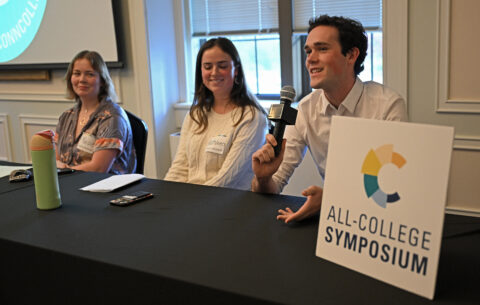
Maisie Higgins ’26, Kathleen Edison ’26, and Palmer Okai ’26 answer questions during a Creativity Pathway penal session at the seventh annual All-College Symposium Thursday, November 6, 2025.
Presentations encompassed diverse scholarly and personal inquiries consistent with Connecticut College’s integrative academic approach. This year marked the return of the All-College Symposium to the fully reopened Crozier-Williams Hall (Cro), enabling students in the largest class on campus, the Class of 2026, to exclusively present a spectrum of research projects advancing toward senior theses. The scheduling adjustment that moved Thursday’s classes to Friday to accommodate the symposium presented challenges, as some professors faced conflicts that prevented holding classes on the new day. The symposium remains a key academic event at Connecticut College, providing an official forum for students to present their work developed through the Connections curriculum.