Courtesy of the Connecticut College Government/International Relations SAB
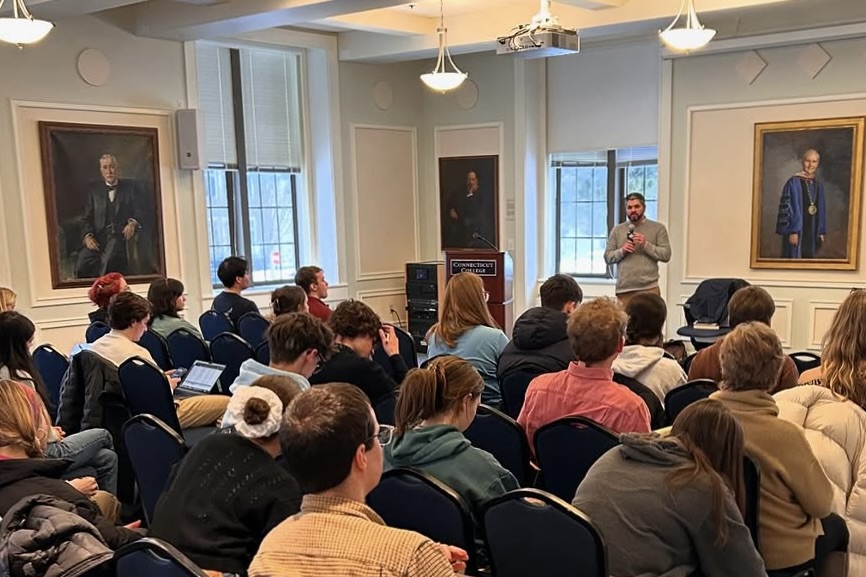
On Thursday, October 24 at noon, students and faculty gathered in New London Hall 204 for the Government and International Relations Student Advisory Board’s Brown Bag event featuring Professor Eric Fleury, Ph.D., Associate Professor of Government and International Relations. Professor Fleury, who joined Connecticut College in 2019, earned his B.A. from the College of the Holy Cross and both his M.A. and Ph.D. from Baylor University.
During the talk, Professor Fleury reflected on his experiences at Baylor University, speaking about the mentors and researchers who shaped his work and academic path. He discussed his early graduate years, including the challenges of grading papers as a teaching assistant, the feeling of publishing his first peer-reviewed article, and the experience of not being a legacy academic. As the first in his family to pursue doctoral studies, he noted that he “did not know anyone around [him] in academia” when he entered graduate school.
He explained that mentorship played a pivotal role in his development, citing one of his professors at Baylor, David Clinton, as central to what he described as his “AHA moment” in academia. Clinton, who advised his dissertation, later said he was “very proud of his accomplishments.
Throughout the discussion, Professor Fleury bridged his personal background with his research in dictatorship, terrorism, and the dynamics of political power in the United States. Reflecting on public consensus, he remarked, “It is very difficult to impose something contrary to what the majority wants.” In response to a question about what citizens can do under the Trump administration, he added, “Sustained protest matters, in the grant’s political context,” emphasizing the importance of continued public engagement as a form of political resistance.
Professor Fleury also addressed how his research extends to recent studies of technological influence and the political use of artificial intelligence. Discussing visual propaganda and the use of AI by President Donald Trump, he said, “I once saw a picture of Trump as Rambo. You are writing on a fictional picture of a fictional couple. The fakeness is about everything, about shoving it down people’s throats; the fact that it is not real doesn’t matter; it’s a tool of psychological warfare.”
He compared Trump’s political strategies to those of previous leaders, observing that “Reagan did a better job at getting a majority and picking on the minority.” Professor Fleury also described how media spectacle has become a defining feature of modern governance, saying, “Trump is a television personality, that is how he governs, seeing this as a show in which he will take what happens to be at hand. He takes what he thinks will look good, and his personal political advantages.”
Turning to public unrest and protest movements, Professor Fleury reflected on the changing forms of domestic conflict: “In the first term, you had Antifa, Black Lives Matter; now Trump wants war in the streets—wars that look good, chaotic—to claim authority. With the war on terror, he watched Jan. 6 and was disappointed that Mike Pence was not killed.”
The conversation included contributions from faculty, among them Professor Borer, who asked, “How do you frame in the lack of pushback… where is the pushback from the people that are supposed to care?” Professor Fleury responded that he did not think there was a real absence of pushback, but rather that the presidency holds an unusually high degree of concentrated power. He said, “Trump is not the first president to abuse his presidency. Obama had American citizens killed without due process. Anyone with that much power is going to abuse it. I think of Spencer Ackerman seeing Trump as the ultimate culmination of the war on terror to use the power base against people he doesn’t like, as a continuity of Bush, Obama, and Biden.”
He added that public support for the war on terror shaped the political climate for over a decade. “The majority supported the war on terror, the war on Iraq was popular until it wasn’t,” he said. “There wasn’t a lot of pushback on the lack of due process.”
In analyzing current political scandals, Professor Fleury commented, “The Epstein files are the closest thing that could bring down Trump in the way that Joe McCarthy did, but I don’t think that would be enough.”
Throughout the event, Professor Fleury’s remarks highlighted connections between mentorship, scholarship, and political power. Drawing on his research, he examined both the concentration of executive authority and the social conditions that enable it. The event underscored recurring themes in his work: how majorities shape legitimacy, how sustained protest sustains democracy, and how political leaders from Reagan to Trump have wielded performance and perception as instruments of control.
As the event wrapped up, attendees stood along the walls of New London Hall 204, as all available seats had been taken. Professor Fleury had brought grape pie to share with the audience, adding an informal touch to the discussion. After taking several questions from students and faculty, he concluded the session and left for his 1:15 p.m. U.S. Foreign Policy class. The packed room and engaged crowd reflected the strong interest in his discussion on mentorship, protest, and the powers of the modern presidency.