Courtesy of Cece Flosman ’28
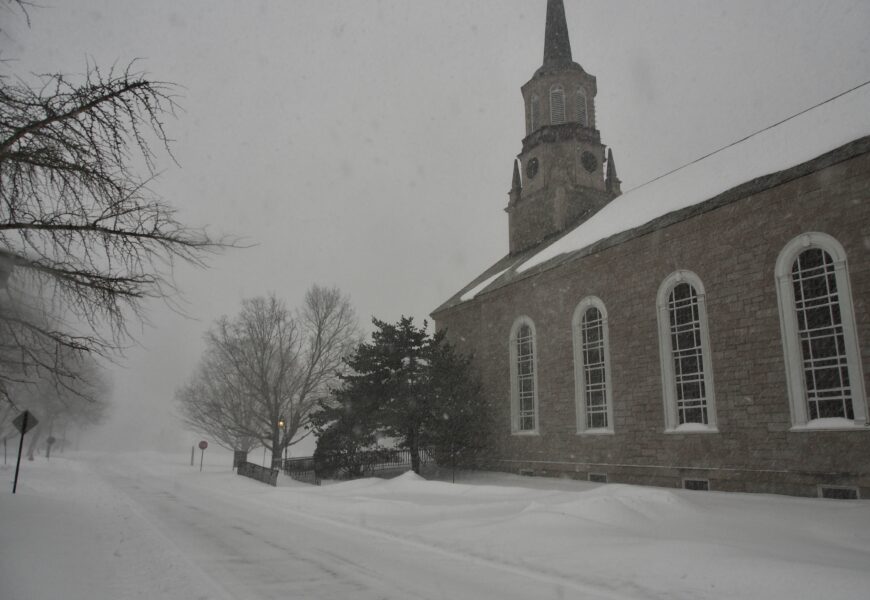
Connecticut’s recent once-in-a-century snowstorm brought feet of flurries and canceled classes, allowing students to savor the snowfall from Sunday, Jan. 25 into Tuesday, Jan 27. Still, few students are familiar with the reasoning behind weather-based college closures, delays, or snow day announcements. In an effort to better understand when and why cancellations may be necessitated by the logistical challenges posed by such a large storm, “The College Voice” sat down with Justin Wolfradt, Connecticut College’s Associate Vice President for Facilities Management and Campus Planning. Our subsequent conversation provided insight into the timing of closure announcements, reopening protocol, in-storm facilities work for student safety, and everyday facilities operations.
As shared by Wolfradt, the Associate Vice President for Facilities Management and Campus Planning “provides senior leadership for the College’s physical, operational, and environmental resources” as well as “collaborates closely with campus and external partners, guides facilities planning and space management, stewards financial and physical assets, and leads the implementation of the College’s master plan to support academics, student life, and responsible campus growth.” Wolfradt also serves as a key member of the College’s opening team.
Per Connecticut College, “Weather-related decisions are evaluated collaboratively by the Associate Vice President for Facilities Management and Campus Planning, Director of Campus Safety and Emergency Operations, and Vice President for Marketing and Communications, in consultation with the president.” Behind the scenes, this team works to monitor the forecast as well as campus conditions in order to provide an opening or closure recommendation to the president. In an effort to prepare for Jan 26’s storm, meetings were held a week in advance of the forecasted weather onset—though the decision to close campus was not made until much later, as drastic differences in weather reports make it difficult to establish how much snow campus will truly receive. As explained by Wolfradt, the forecast will often predict several inches of snow, yet the College will see only rain due to its proximity to the coast, meaning “decisions regarding closures, delayed openings, or early dismissals are typically finalized in the early morning hours.”
Though many may anticipate such decisions are made on the premise of road conditions or sidewalk accessibility, Connecticut College calculates whether to stay open based on a per inch estimate of how many hours it will take to clean snow in front of emergency exits. On Tuesday, Jan 27, for example, the delay for Tuesday’s reopening was not communicated until 5 am as a result of additional overnight snowfall. At around 6 o’ clock on the eve of the 26th, around 12-14 hours of work were left. Still “once we got up, 4 o’clock in the morning, we reassessed,” Wolfradt clarified. “Another inch delayed further cleanup.” Moreover, the reopening email sent on the 26th was not intended as an indicator that classes would be held the following day.
Throughout the storm, facilities employees worked around the clock to manage snowfall impact on campus operations, as the college would remain closed for days on end absent real-time cleanup. “During [the] initial event, your goal is to keep primary access areas open,” stated Wolfradt. The effort was made possible by Connecticut College’s hybrid partnership with Mountain View—which facilitates contractor access and staff augmentation towards increased labor—leading to a taskforce of 20-30 shovelers on short notice through a mix of in-house and contracted staff, and providing the college with specialty equipment. Such benefits have made an exponential impact on cleanup, according to Wolfradt. “We were able to bring in extra trucks fitted for snow…We only have one loader, we were able to bring in additional loaders and additional skid steers.” These additional trucks and loaders helped the College mechanically remove piles of snow from streets and parking lots to ensure the college’s reopening.
Given the significance of this particular storm’s snowfall, the hybrid grounds crews worked around the clock to help ensure the college could open. Their work included “clearing and reopening parking lots, widening pedestrian pathways, knocking down snow piles that create visual impairments for both drivers and pedestrians, addressing known hazards, and maintaining emergency access routes.”
The residential status of the College means that there are challenges which differ greatly from municipal streets or private properties. “Unlike towns where most vehicles leave during the day, student parking lots remain largely full during storms,” said Wolfradt. “Plowing lots packed with vehicles is not only ineffective, but it can also damage cars and equipment and create unsafe conditions for operators and pedestrians.” Given the ineffective ability to plow full lots, Wolfradt stated that “the safest and most effective approach is to ask students to temporarily relocate vehicles so that lots can be properly cleared, scraped, and treated for ice.” In the case of the recent snowstorm, a parking relocation schedule was instituted requiring all cars to be vacated from South, North, and West (gravel) lots by 7 pm on Tuesday, Wednesday, and Thursday for each lot, respectively. This allowed facilities to remove piled snow from the lots, and to keep the campus operational.
Much of the College’s maintenance work too is outsourced. After struggling to fill maintenance positions, Connecticut College found a solution through partnership with a company called SMG. “In Facilities, we were at 40% filled…60% of our workforce was vacant,” Wolfradt confessed. “You just can’t operate or maintain a campus with those numbers.” Indeed, 0% of positions were filled in plumbing and 0% were filled in HVAC. “We just weren’t able to attract or retain [skilled trades].” Following partnership with SMG, over 90% of positions are currently filled. Wolfradt further implied former staffing shortages may have been in part caused by the College’s compensation structure. “This younger generation is more concerned about the hourly rate rather than the benefits,” opined Wolfradt. “One of the things that makes us attractive to potential employees is our benefits.” In contrast, regional competitors in Southeastern Connecticut such as Electric Boat are able to pay higher hourly rates to skilled trade workers.
Though the predicted biggest storm of the season is now behind us, Connecticut College students may rest easy knowing potential college closures are carefully considered by Wolfradt, Director of Campus Safety and Emergency Operations Mary Savage, President Andrea Chapedelaine, and other campus officials. Should the string of blizzards continue, students may typically expect a decision on class cancellation at or before 5:15 am on the day of the storm. Again, emergency exits must be accessible in order to allow the college to safely reopen—area school closures may be taken into account, but Connecticut College’s residential status means the campus may reopen when commuter schools are shuttered.
Further information on college operations and campus projects can be found in Wolfradt’s monthly Facilities Management and Campus Planning Spotlight emails sent out to the college community. Community members who need mobility assistance or have accessibility concerns are encouraged to contact Campus Safety at (860) 439-2222 for support, especially during severe weather conditions.