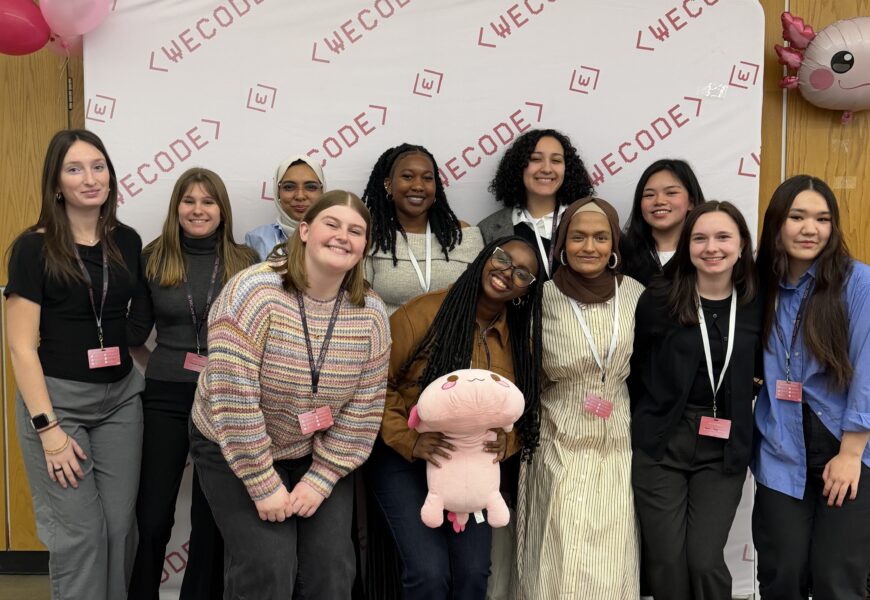
Courtesy of CC Girls Who Code
As much of New England braced for what would soon become the (second) Blizzard of 2026, members of Connecticut College’s Girls Who Code College Loop were already in Cambridge, Massachusetts, representing Conn at Harvard’s WECode, the world’s largest student‑run women‑in‑tech conference. The two‑day event, held February 21–22, unfolded just as snow began sweeping across the region, but inside Harvard’s halls, hundreds of women and nonbinary technologists gathered to share ideas, build networks, and redefine the future of technology.
For Girls Who Code Connecticut College, led by co‑president Sababa Ahmed ’27, attending WECode marked both an educational milestone and a statement of intent. The club, which officially launched in the fall of 2025, aims to strengthen the community of women in technology at Conn. “Women in tech—this is still a very small group of people around the world, and at Conn, we are a very small group,” Ahmed said. “Even if you look at the CS department, we only have one female professor. Where everyone tries their best to help, I felt like there were still some gaps.”
Ahmed had heard that students had previously tried to start a ‘Women in CS/Tech’ organization, but it never gained college approval. “They mentioned it would serve the same purpose as Equity in STEM,” she explained, “but tech and computer science are broad and diverse fields in themselves, and that earlier group was really doing the work.” Seeing that gap, Ahmed decided to act.
“I knew about Girls Who Code since high school,” she said. “That’s why when I got to know that you can start their college loop, I immediately consulted Professor Chung if we could do it, and she approved. Then, last summer, I started working on it and got approved by Girls Who Code HQ, and from last fall, we started our work. My main goal is to make a community for the women who are interested in tech and computer science, and get them resources and opportunities from around the world.”
The trip to Harvard for WECode was one of the club’s first major events since it was founded. “I got to know about this conference in my freshman year, as some of the CS seniors were attending the conference that year,” Ahmed said. Once she became co‑president, she saw WECode 2026 as the perfect opportunity for the group to engage directly with peers and professionals across the global women‑in‑tech network.
“This conference is only for women and nonbinary individuals in tech, where you can meet all the industry professionals who are also women,” she explained. “So, I thought it could be a great opportunity to learn from a lot of these people and connect with them. You could also meet other students from universities who are working in the same field from around the world and learn about their different experiences and backgrounds.”
That mix of industry leadership and student collaboration made WECode stand out. Among the speakers, Françoise Brougher, CEO of Pebl and former COO of Pinterest, left a deep impression on Ahmed. “The opening keynote speaker, Françoise Brougher… opened her speech saying, ‘I have never given a speech before all the women in tech and engineering,’” Ahmed recalled. “I think that time I realized how big it was and how significant the term ‘women in tech’ is.”
She also drew inspiration from Grace Lee, Head of Design for Verticals at Logitech. “As someone who wants to work on the creative side of tech, her work and talk motivated me so much, and I definitely want to be like her one day,” Ahmed said.
For Ahmed, these moments represented something larger than professional advice—they offered a vision of what inclusion in tech can look like. “Since the field moves so fast, you have to keep up,” she said. “Being around so many people who are passionate about technology made me realize how valuable it is to have spaces like this.”
The conference also connected Conn’s Girls Who Code chapter with others nationwide. “We met other people who also work with their Girls Who Code College Loop at their college,” Ahmed said. “We learned about their work at their college, and got ideas. I think we are definitely going to implement them.”
Back on campus, those exchanges are already shaping new programming goals. “We plan to host more workshops that prepare students for the industry,” Ahmed said. “We want to host coding workshops, résumé workshops, and many more like that. In April, we are planning to host a résumé workshop related to the tech industry.”
Ahmed hopes these efforts will make tech at Conn more welcoming and accessible for women and nonbinary students. While she appreciates the encouragement from professors and peers, she recognizes that many students still see computer science as intimidating or exclusive. By hosting collaborative, skill‑based sessions, the club aims to lower barriers to entry.
“My main goal,” she reaffirmed, “is to make a community for women who are interested in tech and computer science, and give them access to opportunities from around the world.”
Through WECode, Ahmed and her peers saw what that global community could look like, a network of students and professionals who share a common purpose but bring a wide range of ideas, backgrounds, and ambitions. For a new club on a small campus, it served as both inspiration and affirmation.
The Connecticut College delegation returned home with a clearer sense of how to grow and sustain that network locally. “We learned about their work and got ideas,” Ahmed said again, emphasizing the momentum the conference created. “I think we are definitely going to implement them.”
For Ahmed, those lessons extend far beyond one weekend in Cambridge. WECode reminded her why visibility and solidarity matter in a rapidly evolving field. The path ahead for Girls Who Code at Conn may still be taking shape, but the foundation is strong: a commitment to transformation through community.
“It made me realize how big this is,” Ahmed said, recalling Brougher’s keynote. “How significant ‘women in tech’ really is.”