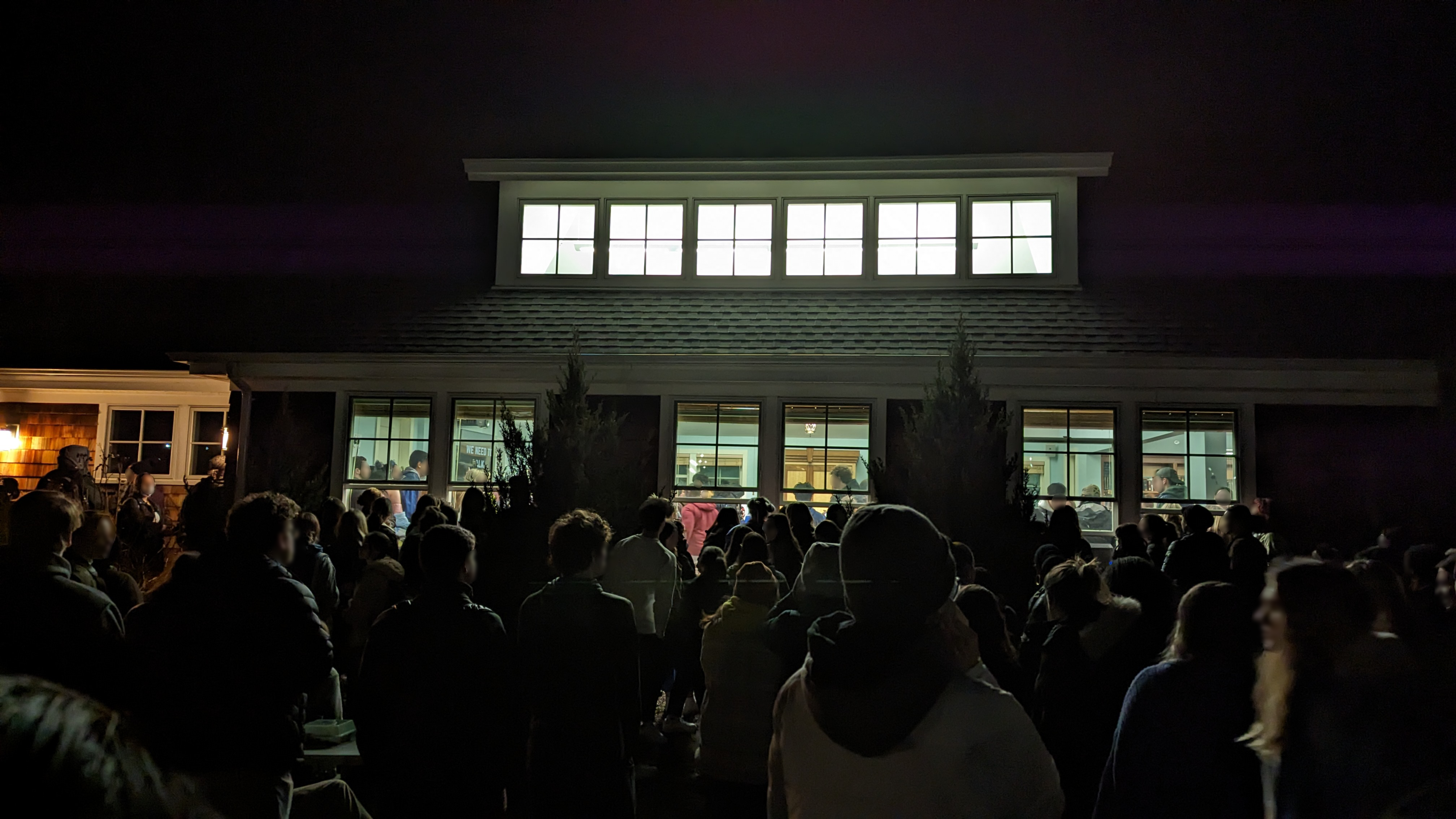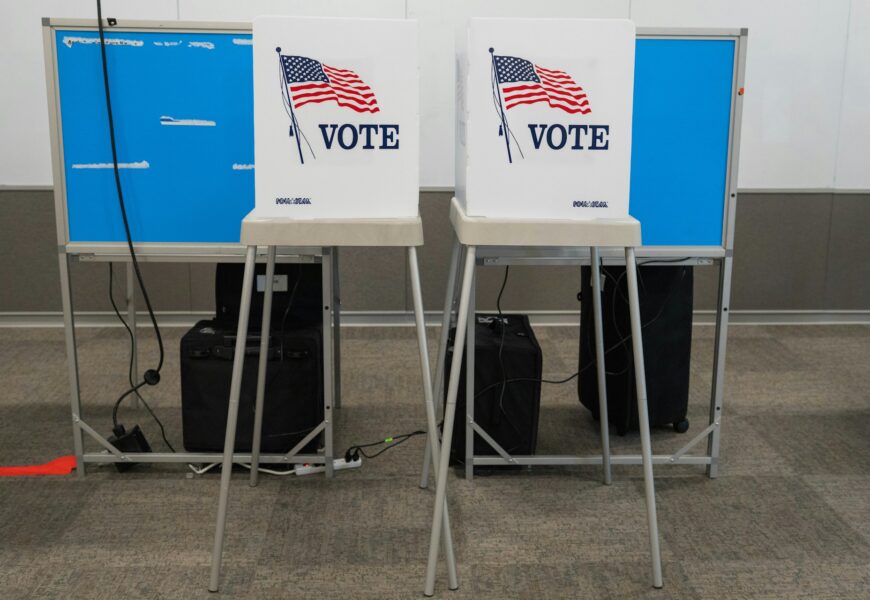
Courtesy of Jesse Paul
NEW LONDON, Conn. — For the party in power, midterm elections are often an indictment of the job they’ve done while in control of Congress and the White House. And as recent history would suggest, President Donald Trump and his Republican Party are likely to lose seats in the House, leading to a return of Democratic control in that chamber. But the expectation is no longer that Democratic gains will be confined to just the House, as a cocktail of frustration over persistent high prices, an ongoing war in the Middle East, and the Trump administration’s immigration posture, has now put the Senate in play, too.
While Connecticut is not one of the states that’ll be receiving significant attention on election night, given its status as a reliably blue state and lack of any competitive races for federal office, the issues voters here care about are ones shared by voters in battleground states.
For those casting a ballot in Ohio, Michigan, Georgia, North Carolina, and Maine, polls indicate that the cost of living, and the economy overall, will play a significant role in who they choose to elect to the U.S. Senate. Two of these states are uniquely vulnerable to recent economic headwinds: one has a Republican incumbent in its Senate delegation, while the other is one that Republicans, in the wake of 2024’s presidential election, saw as an easy pickup opportunity.
Maine
Sen. Susan Collins (R-Maine) has managed to hold onto her New England Senate seat, as a Republican, by presenting to voters a moderate image and, at times, willingness to vote with her Democratic colleagues across the aisle. But amid President Trump’s deep unpopularity in the northeast; his trade war with Canada, to which Maine is uniquely exposed; and the July killing of 25-year-old Johan Sebastián Durán Guerrero by Immigration and Customs Enforcement, which took place in her state, Collins will have to defend her record under difficult conditions for any Republican in competitive territory — let alone one representing a blue state that has seen, up close, the impact of the current administration’s policies.
Michigan
With the retirement of Sen. Gary Peters (D-Michigan), it’s Democrats who are playing defense in this Great Lakes battleground. The party’s nominee to replace Peters, former Detroit-area public health official Abdul El-Sayed, faces former Republican congressman Mike Rogers. Behind the GOP’s confidence in purple Michigan, despite not winning a U.S. Senate seat there since 1994, are a couple factors — the first being that Trump narrowly won Michigan in 2024. The other is that Rogers, the Republican nominee in this year’s Senate race, was also the party’s nominee in 2024’s Senate race. And while he lost to Democrat Elissa Slotkin in the race to replace then-retiring Senator Debbie Stabenow, he did so by only 19,006 votes (in a race where over 5.4 million ballots were cast). Because of that close margin, and name recognition created by his last campaign, there’s a sense that he can win this year. But the same headwinds impacting Collins’ race in Maine threaten to hurt Rogers’ candidacy in Michigan: high prices (particularly for diesel, as a result of the war in Iran) and the ongoing trade war with Canada, a country to which Michigan’s economy, like that of Maine, is greatly linked.
ICE actions in Minnesota, Texas, and Connecticut
In states where Democrats are favored, such as Minnesota, and in those where they’ve started to gain momentum, like Texas, ICE actions have become a key issue. In those states, immigration operations have been fatal. Examples include 37-year-olds Renée Nicole Good and Alex Pretti, who were fatally shot in Minneapolis earlier this year, and 52-year-old Lorenzo Salgado Araujo, who in July was fatally shot by an agent in Houston.
While Connecticut has not seen fatalities as a result of immigration enforcement actions, that doesn’t mean ICE hasn’t had a presence in the state. The agency’s increased activity, beginning in late summer, led Gov. Ned Lamont (D-Connecticut) to express, in no uncertain terms, that he was personally opposed. The governor said, in an August 26th statement, that “Connecticut does not want, nor do we need, the type of presence ICE has had in our state this week. Connecticut has some of the lowest crime rates in the country, thanks to the excellent work our state and local police do to keep violent criminals off our streets.”
“Rounding up people at random to fill a quota does not lower crime. It traumatizes families and communities,” he added.
Days earlier, the Department of Homeland Security said in a statement that a joint operation between it and “federal law enforcement partners” led to the apprehension of 65, what it referred to as, “illegal aliens.” DHS stated that those detained during the operation “are expected to remain in ICE custody pending the outcome of their removal proceedings or their deportation from the United States.”
The governor’s office, as well as advocacy groups, remind people that they do have the right to remain silent and refuse to be searched if approached by immigration agents.