Courtesy of Stan
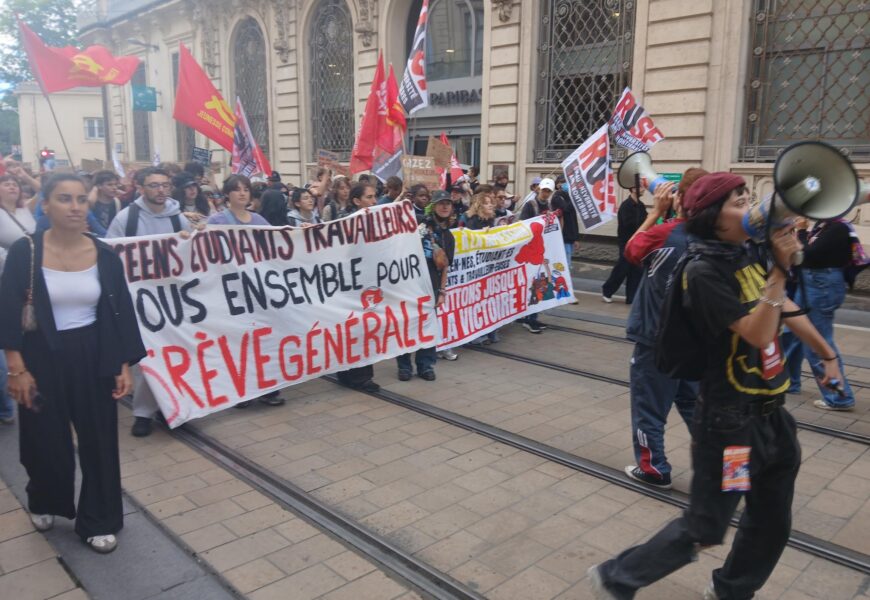
What began on September 21 as a small student and teacher strike at Saint-Exupéry high school, or lycée, in the suburbs of Paris, has become, in a few short weeks, an international student and worker movement with France at its center. Lycée students led these strikes and protests, citing underfunded and neglected lycées, underpaid and overworked teachers and staff, and deep concerns for their career and university futures in a struggling country.
The movement has grown in the past several weeks to include labor unions and political organizations, and has spread across the nation.
Protests have gained international media attention for the violence of the interactions between youth protestors and police—including the use of tear gas and stun grenades—as well as the striking videos caught of the Mayor of Saint-Denis, Bally Bagayoko, putting himself between the student protestors and riot police.
The movement has also directly mimicked aspects of past protests in France, from marching on the Bastille to recreating the tactics and images of the 1968 French youth protests, which also concerned, in its origin, poor university conditions.
In response to protests and looting on October 17, a day of increased action around the nation, the French government introduced a coming ban on ‘illegitimate’ protests, limiting the legality of student protests, as opposed to those from labor unions or political organizations. Certain incidents from that weekend of protests went viral online after young men looting Sephora and similar makeup stores took bags of gifts for their girlfriend, as social media has played an integral role in the spread and outreach of the student movement.
Another viral quote from a young person on X read, in translation, “we smash windows BECAUSE WE’RE NON-VIOLENT… if we weren’t, we’d be like you: we’d aim for the head.”
Across Europe and the rest of the globe, young people and workers of all ages have responded to the French student movement with their own protests, either in support of French youth or in resistance to issues in their own nations.
Housing protests in Spain, concurrent with the start of the French student protests and later intertwined, were sparked after the eviction of an 87-year-old woman from her home, who passed away a week later.
Across Brazil, primarily in Rio de Janeiro, young people have organized mass protests ahead of their presidential elections and against the far-right candidate and former president Jair Bolsonaro.
Students in Greece, Germany, Italy, and further internationally, have begun strikes in solidarity with the French movement.
A Student’s Perspective
Stan, a university student and political activist in Montpellier in the south of France, spoke with me after yet another night of confrontations on October 22. Although it was only supposed to be a night where students assembled to discuss current issues with one another, he and other students had been alerted that 30 student activists on another campus were “trapped and surrounded by police officers… we stopped the meeting to spring the comrades out,” Stan said.
Although they successfully got the other students released, they were collectively tear-gassed during the confrontation.
At Stan’s campus, which students have occupied for the last two weeks, halting all classes, “there’s students protesting and others, students studying some place else, people who aren’t students anymore, all building the movement together.”
Their demands range from general to more specific to their campus– two of the main demands concern how “now, if you’re a foreign student not from the European Union, the fees raised to around 3,000€ for a bachelor’s and 4,000€ for master’s degree… and [how the university hired a company] to give classes on campus on renewable energy, asking one of the highest-polluting companies in France to give these classes,” Stan said.
“The movement started with the high school kid movement, with very down to earth demands,” Stan reported. “It has spread to everything— what we understand is that we are fighting for basic demands, but they are fighting for a right to a future. It connects to everything, to climate change, to Palestine,” he said.
Although the response from international media has often been critical to the young people protesting, he believes that “what we see is a new generation; people have been saying that they only care about games, they’re materialistic, nothing in their brains– this generation in France were the first ones to rise up two weeks ago, they’re not afraid of the police. The response from the government, between carrot and stick, was only stick. One kid lost all his teeth because a cop threw a [stun] grenade in his face, two kids lost limbs because of the kind of grenade. This new generation that everyone has been saying bad stuff about– their brains are filled, they’re filled with politics and understanding, much more than their older counterparts.”
“This new generation, through social media, are connected all over the world,” Stan commented, for what he’d like to say to a U.S.-American audience.
“American youth have also been showing us the way about Palestine– the only thing I hope is that this Gen-Z revolt spreads to America and, as I’m a bit older than the other students, that it has the potential of awakening older workers, who have been putting up with this system and suffering for many years, strong and silent, that Gen Z will awaken even them,” he said.
The protests continue across France and echo internationally, with no end in sight, as the movement expands into the weekend of October 24th and the French government refuses to heed student and worker demands.