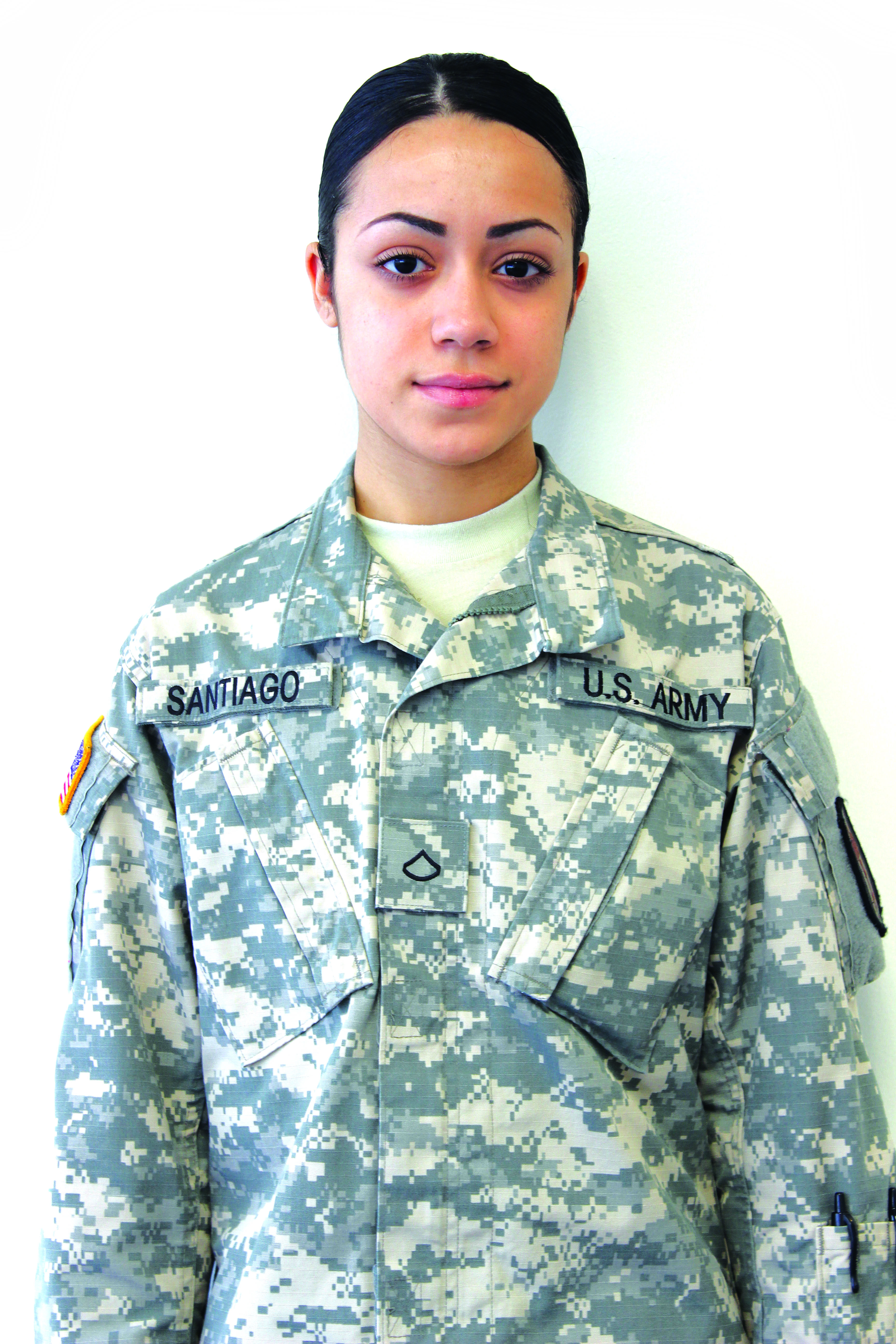
Considering that the Coast Guard Academy is right next door to us, the lack of military awareness on the Connecticut College campus is pretty astounding. This was the sentiment expressed by Samantha Santiago ’16. You might have seen her walking through Harris on Sunday dinners. If not, make sure to keep an eye out for a girl donning an Army Combat uniform. Santiago is currently the only Connecticut College student who is involved in the Armed Forces, partially due to the fact that Connecticut College does not have a Reserve Officers’ Training Corps (ROTC) program. She is a part of the Military Police, and currently on reserve. One Sunday out of each month Santiago goes to drill training, during which wearing full uniform is required.
There have been many inquiries by Connecticut College students on Santiago’s situation. She said of walking around campus in uniform: “I just get stared at. I’ve even had someone say thank you for your service and then run away.” These sorts of interactions only succeed in alienating Santiago from the College community.
Santiago wants to be a military therapist. One of her motivations for joining the army was to be able to empathize with her patients when she becomes a psychologist. “I thought, ‘How could I sit there and try to understand what they had been through if I had no experience myself?’” she explained. Her experience with the military is intended to help her pursue this career path, as she is simultaneously working towards earning her Bachelor’s degree in Psychology.
Santiago is a member of the Posse program here at Conn. The Posse scholars go through a highly selective interview process during their junior year of high school in order to win a full scholarship to one of the Posse sponsored schools throughout the country. A Chicago native, Santiago found herself discomforted in the Connecticut College community in her first semester.
She ended up taking the spring semester of her year off in order to take part in Basic Training at Fort Lenord Wood, Missouri. Basic Training involves ten weeks of intense physical and mental training, turning recruits into soldiers of the United States Army. During these weeks, superiors completely monitored Santiago’s every move. Time was no longer her own. Periods to shower, sleep and eat were scheduled out and diligently adhered to. Physical tests every few weeks monitored each recruit’s performance – if the requirements were not met, that individual was cut from the program.
Santiago established that the fear of being cut was an omnipresent terror during Basic Training. “I knew so many people who were cut. We started off with over 200 people, and by the end there were between 160 and 180.” The fear of failure was enough to keep her driving forward and pushing through the physical pain. This anxiety was portrayed particularly well through Santiago’s narration of one extraordinarily strenuous challenge. Her unit hiked about 12 miles through a number of mountainous inclines. They were dressed in full gear, which weighs about 40 pounds including the pack and uniform.
“I wanted to die,” Santiago remembered. “Halfway through I started crying … if you don’t finish it, you can get sent home.”
Santiago described experiences ranging from throwing grenades to monkey-crawling 20 feet across a rope. She described shooting multiple machine guns, taking her equipment off in a gas chamber (to demonstrate its use) and repelling down towers. Ultimately, she passed all the physical tests and graduated Basic Training, and joined the Reserve as a part of the Military Police.
Santiago may be deployed at any time, despite her current status as a student. This spring break, she is being deployed to Belize with her unit, to “help out the Belize Defense Force.” While many students might be working on their swimsuit tans on the beaches of Cabo and Miami, Santiago and her unit will be working with border patrol and forming what she calls an “army tan” – the extreme tanning of the neck and hands.
Conn does not offer students information on joining the army, nor does the College currently have a policy in place for its students on military leave; if students need to take time off from their studies, it must be done through either a personal or medical leave, neither of which fit Santiago’s situation. Santiago explained that her deployment to Belize was lucky in that two of the three weeks she will be gone will be during spring break, limiting the classes she’ll miss to only a week’s worth. However, if she were to be deployed for longer, the school doesn’t have a policy set in place to allow her to leave and come back without impacting her grades.
Santiago’s personal narrative brings to light the lack of military awareness on campus. Though her uniform might elicit isolating stares and strange comments from some members of the community, Santiago has also been approached by a number of Conn students inquiring on how to become involved in the military. “I’m not a recruiter. I can’t answer all their questions,” Santiago commented. Apparently, military recruiters have not been allowed on campus through the CELS office, limiting the opportunities of those who are interested in joining the army. Santiago is currently working with Associate Professor of Sociology Ron Flores to form awareness about military service. She hopes to form some type of memorial for Veterans Day, which basically goes unacknowledged on campus, and incorporate military education for those who seek information on the subject.
Santiago hopes that promoting this basic knowledge may change the strange reactions she encounters in the dining hall. “I wish it weren’t such a shock,” she remarked on the presence of military uniform on campus. With this in mind, she is motivated to inspire a push for military awareness on campus will create a more conscientious and welcome community overall.
And it is completely okay to thank Santiago for her service with sincerity; it’s well-deserved. •