Those who ventured into Palmer auditorium on Saturday night during Fall Weekend were, perhaps unknowingly, in for a breathtaking treat that aimed to change their perspective of traditional ballet. This past weekend the legendary Dance Theater of Harlem, co-founded by Arthur Mitchell and Karel Shook, took the stage as part of OnStage, Connecticut College’s guest artist series. Mitchell and Shook’s decision in 1969 to open a predominately black school and company was unheard of in this era of white ballerinas. Virginia Johnson, the current artistic director of Dance Theater of Harlem, currently leads the company, as they met the theater’s 50th anniversary. Impressively they last took the stage in Palmer in 1973. The Dance Theater of Harlem had the audience on their feet — as a dancer myself, I wanted to get up onto the stage and dance with these elite ballerinas.
Broken up into four different pieces, with pauses in between each, the performance opened with a strong ballet foundation in “Valse Fantaisie” choreographed by George Balanchine. This piece began with four dancers on stage wearing classic green velt leotards with an attached long, flowy skirt, designed by Larae Theige Hascall. A similar blue-green backdrop matched the dancers. The four dancers–Alicia Mae Holloway, Daphne Lee, Amanda Smith and Alexandra Hutchinson–seamlessly carried out the choreography, consistently in time with each other. This part of “Valse Fantaisie” reminded me of the “Four Little Swans” piece within Tchaikovsky’s Swan Lake. Even the music was evocative of this traditional ballet.
Suddenly Crystal Serrano and Dylan Santos entered the stage and carried out a pas de deux alone and among the four other dancers. Although both were talented dancers, I felt that perhaps it was not their night. Santos did not jump as high or turn for as long as I imagine he could have. Additionally, Serrano seemed to struggle to complete a triple pirouette –which is difficult, I know — but there were other moments where she had difficulty, such as falling out of another turn on pointe and completing several leaps in a row — a difficult feat yet again. However, her beautiful lines, battements, and attitudes scattered throughout the piece made up for some small mistakes. Ellie Goudie-Averill, a professor of ballet at Conn, went to the company’s rehearsal for the show. She felt that the neo-classical piece, Valse Fantaisie, spoke to the history of Dance Theater of Harlem. Arthur Mitchell implemented these renditions of Balanchine, such as in Valse Fantaisie, into the company’s repertoire. Goudie-Averill felt that the classical qualities of this piece “set the tone for everything else…you were able to see the differences” between classical ballet and more contemporary works.
Gradually, as the show continued, the dances became more contemporary, modern, and jazz-like. These changes evoke the Dance Theater of Harlem’s tradition of combining ballet classics with “innovative contemporary works that use the language of ballet to celebrate African American culture,” according to Conn’s website. The second piece, “The Bitter Earth,” choreographed by Christopher Wheeldon, was a breathtaking pas de deux with Yinet Fernandez and Da’von Doane. In contrast to the previous piece, the music, composed by Clyde Otis, was not entirely instrumental; it also used operatically sung lyrics. Similar to the music, the choreography took ballet to a modern level and questioned how traditional movement can be revolutionized. Sara Abbazia ‘21 studies dance at Conn and participated in the master class and lecture provided by members of Dance Theater of Harlem. She shared my reaction to the show, expressing that “Dance Theatre of Harlem [knows] how to resurrect an ancient art form back to life.”
After the intermission, Lindsey Croop, Daphne Lee and Ingrid Silva performed “Change.” Choreographed by Dianne McIntyre, this piece was definitely my favorite of the show. The dancers began the piece wearing black, sheer robes, with a hint of gold beneath that was later revealed to be shiny gold geometric patterned leotards, designed by Oran Bumroongchart. A fun fact about these leotards included in the program: “the women in this ballet wear leotards constructed of a creative patchwork of tights worn by former dancers with Dance Theatre of Harlem.” The lighting, by Alex Fabozzi, was also a favorite. In the beginning, the lights were dim and the figures of the dancers were blurred. However, as the dance continued the lights brightened and a light pink and orange background was lit up, catching shadows of the dancers as they carried out the choreography. This piece was strong physically with fierce kicks, jumps, and group work, but also with its message about female power.
Recent political scandals, such as the abuse allegations within the NYC Ballet, have belittled minority groups and women. This piece reminds us of how powerful women are and how they can achieve great feats unimaginable to many. The dancers used their diaphragms to release startling screams and yells. Dance Theater of Harlem prides itself on breaking from the norm and accepting all talented dancers regardless of their ethnicity or background. Within this particular traveling company, dancers were from various states, cities, and countries including New Orleans, California, Harlem, Brazil and South Korea. Dance Theater of Harlem “tackles the racism and elitism of ballet head-on,” according to Abbazia. Goudie-Averill even felt that some of the arms in this piece “were ruances of African dance, within the contemporary vocabulary.”
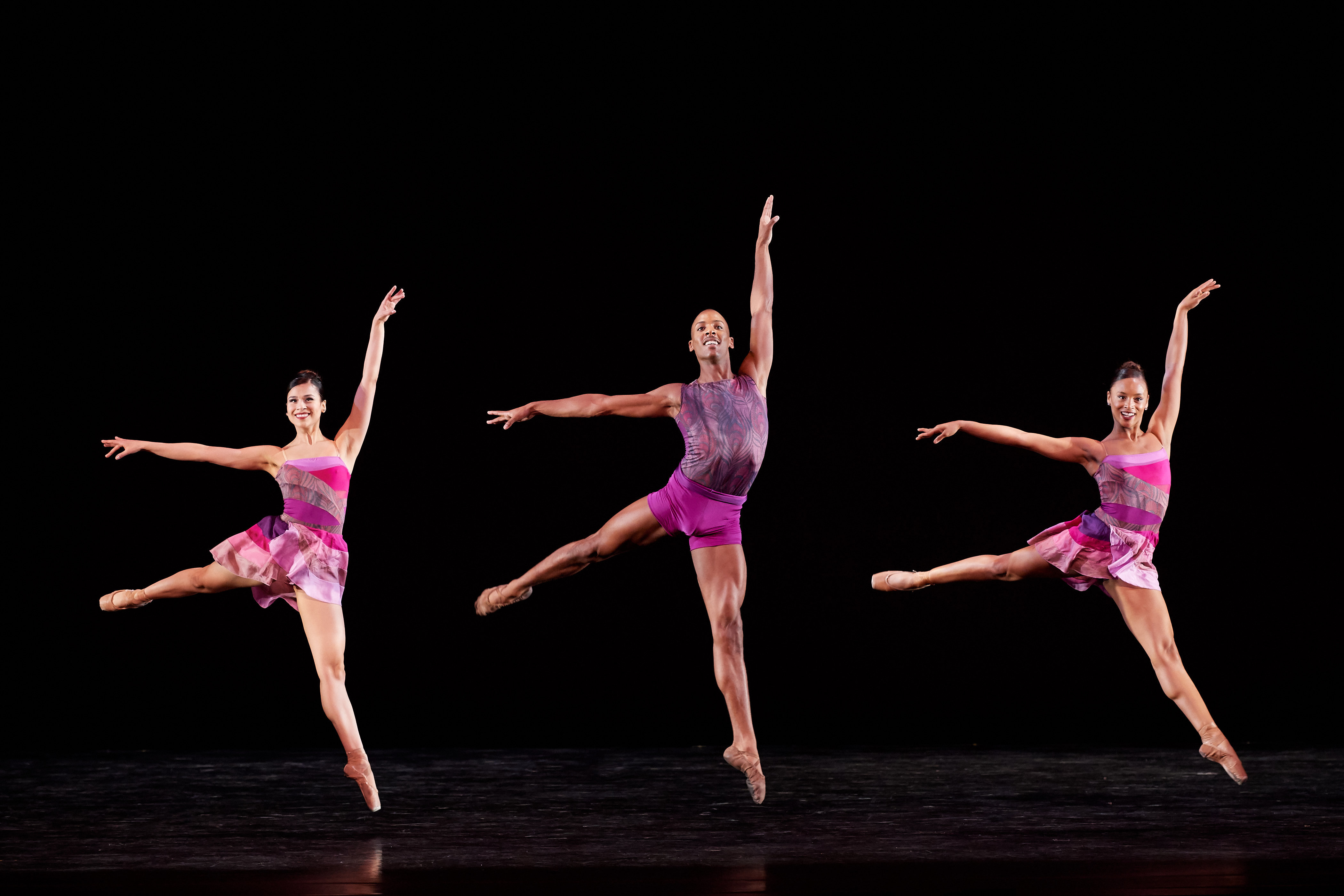
The final piece of the performance was “Harlem on My Mind” choreographed by Darrell Grand Moultrie, was broken up into five separate mini dances. The first piece, “Out and About,” introduced the company of dancers. Each man and woman was partnered together as their introduced their talents to jazzy, circus-like music. And this group of dancers is for sure a circus to come see. Women wore striped pink and purple short, flowy dresses and the men sported tight, red shorts and mesh tank tops with red in the back. After this introduction, Christopher McDaniel performed an impressive solo completing complicated movements, but also dance moves familiar to most, for example the Bernie. Following McDaniel’s performance was “Duo de Jazin’” performed by Amanda Smith and Da’von Doane and “Soul of the Hood” by Ingrid Silva. Silva’s dance was in particular captivating; it ended with a light design in which a spotlight was put on her at the end of the piece and then quickly diminished as the piece came to an end. Similar to the beginning, all ten dancers came out onto the stage one more time in “We Rise” for a final farewell. This final piece was one of Goudie-Averill’s favorites because she felt it fused the shear love of dance the company dancers, and her students at Conn, possess.
The piece met a boisterous applause from the audience at its close. By the end, I felt inspired and uplifted, eager to get back on stage to dance. Goudie-Averill stated that Dance Theater of Harlem is “a model of the of a traditional ballet company, and yet some things about it are different and progressive and so refreshing.” For this reason, whether you are a dancer, like me, or not Dance Theater of Harlem’s performance exceeds standard expectations and it does not take a person with ballet experience, to appreciate the magnificent fine art that is dance. •