
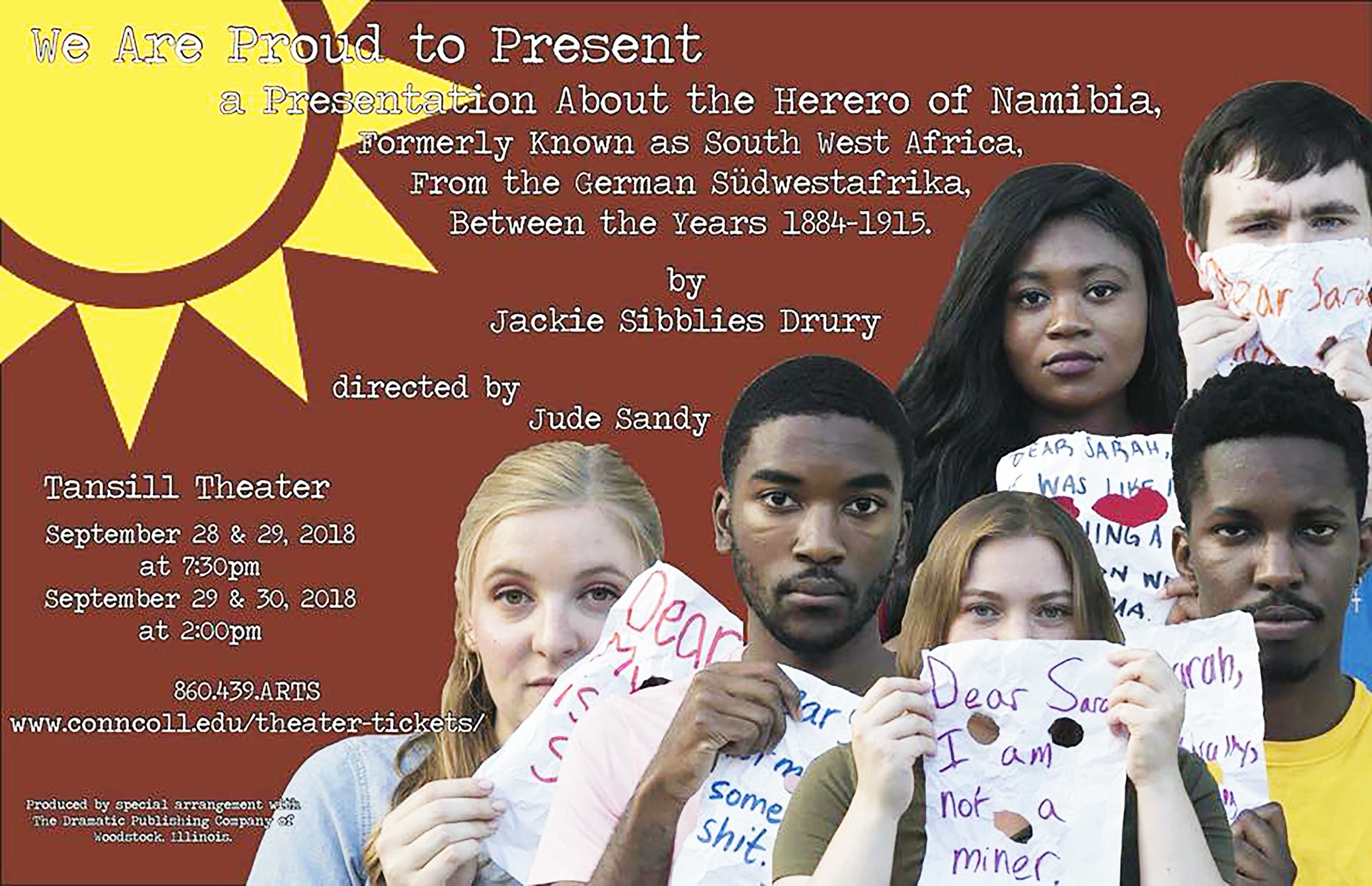
By some measures, including mine, Jackie Sibblies Drury’s humorous lengthily titled one act play We Are Proud to Present a Presentation About the Herero of Namibia, Formerly Known as Southwest Africa, From the German Südwestafrika, Between the Years 1884–1915 begins as a light take on microaggressions, racism and sexism. The production follows six idealistic young American actors, three black and three white, who attempt to create a hybrid lecture-play about the Herero, a tribe indigenous to modern Namibia that was the victim of the first genocide of the 20th Century from 1904-1908 in the colony of German South West Africa.
However, the play becomes darker as the actors move from rehearsing, acting and lecturing about the lives of the German and Herero inhabitants of South West Africa to attempting to reenact the violence that was inflicted on the Herero. In the final tableaux, a reenactment of the enslavement in concentration camps that the surviving Herero were forced into quickly degrades to one of a Southern chain gang and lynch mob.
Director Jude Sandy, an adjunct professor in the theater department, assembled an excellent cast wthat all worked very well together and had clearly put in the effort to develop their characters. The performers were Shay Borden ’21, Declan Rockett ’20, Andre “A.T.” Thomas ’20, Julia Hutton ’19, Jermaine Doris ’19 and Truly Siskind-Weiss ’19. I particularly appreciated how Sandy and the ensemble highlighted a trio of relationships between pairs of characters. A quasi-love scene between Borden and Thomas seemed to be further highlighted by his character’s constant interest in hers. In fact, in several scenes where they were not featured, they tended to be on stage together. There also appeared to be some sort of companionship between Doris and Siskind-Weiss’ characters, particularly in the later half of the play. The German soldiers that Rockett’s and Hutton’s characters were attempting to portray seemed to have an intentionally poorly conceived relationship that worked well to close out the trio.
One of the things I liked about the costuming for the ensemble, by Carly Sponzo ’21, was how the characters initially were overdressed, with everyone wearing some sort of jacket. However, as the play progressed, most characters shed their jackets for something more personal. This change was particularly noticeable in Borden’s character, the “kind of the artistic director” of the ensemble, who initially appeared in a grey suit jacket and jeans, but later changed into a dress from an “African-style” print.
In individual performances, Thomas led the cast well in a set of rhythmically tricky passages in 7/8 time near the play’s conclusion. He also deserves a great deal of praise for his bravery and fortitude in taking on the role of the character who is nearly lynched. I also enjoyed the development that Hutton, Doris and Siskind-Weiss brought to their characters. Hutton’s character was originally a male role, but was transformed very well into the role of a female playing a male part. She brought out a dimension of acting like she wanted to be artistic director, which created an interesting contrast with Borden.
Doris’ and Siskind-Weiss’ individual portrayals both seemed to stem from the relationship between their characters. Doris seemed conflicted between his relationship with Borden and Thomas and his relationship with Siskind-Weiss. He sought to offer a stereotypical but unrealistic portrayal of a savage untamed African man in the presentation. Siskind-Weiss’ portrayal perhaps stemmed from a strong belief of her character’s that her acting could bring racial harmony, and it was interesting to see her beliefs shattered at the end of the play.
The play is rather complex in that it touches on a lot of different tropes in theater and society; a notable trope is the play-within-a-play element that serves to break down process and really makes it an actor’s play. However, I found it difficult to relate to the characters until the final third of the play, which contains the most severe forms of racism portrayed in the play including two scenes with actual violence rather than the scenes portraying the actors themselves. I felt that the actors’ portrayals of their actor-characters were a bit muddled up until the play’s abrupt transition from poor attempts to depict the Herero’s and German colonists’ lives to depiction of the genocide and violence inflicted on the Herero in Namibia and blacks in America. Understanding these characters’ motives—who they are was clearer. The character trajectories of the final third of the play are better written than in the preceding two thirds; it’s easier to see how the characters interactions feed off each other to foster the brutality of hate.
What I find disturbing about this view is that it leads to the conclusion that it is much easier to portray a believable version of outright disgust and hatred at someone’s existence than to attempt to show the everyday problems of interacting with and accepting the Other. One of the points Sandy mentioned in the post-show talkback is that Drury was able to work with an ensemble of actors while writing the play and wrote it based on her experiences and impressions from that work. I feel like this forces actors who are not members of the original ensemble into a very difficult position as they have to portray a human whose traits are almost perfectly defined; there’s little room for their own nuance that they can put into their roles.
In this way, the more broad strokes in the closing scenes of the play allow for a great deal more interpretation and use of space. In one scene. Thomas, portraying a Herero man, wore a grey hoodie, meant to evoke Trayvon Martin, while Rockett, portraying a German soldier, shot him repeatedly. This reference to Martin is not in the original script as the play was written prior to Martin’s death; the script calls for evocation of historical racism by directing Thomas and Rockett characters to speak with southern accents in their dialogue.
Another liberty was taken in the final scene; the script calls for no actual words to be verbalized as the characters attempt to come to grips with the violence they’ve witnessed and inflicted. However, the script does not state how long the various physical actions are supposed to take. The ensemble spent 5-10 minutes working through this routine, until finally, after the last actor, Doris, walked off stage, they allowed the audience to sit in silence and reflect for a few more minutes before dramaturg Rachel Haines ’20 thanked everyone for coming. I did not see these sorts of liberties taken at most other points in the production because of how precise Drury is in her scripting. In many ways, the production is much more reflective of Drury’s play than Sandy’s or any of the casts’s work.
As a closing note, since this is the last Fall Weekend production I will be viewing as a student, I would like to praise the Theater Department for consistently deciding these past four years to produce a play that touches on hot-button topics during Fall Weekend. Specifically: animal rights (Elephant’s Graveyard, 2015), women’s rights and history (Hedda Gabler, 2016 and Uncommon Women and Others, 2017) and this year, black rights and history. These are topics easy to avoid on parents and alumni weekends for fear of causing offense. I hope that the theater department will keep producing shocking and compelling works that continue to touch on more and different underrepresented issues of today during future Fall Weekends. •

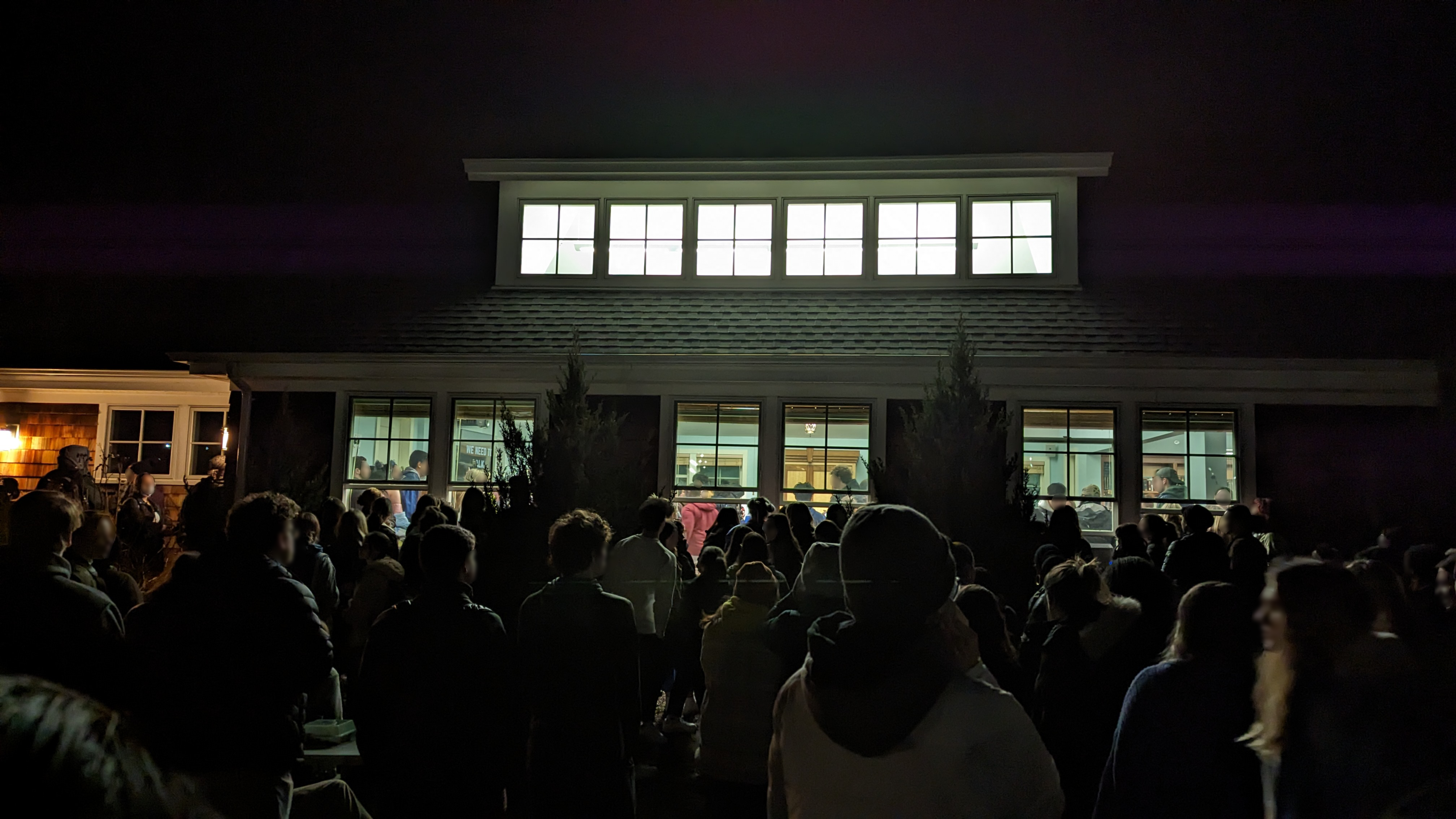






We Are Proud to Present intriguingly deployed multiple points of view, time periods, and flexible, intersecting narratives drawn from letters written by the German soldiers who protected colonial interests in Namibia.
However, I agreed with the Herero character who bemoaned the lack of Herero perspective in the play. (Post-modern interjections of self-critique within the play gave rise to that observation and many instances of humorous self-examination.) But I felt the playwright might have searched the ethnological records for evidence of how the Herero reacted at the time: what they had said or done in reaction to the hostile German occupation.
That’s what anthropology can do for us: Remind us that the official government accounts and European personal accounts are not the only historical documents we have. While it’s possible that ethnography can be polluted by power and the European perspective, there are also enough ethnologies that carefully represent local perspectives to make it worth the effort to do the research.
On a similar but smaller note, the song Edelweiss from The Sound of Music (written by American theater team of Rogers and Hammerstein) is used as an emblem of “German-ness” in the play. And that annoyed me and probably others in the audience for its multiple levels of inappropriateness: It isn’t a “German song” it’s American, and within that American musical it represents the patriotism of Austrians: Austria is not Germany.
No excuse for that kind of sloppiness in a college theater production.