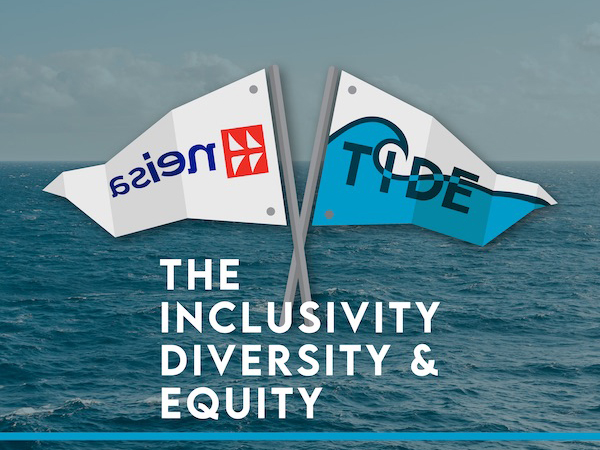
Photo courtesy of Allison Chenard (NEISA Tide logo designer).
After the death of George Floyd during the summer of 2020, the BIPOC community unified, as the United States clamored for accountability. This unacceptable series of events challenged us all to start an uncomfortable but imperative dialogue in an effort to identify and combat the deeply rooted prejudices and racial disparities within established facets of our lives. Even the most long withstanding institutions came to acknowledge that more could be done on their part to create a more cohesive environment.
One such entity that wished to channel this energy of improvement was the world of college sailing. In recognizing that sailing is a predominantly white sport frequented by those of a higher socioeconomic status, many members of this community realize that our sport may appear exclusive or inaccessible to those who are peering in from the “outside.” This unintentional reputation is one of the reasons why many who have come to love this sport have been inspired to devise a way to shake this exclusionary image and open up this mentally and physically engaging sport to all those who wish to find their passion within it.
A group of sailors from the New England Intercollegiate Sailing Association (NEISA) pushed for the formation of a conference-specific division of The Inclusion, Diversity, and Equity committee (TIDE) to be established within the Inter-Collegiate Sailing Association (ICSA), which is the governing authority for collegiate sailing competition across the nation.
This student-led organization, of which I am a representing member for Connecticut College, has taken impressive strides despite its very recent inception. Led by Preston Anderson ‘22 of Bowdoin, TIDE has already seen success in drafting two amendments to the NEISA constitution which establishes a requirement of all teams within the conference to complete an educational program about race and diversity prior to participating in competition for the season. The second amendment, which passed this past week, includes an anti-discrimination clause that installs a zero-tolerance policy for derogatory language and marginalization.
The organization has also established an infrastructure that is divided into subcommittees such as Education, Community Outreach, and School Outreach and Recruiting. Each subcommittee has been working tirelessly and enthusiastically on their respective focuses, all driven by the hope of expanding their beloved sport to those traditionally unable to access it, as well as creating a more inclusive environment for all to feel comfortable and accepted.
Not only do TIDE meetings lead to productive ideas such as expanding the collegiate sailing recruiting pool or how to promote more inclusive language on and off the water, but I have also noticed that those within TIDE have found a sense of community-based on this common interest of inclusivity. Given that these engagements involve communicating and working with sailors from all across NEISA, I have had the opportunity to meet so many compassionate and engaging individuals who share not only my love for sailing, but also my passion for creating a more accessible and diverse sailing experience.
As a sailor who identifies as BIPOC, I cannot stress how important the establishment of TIDE is for the future of this sport. It is time for people to recognize that collegiate sailing is an environment for anyone to develop a passion for the sport and find lifelong friendships in those who they encounter. I know that, from personal experience, the members of Connecticut College’s own Varsity Sailing team have taken great strides to acknowledge the progress that has been made in collegiate sailing towards a more inclusive and diverse environment, and it’s incredibly uplifting to feel so supported by a community that I care deeply for. I do hope that, with continued momentum, the efforts we have spearheaded today will foster an environment that allows more people, regardless of their race or ethnicity, to compete at the collegiate level.