Photo courtesy of Connecticut College.
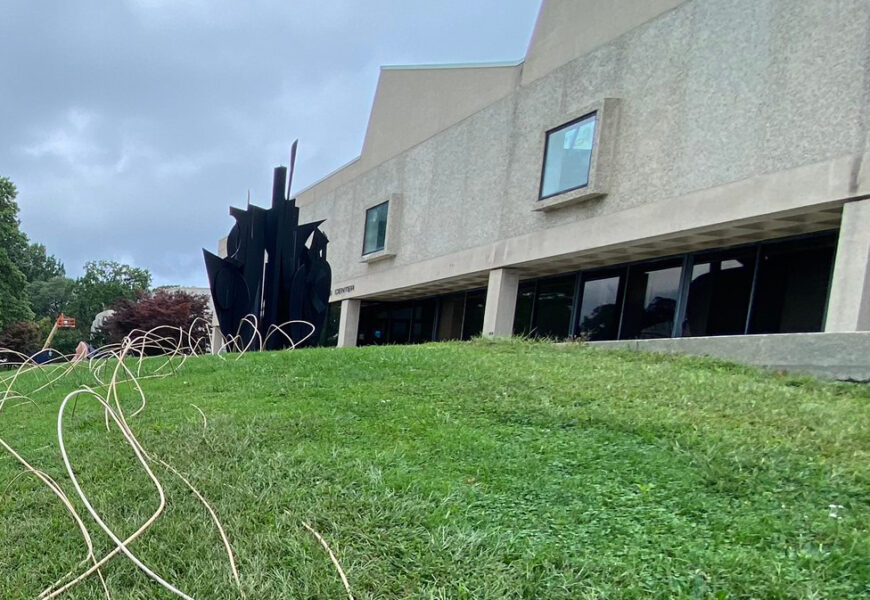
“Some say the world will end in fire, Some say in ice.” This quote by Robert Frost, displayed prominently on the back wall of the gallery in Cummings Art Center, neatly encapsulates the essence of the exhibition, Fire and Ice. It is an expression of the dire nature of the climate crisis as well as an indictment of the unmitigated growth championed under capitalism that threatens nature and our very way of life. Curated by Timothy McDowell and Barbara Zabel, a professor and professor emeritus at Connecticut College, respectively, Fire and Ice features work by a variety of different artists in multiple mediums, including painting, drawing, sculpture, recordings, and audio-visual presentations.
Upon entering the gallery, one of the first pieces the viewer is exposed to is Mina de Ferro de Carajás (2019), an oil and charcoal on linen by Bob Nugent, an abstract piece stylistically reminiscent of Cubism. It is meant to depict the destruction of the Amazon River Basin because of irresponsible mining practices and its consequences for indigenous tribes. Lydia Nugent also depicts the destruction of the Amazon region with Honey to Ashes (2019), a collection of watercolors on yupo illustrating the burning of the forest with haunting simplicity and serenity.
One of the highlights of the exhibition includes an oil on wood panel by Timothy McDowell, titled Daily Concerns (2019). Serving as a representation of the ways we recklessly exploit natural resources, it distorts the boundaries between sea, land, and sky, as oil pours from the end of a pipe, the moon rests on the ocean, and a group appearing to be drilling for oil approaches from the distance. A seemingly random sketch of a bug is affixed overlaying the drillers. With a lot of dense imagery and symbolism, McDowell presents a rich and deeply unsettling vignette of humanity’s will to extract everything possible from nature to sustain our way of life.
Similarly, Pamela Marks thoughtfully depicts the interconnected nature and precariousness of our world with Living Earth Series (2018-2021), a collection of acrylics on paper that innovatively contrast organic gesture and imposed geometry – and, thereby, nature with man-made systems. Christopher Volpe’s Any Human Thing…(2017) expands on this theme with images reminiscent of dark curtains of smoke, evocative of both the apocalypse and industrialization. His use of tar in addition to oil paints further suggests a psychic connection between the promise of the Industrial Revolution and the imminent destruction of climate change.
Another exhibition highlight includes Chris Barnard’s Deepwater Horizon (2015), an oil on canvas. An abstract depiction of the eponymous 2010 BP oil spill in the Gulf of Mexico, Barnard’s piece is a haunting portrait of environmental degradation in service of corporate interests that also challenges viewers to consider the racial injustice that the negligence of corporations towards the environment perpetuates. The question of how systemic racism pervades climate inaction is further explored in Under the Weather (patience study: sagittal, echo, coronal) (2021), a triptych of archival pigment prints by Amanda Russhell Wallace, a professor at Connecticut College. Wallace’s piece examines the relationship “between environmental disruptors and biological weathering”, and how the latter permeates interactions with the unremarkable, suggesting that antiblackness is an omnipresent environmental factor. The piece is a fascinating mediation on the weather as a culmination of our environments, the cyclical nature of life and death, and their implications for the intersection of the climate crisis with racial violence.
However, the exhibition also leaves the suggestion of hope for a collective redemption open with Gregory Bailey’s Rain Collecting Water Cistern (2018), a large sculpture made of various recycled materials featured prominently in the center of the gallery. The sculpture is both aesthetic and practical, as it can be used to collect water that can be used to grow trees. According to Bailey, the carbon sequestered by the trees will eventually surpass the carbon used to make the sculpture. The piece suggests that art has a moral imperative not only to comment on society, but to be a part of the solution, standing in contrast to the pessimism of the rest of the exhibit.
Fire and Ice, while featuring some incredible works, is more than merely the sum of its parts. The combination of the industrial with the idyllic, the bright with the nightmarish, and the systematic with the chaotic creates an experience that compels the viewer to contend with their place in nature and ponder questions ranging from political to metaphysical. The thematic and stylistic variety of the exhibition, while seemingly incongruous on its face, follows a certain internal logic and addresses the same theme from multiple lenses. In so doing, Fire and Ice thoughtfully depicts an expansive, nuanced point of view on the climate crisis.
Fire and Ice is on display through Oct. 15th.