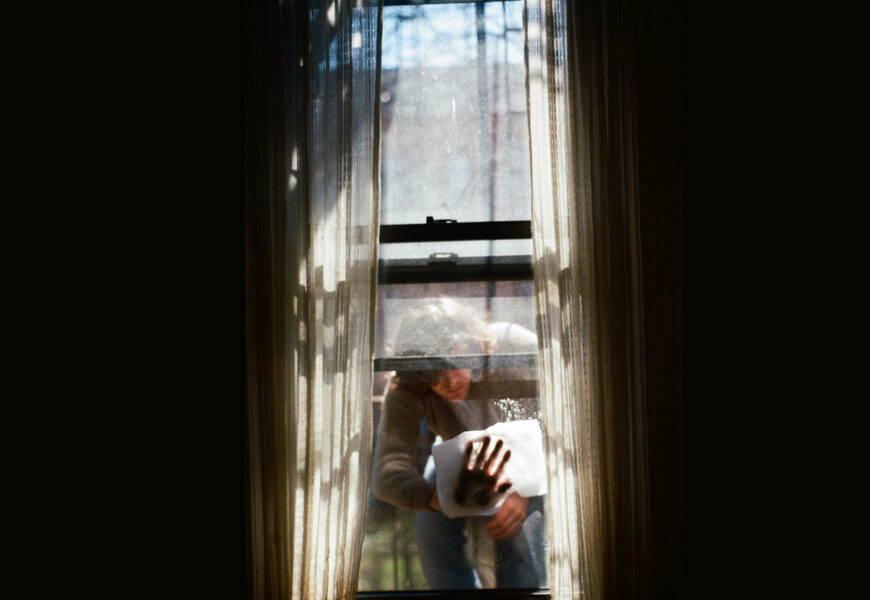
Photo courtesy of Cut Worms
There are an approximate 340 million specks of sand on any given beach where you are currently standing. Over in the distance, just underneath where the sun still floats, stands a mariachi band playing asynchronously. A shadow of the acoustic guitar at play looms over ~75 people. Heads bob and legs flounder as waiters bring in trays and people find spare seats at this dimly lit rooftop cafe. Children brush past you and in the glasses they wear you see a refracted moonlight. Why does the world look so much more sad in that liminal period between day and night? You wonder.
Modern life is overwhelming — this is what Cut Worms, the nom de plume of singer-songwriter Max Clarke, implies in his 2020 folk/Americana double-EP “Nobody Lives There Anymore.” With its 12 bar blues-y rhythmic structure, Worms’s “The Heat Is On” — the opening track on the album — intones emphatically about the once-was, a world which “soak[ed] in ballroom tears/Where the dresses once/Had swayed”. This is a rough schematic of the motif that Worms employs throughout the album: the simple notion that there was once a world built on promises long forlorn by people and systems beyond our control. Like how you feel an estrangement from yourself when the sun is setting, when you are strolling away from the happenings of life, so do you also experience an angst driven by a remembrance of these forlorn promises. That, above everything, this angst isn’t an aberration but a necessary feature of life — a recalling back to a history you are not waking from, but to.
Because it is a double-album, it has a tripartite structure, with fluctuations in ennui: the first quarter looking towards the past, the second coping with angst regarding lost promises, and the third asking the listener to consider themselves as an individual in the wider context of history and make something with the experienced angst.
The Past (and Tragedy):
This recalling of the past is most explicit in “Unnatural Disaster” and “Last Words To A Refugee.” A fundamentally historical project, the former concerns itself with the fundamental teleology of history. Where does it end? What is the process? Worms’s narrator is a dismayed victim of the tide-turning of history, filled with violence and fear: “Well have you heard the news?/Well do you think that it is true?/How the bad seed spoiled the brood?”. And aren’t there so many identifiably bad seeds, in the shape of genocidal individuals in power, throughout history — a process which Worms refers to as a “death march”?
This is an epiphany that our narrator — the eponymous “refugee” — experiences. With its folksy, teary-eyed narration, the song chooses to comment on the powerlessness one feels in the schema of history — ask yourself this: would a soldier of “the Evergreen War” (as Worms’s sings in Veteran’s Day) matter in the happenings of history? Would a Jane Doe from Ohio be remembered actively by any seeds of any worth whatsoever? This creates angst which Worms beautifully builds on in the second quarter of the album — angst created by considering the role of the individual in relation to the larger trauma of the death march that is history. Our narrator is a refugee who is still living — they are someone who has escaped a descent into fascism and is now burdened by the question of mortality, hoping to make something of their life. They reflect on their salvation from false promises, dwelling on the what-could-have-been.
The Present (and Acceptance):
Worms’s “Veterans Day” stands as the foremost testament to the grandeur of the album, showcasing its most immediate strength: the ability to craft a narrative about simple abstractions. This song, as I see it, is a recollection of the American Dream — most reductively an experiment in pursuit of equality for every person of every creed — with its flowery, almost repentant poetry. Our narrator is a former soldier who has been forgotten in this new world, having once committed himself to the seeming improvement of his former countrymen, forced to “act at their command/I do tricks/Like a dog” to simply make do. The song argues against mythology — that of the American West, that of the American Dream, that about the world at large post-9/11 — with lyrics informing the old-worlders to “Stop telling tales/Nobody believes in chasing white whales.” The old has faded to give way to reconstruction… but what does that exactly mean?
Worms withholds the answer to this question to (beautifully) demythologize the American West in “Sold My Soul,” twangily orchestrating the callousness of negating the actual from what is purported to be. With its talk of antique roadshows and limousines, the song serves as a beautiful companion piece to “Castle In The Clouds,” its lyrics illustrating the world as it stands
right now, simply “fit for the Wall Street trade”. These two songs, when taken together, paint an ethereal mosaic of change and acceptance through reflection — the world simply isn’t a hallucinatory, floaty glass globe where you pass off “in the smiling breeze” and “let the stars be your guide” in the cider “sweetness of desire”. It really is true — “Nobody lives there anymore/In
the Castle/In the clouds.” And it is this acceptance that gives rise to an answer to who you can be.
The Future (and Love):
But why this odd demarcation between who and what — what’s the difference? While the question might sound like an odd Seinfeld bit, it is important to consider in light of what we now know about history. You are all who you are or can or will ever be. If you locate yourself within the circumstances allotted to you in life, you will have to take them into account and work through angst to identify what really matters to you. The entire third episode is simply a chronicle of this acceptance, with our various narrators devoting themselves to things that they, as individuals, can fully appreciate. “Baby Come On and Walk With Me” celebrate a mature portrait of love — “I don't mind where you been/Or what you never got/I don't wanna make you
into something you’re not” is what our narrator in Baby says, referring to a need for partnership through alone-ness, understanding through confusion. You can love someone entirely and forever be with them but only if you can first position yourself and not fall nauseous at the thought of figuring things out. Or, as Mr. Worms puts it, “When we’re waltzing in a dream/laughing at all we only thought we’d seen/by the time that we will open our eyes/then we won’t be so alone.” And indeed, that world of “crowd[s]” in a “city so loud” simply won’t matter because your love for yourself and your partner will cultivate itself to become divorced from what everyone else might think of it. No matter what the “jury” in “Always On My Mind” might
think, if you can morphose into the best person you can possibly be, “you can fall in love forever”, giving way to the promise that you will be happy. That you will have no desire to look at the stars above with a simple sadness. That you will see the cerulean blue of the horizon with an air of beautiful uncertainty. That you will turn around to see the mariachi band and the dangling white bulbs and the surrounding people with a certain reverence. That you will fundamentally have become you.