
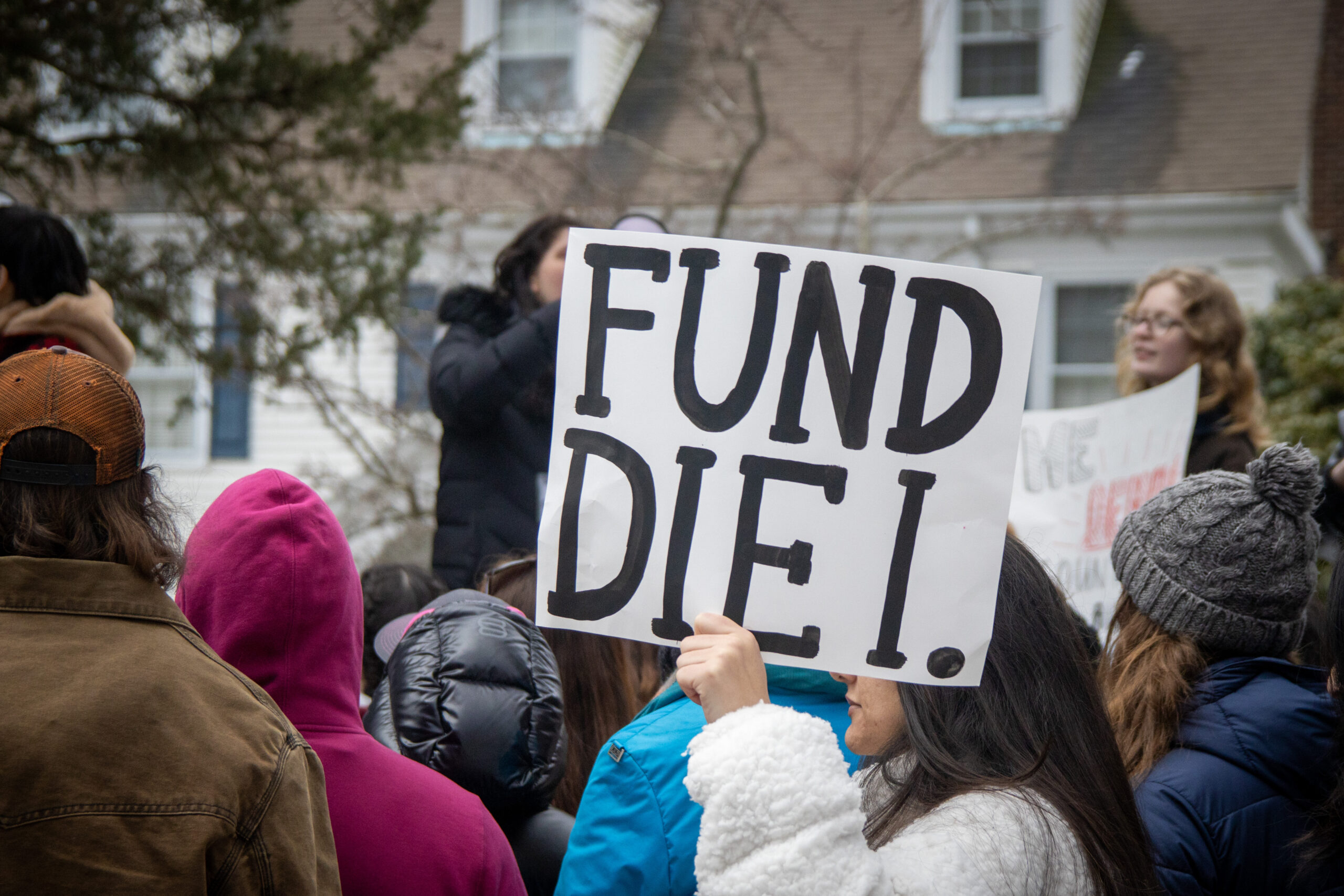
Photo courtesy of Robbie Lynch ’24
In her email to the campus community on Mar. 1, President Katherine Bergeron linked a 28-page document that outlines the College’s Equity and Inclusion Action Plan, published in 2016 and revised in 2018. An analysis of Bergeron’s email itself has been done, but this article is to dissect the Action Plan.
After messages from Bergeron and former Dean of Institutional Equity and Inclusion John McKnight, the plan is broken into “Plan Overview,” “Strategic Priorities, Goals & Action Items,” “Implementation Plan,” and “Tracking and Reporting.” At the end of the document, there is a list of 21 members of the President’s Council, DIEI Staff, and Ex-Officio Council Members who presumably read and signed off on the plan, including Bergeron and several representatives of staff, faculty, and students.
The plan outlines several actions that the College has successfully implemented:
- Connecting with New York Posse Scholars
- Establishing the LGBTQIA+ and Womxn Centers
- Creating the SDP academic requirement for graduation starting in 2024
- Forming the Center for the Critical Study of Race and Ethnicity
- Offering American Sign Language as a language option
- Develop a curricular initiative that serves the needs of students who excel in their work on racial justice and equity
- Activate the Creating Connections Consortium (C3) New Scholar Series
- Allowing staff to serve as advisors/collaborative partners with faculty in designing and teaching First-Year Seminars
However, there are several action items that have made no progress, and an unbelievable number of unrecordable action items.
Amongst the other action items listed, a few in particular stick out. One action item reads, “Create a formal ally development program for White students, men, cisgender people and others who want to increase their effectiveness as allies.” As a Predominantly White Institution (PWI), Conn does not need more organizations exclusively for privileged students. It would be more productive to create opportunities for students from different backgrounds to come together.
Another action item is “Leverage athletics recruitment to increase diversity,” implying that BIPOC students only come to college for sports. This is an outdated and incredibly racist stereotype that Conn should never have implied, especially in a plan to make the college more equitable and inclusive.
The action item which states that the college intends to “significantly increase proportion of native and indigenous students” directly contrasts the latest Faculty, Student, and Staff Demographic Data, which shows 0% indigenous students and faculty.
Another action item promises to “revitalize and enhance Unity House as a functional and stylish, student-run multicultural house,” in addition to the Chapel. Unity House and the Chapel (especially the Chapel basement, home to the Muslim prayer room) have been in poor condition for years.
The Action Plan also vows to “install lactation rooms on campus,” which apparently manifests in an vaguely labeled “wellness room” located in Fanning Hall. This item is listed under “Women and LGBTQIA students.” Nowhere in the Action Plan is there a promise to have free menstrual products in every bathroom on campus. This would serve significantly more students than lactation rooms.
Several other promises are made in this document, including mandatory faculty training programs for Title IX and ADA compliances, creating alumni networks for BIPOC alum, locating non-work study options for international students, identifying and implementing equitable strategies for spousal hiring, improving policies and expand faculty and staff training on issues of accessibility and accommodations, and expanding educational programming for the campus for disabled students. These are just a few of the dozens of action plans.
\In theory, these actions are tracked publicly on the College website, though there is not indication of the last time any of it was updated. In the PDF of the 2018 report, it is stated that “the dean of institutional equity will also compile and provide annual reports to the College community” which is a little hard to do without a dean in that position.







Why shouldn’t there be a group where white, cis gender, and/or men who are interested in understanding social justice movements can feel safe to question their white fragility? It’s an incredibly humbling experience, and it’s possible that just as BIPOC people need spaces to explore their experiences, I can imagine that if someone is interested in understanding such intense issues in a structured and moderated setting, it may be useful. Such a stance kind of furthers the whole exclusionary aspect of social justice that Fox News reinterprets as liberal fascism. For fear of saying the wrong thing and being judged or crucified, people tap out all together and don’t want to engage in the dialogue for fear of being seen as a villain. Ardency while useful at times can also kill your aspirations. Isn’t the whole point to bridge divides? Engaging in self work is essential, but shouldn’t be the responsibility of BIPOC to have to guide the above through.
Dear old clay pigeon,
If you read the article, you notice, that it said in the following sentence:
“It would be more productive to create opportunities for students from different backgrounds to come together.”
It takes student from minority backgrounds to convey their lived reality to privileged students.
Another “safe space” where the privileged majority tries to talk about something they have never experienced themselves does not help.
I remember the song “Scary times for Boys” by Lynzy Lab of 2018.
This song shows in detail that men don’t even understand the living realities of women although they live closely together.
How are they supposed to understand people they don’t even meet on a daily basis?
Not knowing is okay, but not wanting to learn and educate yourself is a privilege people of minority groups cannot afford.
Please do better.
I do not deny that minority groups need safe spaces. This can be an “and” situation. I was a part of Queer and Questioning, and that was incredibly helpful for me. My suggestion is that it creates a structured place for people to learn and ask questions? What’s wrong with that? Also, why do we immediately assume that white, cis, and/or male don’t have any intersectionality identities to relate to these issues with?
Furthermore, I explicitly said it is not BIPOC responsibility to do this. A structured space moderated by another non BIPOC person. Part of exploring fragility is about talking to others doing the same thing.
As a side note, please refrain from condescending remarks such as “Please do better.” It elicits a response that prevents me from wanting to engage in healthful dialogue and questions the good faith I have in others when putting ideas out there.
Dear old clay pigeon,
I apologize for the last sentence (which was born from long years of frustration, but which does not excuse hurting your feelings).
But for the rest I beg to differ.
It needs the experience of a minority person to educate. A group led by a non-minority person is NOT able to really convey the lived experiences of a minority person.
This would feel more like a “Social Media Bubble” where (e.g.) white men discuss among themselves the problems of women/LGBTQI/BIPOC or other minorities. Problems they only know from hearsay.
It does not work. Unfortunately.
I wish it was easier, but it is not. And I understand all minorities who are getting tired and frustrated for endlessly having to advocate for themselves.
I appreciate your response. I see your point regarding worries about misunderstandings about BIPOC issues, and also I have been in spaces led by white facilitators that have increased understanding of these issues. Once again, I think it can be an “and” situation. There are many tools to make these spaces effective, such as NYTimes videos where they have x group have a conversation on race, primary accounts etc.
I agree that privileged groups don’t need a “safe space” in the way BIPOC people do, and I also know many whiteys who don’t want to feel shutdown, a normal human desire, especially when their initial intent is to understand. If these groups are part of the problem, how can we make them part of the solution?
My whole goal in asking these questions is not to dismiss what the students are arguing for. It is crucial to engage in a critical mindset about the world around them, but also nuance is important. As someone who was deep in the activism world only to kind of feel disenchanted and burned because because of the lack of nuance, I want students to feel that such work is sustainable. My own experience with the question of sustainability as led me to realize that compromise is not as dirty of a word. People may disagree with me; this is a thought I have developed over my multitude interactions and observations.
I appreciate the time you have taken in considering my thoughts, and please understand that I don’t have a clear and concise position on what the “correct” way to achieve these goals are.