
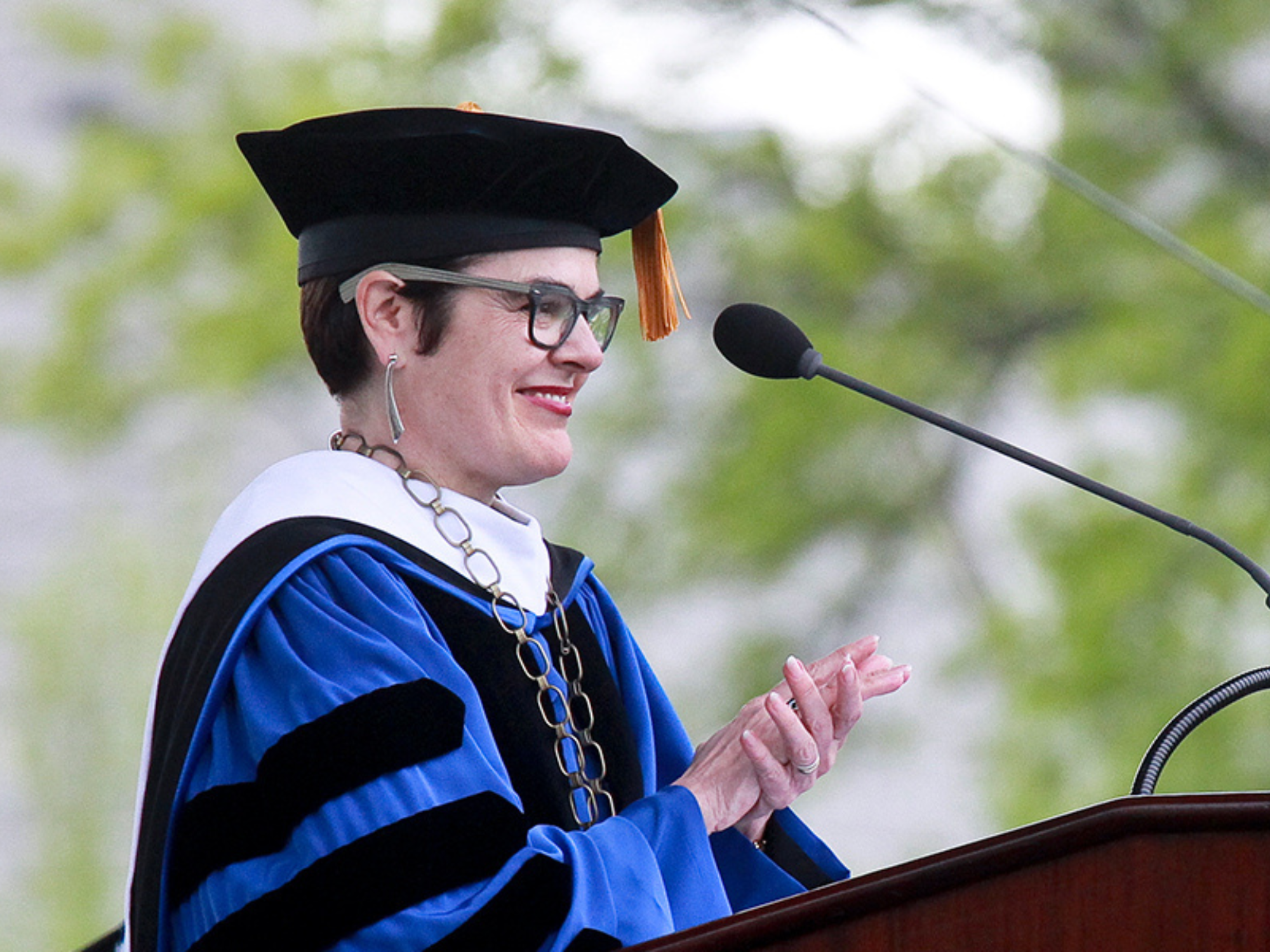
Photo courtesy of Connecticut College
As the final days of the semester creep closer, so too does the ceremonial celebration of the hard work of the Class of 2023 as their collegiate education draws to a close. Given the events of this spring, many are wondering how current president Katherine Bergeron will be involved in graduation. Unfortunately, we still don’t know what to expect because the administration has excluded graduating students from these conversations. A committee, separate from the Commencement Committee, has been formed to determine Bergeron’s role at graduation without any student involvement. As students who have experienced the rollercoaster of the last four years, the voice of the senior class is integral to these conversations and their exclusion is just additional evidence of how much this administration needs to change.
Students from the Class of 2023 started their journey at Conn in the Fall of 2019 when the world seemed normal. In the past four years, they have spent semesters at home and in isolation, watching as the Class of 2020 missed their graduation and wondering if they too would lose this special day.
Now, finally, their graduation date is approaching, and they are excited to celebrate their tremendous class achievements. They have made friends in spite of COVID-19 restrictions, received honors in spite of Zoom classes, won national championships and prestigious scholarships like the Fulbright and Watson, participated in a historic Fanning occupation, and finally, made it to the finish line. If graduation is a day to celebrate the lengths to which they have gone, why are they not given a voice in making decisions for this special day?
The politics of the current president’s involvement in graduation is important, but more important is how the students themselves are included in the decision-making process for graduation. There is widespread consensus among the senior class that they would prefer Bergeron’s absence or absolute minimal involvement. Her attendance risks detracting from the seniors as the focus of the event because of the scandals she has been central in. They have spent four years keeping up appearances for Bergeron’s benefit; Bergeron could, for them, honorably step aside and let them have their spotlight in the way they deserve.
Students aren’t only excluded from presidential decisions regarding graduation. In a recent conversation with the Board of Trustees, the Faculty Steering and Conference Committee (FSCC) was told that there is no plan for meaningful student participation in the selection of the anticipated interim president. This comes in spite of weeks of protests against the administration and its lack of transparency and inclusion of students in decisions impacting their College experience. It is overly ambitious for the administration to presume they alone have the means to acquire an interim president that satisfies the student body. It also comes across as a slap in the face that after everything, every attempt of the students to share their needs, passion, dedication, and commitment to the College to now be excluded from a decision like this.
Hopefully, the administration will reconsider this decision to continue their faulty and exclusionary decision-making traditions, but it is unlikely. As conversations about the search for an interim president continue, students will look toward each other and student leaders to assess how much they will put up with before demanding their voices be heard. Connecticut College is built on shared governance, so including student voices in decision-making is the least the College can do.









brutally cringe
Rather than facilitate campus dialogue, and despite evidence of DEI inefficacy, The College Voice chose to engage in what it now admits was an “information battle.” Read more here:
https://theconntrarian.substack.com/p/the-college-voice-acted-unethically