Courtesy of Speak Up for Justice
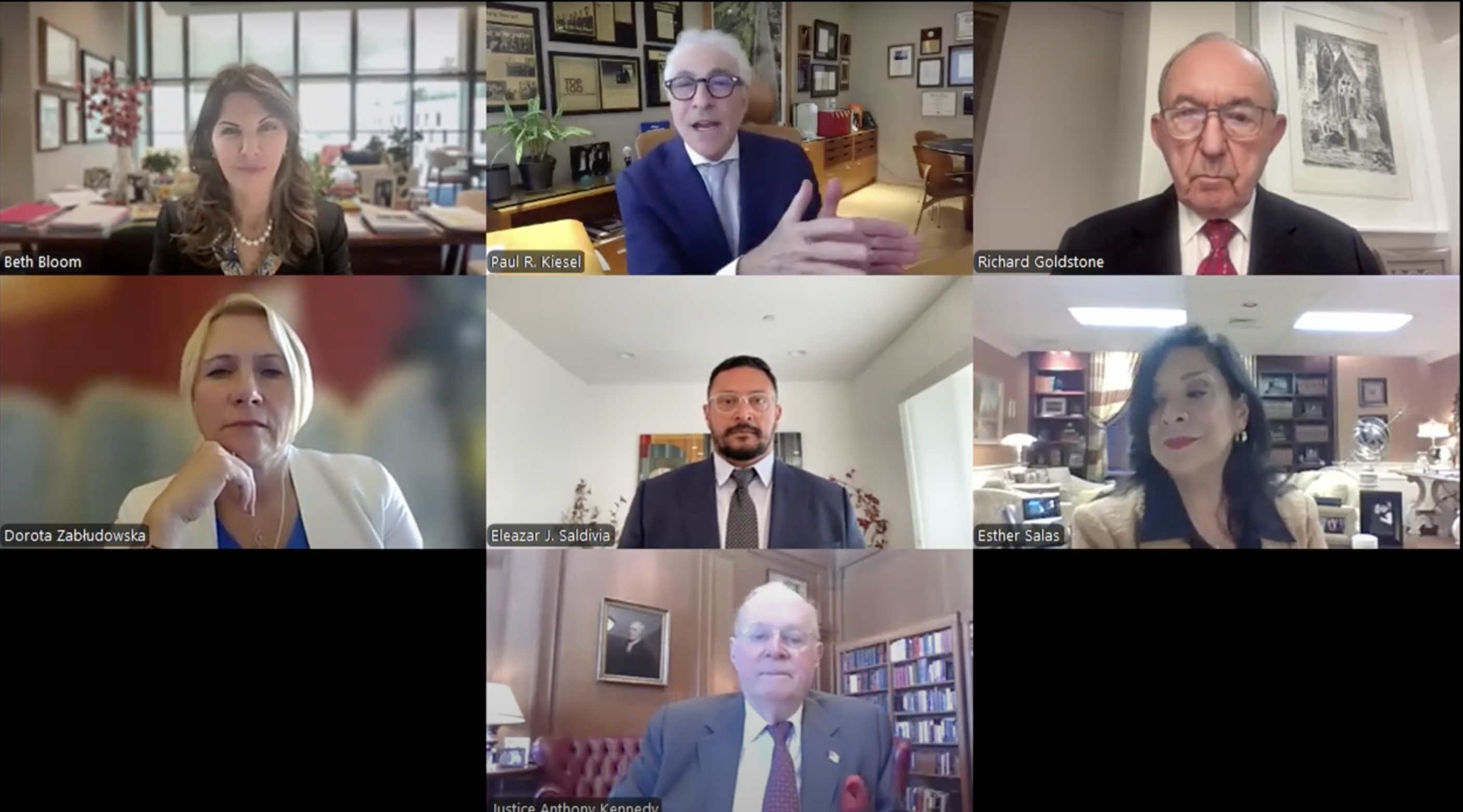
On June 26th, 2025, Connecticut College alumnus Paul Kiesel ‘82 moderated an event entitled Global Risks to the Justice System– A Warning to America. This forum served as one of several renditions in a series of panels hosted by Speak Up for Justice, a nonpartisan forum dedicated to fighting for the independence of the federal judiciary.
Paul Kiesel graduated from Connecticut College in 1982, and went on to receive his J.D. from the Whittier College School of Law. A partner at Kiesel Law LLP, he has served as one of the most distinguished lawyers in California throughout his career, gaining recognition as one of the top plaintiff lawyers in the state of California. Kiesel organized the first virtual nationwide event held by Speak Up for Justice in April, and has continued to bring together judges from across the world to share their stories since then.
This mission has become increasingly more urgent as personal threats to federal judges have increased in number under the Trump administration, and the continued executive branch control of the U.S. Marshals Service (USMS) has faced growing public criticism (The USMS was established in 1969 as a branch of the Department of Justice, dedicated to protecting loop the safety and security of federal judges and enforcing federal laws, such as carrying out court orders and operating the federal Witness Security Program, known colloquially as witness protection). The June 26 event featured a number of notable speakers, including retired Supreme Court Justice (1988-2018) Anthony Kennedy, several U.S. District Court Judges, and premier justices from Venezuela, Poland, and South Africa.
The event opened with remarks from former SCOTUS Justice Kennedy, who acknowledged the fact that preserving judicial independence has fallen to the background of national concern given the pressing conflicts in the Middle East. With regards to the U.S./Qatari-brokered Israel-Iran ceasefire, Justice Kennedy pointed out that peace around the world gives us the opportunity to pursue freedom and democracy within our own spaces in the U.S. He went on to add that judges are best protected when the public, and the nation, realizes how central they are to our civil discourse. As he described, judges are responsible for teaching the importance of freedom and democracy in our society: those values are not naturally preserved, they require assistance- especially in times of global tumult. With regards to this role, a good judge is one who constantly questions the law, the systems under which they operate, their own decision-making, and how our “big C” Constitution functions in today’s America.
Justice Kennedy went on to say that his greatest hope is that young people will continue to learn about the Constitution: “The purpose of our nation is to preserve and enhance freedom for ourselves and the generations to come, and that is what judges do. And so at this time when we are celebrating peace in other parts of the world, we must remember that peace is what gives us the opportunity to make democracy stronger and freedom more attainable- we must always say no to tyranny and yes to truth.”
With those powerful words, the conversation pivoted to the personal story of Eleazar Saldivia, Former Federal Judge of the Anzoátegui State Circuit in Venezuela. Judge Saldivia shared the jarring story of the rise of authoritarian government in Venezuela in the 2000s, and how it began with subtle encroachments on the independence of the judiciary by the increasingly all-powerful executive branch. Judge Saldivia recounted how, after he ruled in 2013 to sentence four police officers to jail for assaulting anti-government protestors, the federal government pressured him to reverse his ruling. When he did not budge, the safeguards in place to protect judges from harm began to vanish before his eyes. He was harassed, threatened, doxxed, and ultimately forced to flee the country for his own safety, just as many of his colleagues had in years before. He recalled at the end of the forum that his greatest regret in the situation was not speaking up sooner to the violations of civil liberties and checks and balances that he saw, remarking rather harrowingly that “dictatorship in Venezuela didn’t arrive with tanks… it came dressed in judge’s robes… the justice system had become a weapon, not a shield.” Judge Saldivia closed out his testimony by circling around to his role as a legal scholar in the U.S., saying that “I’m not here to talk about Venezuela. I’m here to warn you that this can happen anywhere. The signs are always subtle. Encroaching executive orders, courts filled with political loyalists, judges punished for their rulings…Democracy doesn’t die overnight- it begins with silence inside rooms, behind closed doors, and then within the minds of those who know better, but say nothing.”
The discussion continued with brief remarks from Polish District Court Judge Dorota Zabłudowska, former President of the International Academy of Trial Lawyers Karen Burgess, and most notably, Richard Goldstone, a former Nelson Mandela-appointed Justice of the Constitutional Court in South Africa. Judge Zabłudowska focused on the importance of making sure the courts are not on their own, and that every judge who has ever been harassed and intimidated knows that they had the will of the people behind them in those moments. Burgess then shared the chilling story of a Dutch colleague who had informed her that the international community were the ones looking out for the U.S. and fearing for their lack of freedom and democracy, not the other way around. Burgess said that she wasn’t surprised by this statement, as the U.S. has systematically gutted civic education to the point where we have a public that doesn’t understand why so many orders from a president many of them voted for are blatantly illegal. She remarked that because of this, when discussing the rulings of judges and the role they play in society, that “we must not dismiss rhetoric as a tool: because the enemies of the law certainly don’t.”
Judge Goldstone wrapped up the conversation with the story of his time as a judge who consistently challenged the Apartheid government, sharing notably that even when the courts issued a ruling the government did not like, they consistently allowed the judiciary to operate in an independent capacity, a rare phenomenon in the history of conflict between the branches of government. He remarked about the U.S. that “our founding fathers built in a system to appeal opinions we don’t like, one that does not allow for ad hominem attacks on judges.” He continued on by saying that therefore, it is critically important for every citizen to understand what each branch of the government does, and what the responsibilities of the judiciary are. Judge Goldstone noted that “this is a question of civility and respect for what each branch of government is doing… if respect is lost for one branch, it is the end of democracy and the end of the rule of law.”
Former Justice Kennedy echoed these sentiments, warning in particular that partisanship has played an unfairly large role in confirmation hearings over the past decade compared to temperament, learning, background experience, and other qualifying factors. He rebuked the idea that judges are inherently partisan figures, saying that “judges decide issues which have political consequences, but they don’t decide things in a political way. Judges aren’t put on the bench so they can do as they like, they are put on the bench so they can do as they must.”
Kiesel closed out the forum by pointing out that in June, for the first time in recorded history, the Department of Justice has sued 15 district court judges in Maryland, an unprecedented legal action taken by the organization that is designed to protect judges and enforce their rulings. He remarked that “never before in this country has our justice system played a more vital role in our democracy than it does today.”
Speak Up for Justice hosted a subsequent virtual event, Judges Break Their Silence: Attacks, Intimidation and Threats to Democracy, on July 31st.