Courtesy of Mia Whipple ’27
If you hear choruses of “I am not throwing away my shot”, have no fear. You have not traveled back to the nostalgic frenzy of 2016. You are simply living in the 2025 Hamilton resurgence, though it seems the fervor never truly died down.
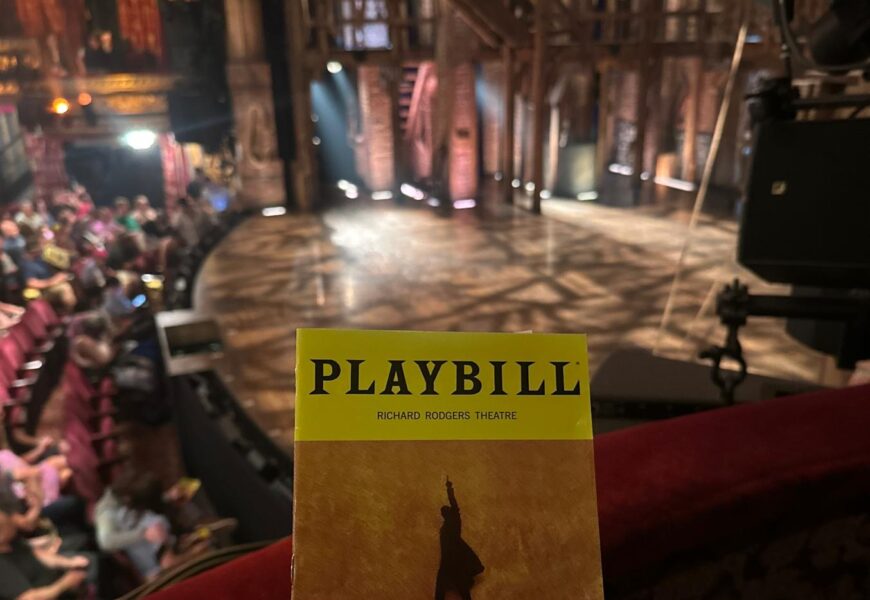
The cultural touchstone that is the musical Hamilton is celebrating its 10th anniversary with a theatrical release in theaters nationwide. I recently went to see the R&B musical on the big screen and was struck by the talent and painful truth of this production. At its core, Hamilton reminds us that our past echoes far into the future. It is a staunch reminder that democracy is paramount and freedom is non-negotiable.
I have seen the Hamilton movie several times. The musical’s genius lyricism never fails to leave me speechless once the credits roll. All I can think is “how did someone write this?” The next thought is always “thank god someone wrote this.” It is ironic how a story very few knew was a story we all needed. It makes you wonder how many untold epics there are out there that could inspire a generation.
Each time I rewatch Hamilton, one performance stands out. This time, the lesson came from Hamilton’s comedic villain, King George. His iconic solo, “You’ll be Back,” has always received audience laughter. The king’s cocky attitude and singsongy delivery of threats towards the revolutionaries is frankly quite funny. At the showing I went to, an audience member even dressed up like him. The truth is, King George is laughable. Here is a man in a powdered wig and Spirit Halloween-esque royal garb having a tantrum about losing his grasp on power. He is a pathetic ruler who enacts violence against his citizens to get his way. He deserves to be laughed at.
However, on this auspicious 10th anniversary, the laughter has given way to more of a nervous chuckle. In years past, King George’s song has represented everything we have overcome. This year, it is a striking reminder of all we have to face. Summer 2025 was marked by nationwide No Kings protests, a response to a man hell bent on achieving mass control by any means necessary. Watching the news or reading the headlines, I cannot seem to silence King George, serenading the audience as he gleefully threatens that “when push comes to shove, I will send a fully armed battalion to remind you of my love!”
As hauntingly familiar as the show is, the entire story is one of overcoming seemingly impossible odds. The main character of the show is a great example. Creator Lin-Manuel Miranda chose Alexander Hamilton as the show’s narrator because of his turbulent youth and subsequent career. Miranda explained his choice to NPR, asking, “What are our favorite hip-hop MCs, if not chroniclers of their own struggle and their own surroundings?” I love this description, which argues that history belongs to us all if we choose to tell it. This particular quote has sat with me as I look at it through a modern perspective. It appears that our generation chronicles our struggles, both personal and global, on social media. We know more about each other than ever before. We have built an archive that is incredibly vast and complex. However trivial, this content is necessary for telling our story.
What is history if not chronicled? Dust. This tumultuous moment will one day be history, and you are living proof that it happened. Write it down, how this moment makes you feel. Do not let someone far removed tell the story of survival, fight for liberation, of the moments where time feels still and progress is untouchable.
Hamilton is beloved in part for its timelessness. It moves with the current of our nation; it speaks to struggles that were overcome, it speaks to longing, it speaks to devastation and mistakes, and it speaks to that pesky creature called hope. The diverse casting allows each audience member to see themselves reflected in history. Hamilton tells us that history is not a luxury to be owned. History is to be shared and disseminated, plucked from obscurity and chronicled.
It is no fluke that Hamilton is famous. People are not silly for attending a nearly 3-hour-long musical about a treasury secretary. We simply long to understand our past, which is a relative of our present. Our longing to understand is an innate part of our human nature. Still, it must be cultivated, else we risk someone else telling our story.