Courtesy of Sean Elliot
Camel of the Edition is a series that seeks to highlight extraordinary Connecticut College athletes who have stood out from the herd due to their recent performances or as a leader on campus or on their team.
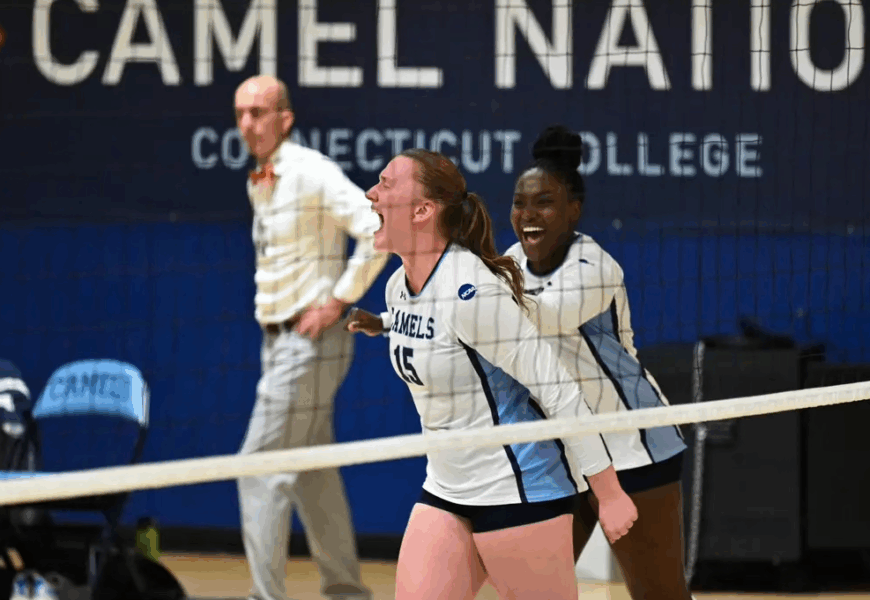
Rae Wartelle ‘27 is a middle blocker on the Connecticut College Women’s Volleyball team who provided the group with outstanding play on the offensive and defensive sides of the ball in route to receiving the college’s second-ever NESCAC Player of the Week in volleyball last year. The junior from Tacoma, Washington, was a vital piece to the roster that went 15-9 in their best season of the past decade in 2024.
Recently, The College Voice caught up with Wartelle to talk about the new concepts and training methods the team is implementing, how to use a mental game to build efficiency, and what music is hyping up the roster this year.
Can you please introduce yourself?
Yeah, my name is Rae Wartelle ‘27. I use she/her pronouns. I’m a film studies major and a French minor, in the Creativity Pathway, and I play volleyball. I’m a radio host for WCNI, so I have my own radio show every other Sunday from 3 to 6pm. I’m also a member of our leadership council for volleyball.
Tell me about your sporting journey, and when did volleyball become your focus?
Growing up, I just did every sport, like most kids do. I was involved in a lot of stuff on the musical side of things, and also [in] athletics. I was a theater kid in elementary and middle school. I think around middle school, it came down to picking what sport I was going to do. In seventh grade, I started playing club [volleyball]. Before that, it had really been basketball and volleyball that were my two real passions. I started doing club volleyball, [and I] really fell in love with volleyball then. I was still involved with my musical interests; I played the piano, sang, and did choir, but not as much theater. Then it became more athletics-heavy. In high school, I played basketball and volleyball. For both sports, we went to state [championships], and we had really good runs. We really built the volleyball program up in my senior year [and] we finished second in the state, which was cool.
What was your recruitment process like, and why did you end up choosing Conn?
When I was thinking about playing, I knew I wanted to play a sport in college. When I started playing club volleyball and it became something I could do. Everyone has the dream of going DI. I remember in eighth grade, I went to our athletic director and asked, ‘How do I play collegiate volleyball? I want to do this.’ As I got into my sophomore and junior years, I started really thinking about what I actually wanted from my college experience. Through that process, I realized I love volleyball, but I didn’t want it to be my life. I think also pursuing the musical side of things and having other interests beyond volleyball made it clear that DIII was the level I wanted to pursue. Having an opportunity for a really great education was [also] really important to me. I reached out to a lot of NESCACs. I had the vision of the East Coast small college. I went to a really small high school so I think that was also part of what I wanted from my college experience: having a tight community, great relationships with professors, and small class sizes that worked for me. Then reached out to Conn. I was talking to a few schools in the NESCAC and when I visited Conn, I honestly wrote it off. I wasn’t really thinking it was going to be my first pick. After [visiting] a couple of other schools in Washington and on the East Coast, I was like, Conn is it. The team was so great and I loved the coaches. Coach Josh [Edmed] came to a couple of tournaments that I played in. It just all worked out and then I applied ED and got in. I also totally romanticized the East Coast small college because of Gilmore Girls. I joke about that, and I’m not proud of it, but I really think Gilmore Girls was part of dreaming about that Connecticut vibe somewhere in the back of my mind.
As a middle blocker (MB), can you talk about your responsibilities and what makes the position so attractive to you?
I love to swing and hit the ball. If I’m being honest, that is so fun—it’s so satisfying. There’s something really fun about the pace of being a middle [blocker] and the speed at which you have to move across the net and transition. [That’s something] we’re working on a lot right now, because especially in the NESCAC, we’re playing really high-level teams and the pace of everything is a lot faster. I think that was something coming into this year that I really wanted to work on. I just love getting a really good transition swing where you go up for the block, get a block, and then get off the net and put the ball down. It’s just so fun. I think there’s a big asset in being a middle [blocker] where you can open up the net for your other hitters, which is something that I think is not given enough credit. We’re calling for the ball in the middle and then the blockers line up on us, but the other pins get to get a big swing. There’s something really fun about opening up the net and helping out your teammates to get a big swing. So much of it is response and being able to read the block and read the hitters. Our job is to give the players on the other side of the net a lack of vision too… [and] there’s a lot that goes with that.
Courtesy of Sean Elliot
Last season, you were second on the team in kills and points, as well as 15th in the NESCAC in total kills. Can you talk about what makes you such a problem on offense?
Well, I think something that we’ve been working on is, like I was saying with that transition footwork, being available for every ball like that I can be. We’ve been working on the setter so that even when the pass is off the net, which is harder for a middle to hit because the pace and speed of the set is so much faster, and there’s less time for transition and a larger margin for error. So when the setter is pushing the ball to us in the middle, there’s the angle of approach you have to be able to get off fast enough so that you can get a tight enough swing. I think what we’ve been working on is really like making sure we’re available every time. Our setters have been working and so much of it is credit to the setters. What makes me the problem is that we push the ball in transition all the time. We’ve been working really hard with the coaches on our angles. If we’re hitting one to five, or if our body’s facing one to five, being able to cut back from one to one. If you’ve been swinging an angle, being able to switch it to back to your body line. Being able to switch up shots, using our handball contact to our advantage, and transitioning, I think, are the biggest reasons.
Coming off a 2024 Fall Weekend performance against Amherst, where you posted 26 kills and four blocks en route to 28 points on blistering efficiency, you were named NESCAC Player of the Week. As one of only two Camels to ever be named NESCAC Player of the Week in volleyball, what did it mean to you to receive this honor?
Well, it’s cool. I was sort of surprised, honestly. When you’re on the court, at least for me, I’m not thinking about statistics and those sorts of honors or awards. You’re going out there to crush the opponent. You have a job to do. Even after the game, I wasn’t aware of that. When it came out, it fired me up in a way that I had to get back in the gym. It [also] meant a lot to have that recognition. It’s nice to see your hard work pay off. It’s gratifying. Even though you’re not looking for that, there’s still something that feels really good to get that recognition. It was just so fun and my team was so awesome and celebratory. I’m from Washington, so from afar, knowing that my parents were able to see, because they can’t come to the games, and know that I am doing it like that. It was just cool.
Now in your third season, you have shown dramatic improvement year after year, with your point total through the first nine games of this season almost matching your point total throughout your entire first season. What have you learned or added to your game to show such rapid improvement?
I know I keep talking about that transition speed but that has been critical. We’re always in the weight room training and getting better. Our jump and our timing, putting that all together. Being able to get off the net and get a really good swing, I think, really contributes. And honestly, putting two and two together with the block. When I land, if I go out and block, automatically having it ingrained to get off the net right away. Whereas before, I think it wasn’t as habitual and it’s been really cool to see that growth. One thing that I’ve been really working on is hitting a heavier ball. Swinging with as much power and force as I can, and looking for a deep court because it’s really hard to defend those deep court angles and corners of the court on the other side. I’m trying to focus on those shots as well.
Another significant part of your game is your efficiency. You are currently tied for sixth in average kills per set, which is even up from your mark last season, where you ended the year as the 13th most efficient scorer. How have you built your game to be so efficient and do you think there is further room for improvement in that metric?
I think I try to be really intentional, especially with the sets that we’re given. I think one thing is that I tend to [be] errorless. That’s an important part of my game where I know I can put the ball away effectively. But it’s also keeping it in situations where, say there’s a bad set, still being able to get the ball over the net. That’s an aspect of my game that I think helps me be efficient. I know what sets to use, what attacks to use in what scenarios, and really having this drive. I really want to go out there and score when I step on the court. I’m always thinking about ways I can score, rather than just keeping the ball alive. I’m thinking about my shots before I’m even on the court. If there’s ever a middle back row or if a middle serves, and we know their back row, I’m going to swing at the middle, because I know they’re not as strong of a defender. I think my mental game is also a huge piece of it. There’s always room for improvement. I think efficiency is the name of the game in volleyball, especially because it’s a game of errors. It’s the first person to make a mistake, that’s part of the sport. I think for me, it’s continuing to work on that transition footwork. I think we were talking about efficiency and I think that comes a lot with my footwork. Using less steps, more powerful steps, and powerful movements, taking bigger, longer approaches, broad jumping, generating my speed, making my approaches so that I’m picking up pace. Working on new attacks, we’re working on a seven that we’re hitting in a slide approach footwork, that’s a really fun hit and something that we’re adding to the arsenal.
Last season was the team’s highest win percentage (.625) since 2015. How were you guys able to perform at such a high level and are we looking at a new golden age of Camel Volleyball?
I hope so. It feels like it. It really does. I think we’re moving towards that and getting there. I think we’re still in that growth period but one of the biggest assets has been having an assistant coach. I think we had our first full-time assistant coach last year, [Coach] Mathilde Verbitsky, and she’s been so great. She and our Head Coach, Josh Edmed’s, dynamic works really well. They provide us with a really great coaching staff and an analytical, strategic, and technical perspective and are just really nice people. I think that was really great for the program and helped us really make a big jump. Also working on getting the ball to the middle has been a big part of our jump. I think we’re making our offense and tempo faster. We’ve constantly talked about tempo and getting our balls in tempo, using our BICs, and the back row attacker. That’s been another aspect of the play that’s helped improve and our serve receive has been so dialed in. We have a lot going on. But I think we’re prepared for it and upping our game and really taking practice seriously. Practice how we’re going to play.
What do you hope to accomplish this season for yourself and with the rest of the roster?
Personally, hitting the 400 kill mark this year already was really exciting. Continuing to work on building that and getting more aggressive with a faster tempo. I don’t really think about my own statistics a lot like that. It’s just not my main concern. That’s why it’s funny hearing all these statistics. It’s cool to hear it, but it’s not something that I’m conscious of. I think a lot about leadership and the mental side is what I really feel like I coach myself on if I’m doing the research myself. Continually working on being the best I can be for the team and being the best leader I can be for the team in a not-so-technical way. But in terms of the team as a whole, I think goals-wise, we’re hoping to be [in the] NESCAC final four. That is the first step to getting a NESCAC championship and then getting in the NCAA tournament and then being NCAA champions. So obviously that’s the dream, but I think it starts with the final four as our goal this season.
What advice would you give an athlete to become the best possible player they can be?
Well, I think one of the biggest things for me was really thinking about what I wanted and needed out of my education and what I wanted to gain from the sport. I think a big aspect of the sport is the team atmosphere for me. Really having community and a competitive environment. There are these things that are more about your experience while you go to school, I think, that are critical. You want to enjoy what you’re doing. I would encourage a younger athlete to really weigh their options and think about what’s going to make them the happiest. You want to be enjoying your sport and have longevity within it too. Also the hard work pays off. When you’re in the gym, getting those reps, like there’s nothing that can help you excel more than that.
Does the team have any special team bonding activities, traditions, or pre-game rituals?
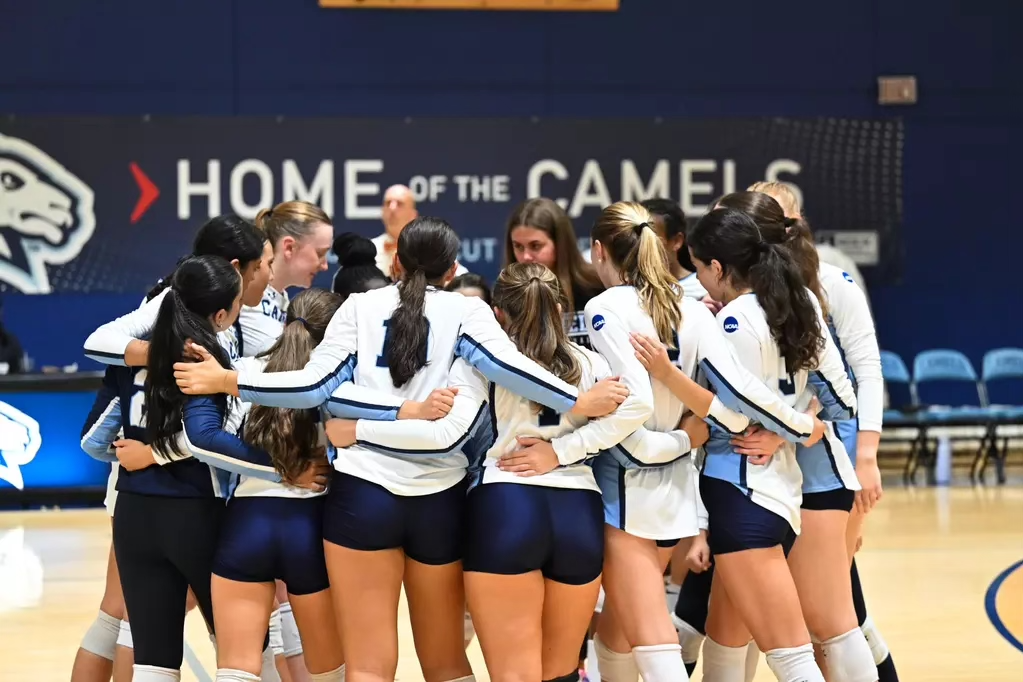
Well, the first one that comes to mind is this dancing game. We listen to Calabria before every game, we each have a signature dance move and it’s a game where you pass along your dance move and if you miss your turn, you’re out. It gets our vibes hype and excited.
What would be your walkout song for games?
So I really like house music. I listen to a lot of Fred Again. I think, notoriously, I’ve always listened to Jungle by Fred again. That’s specific, but I really like that. Our walkout song for the team is Thunderstruck by AC/DC and I honestly love that song. That will get me hype and in the zone. My dad loves AC/DC so it always makes me think of him and he’s been such a big part of my athletic journey.
Are there any games coming up that you guys have circled as an exciting matchup that volleyball fans must tune into?
The Coast Guard match. They’re next-door neighbors which is always a fun one. We’re very equally matched. We always play them twice, we scrimmage them at the beginning of the season and then we play them in a legit match that’ll go on our record. We’re playing them later in the season this year so we’re going to be all the more ready. We will play them [at home] on October 15.
Is there anyone you would like to shout out or any last comments you would like to make?
Well, shout out to the team, of course! They’re the ones that make it possible to achieve those statistics as you listed. It’s such a team sport; it wouldn’t be possible, we need three people to touch the ball every play. Shout out to my parents! They have been so supportive. They got me here and the whole journey is because of them.