Courtesy of Amelia Racicot ’27
House senators have been the building blocks of SGA since 1988. There’s one primary issue with this: in 1988, House Senators emerged not only out of the previous ‘House President’ position– sort of an RC, House Senator, and club president all in one– but also out of the larger house-centered culture of the College. It’s almost unimaginable to today’s Conn students: houses were your friend groups, they were the people you ate dinner with, hung out with all night in common rooms, and threw events and parties with.
For some years, SGA has been realizing that the House Senator system worked best forty years ago with a house-based campus culture, where representatives knew their house communities well, and could actively and appropriately represent them. The need for a new system has become especially clear this year, when multiple houses did not elect representatives and therefore aren’t receiving information or representation from a senator.
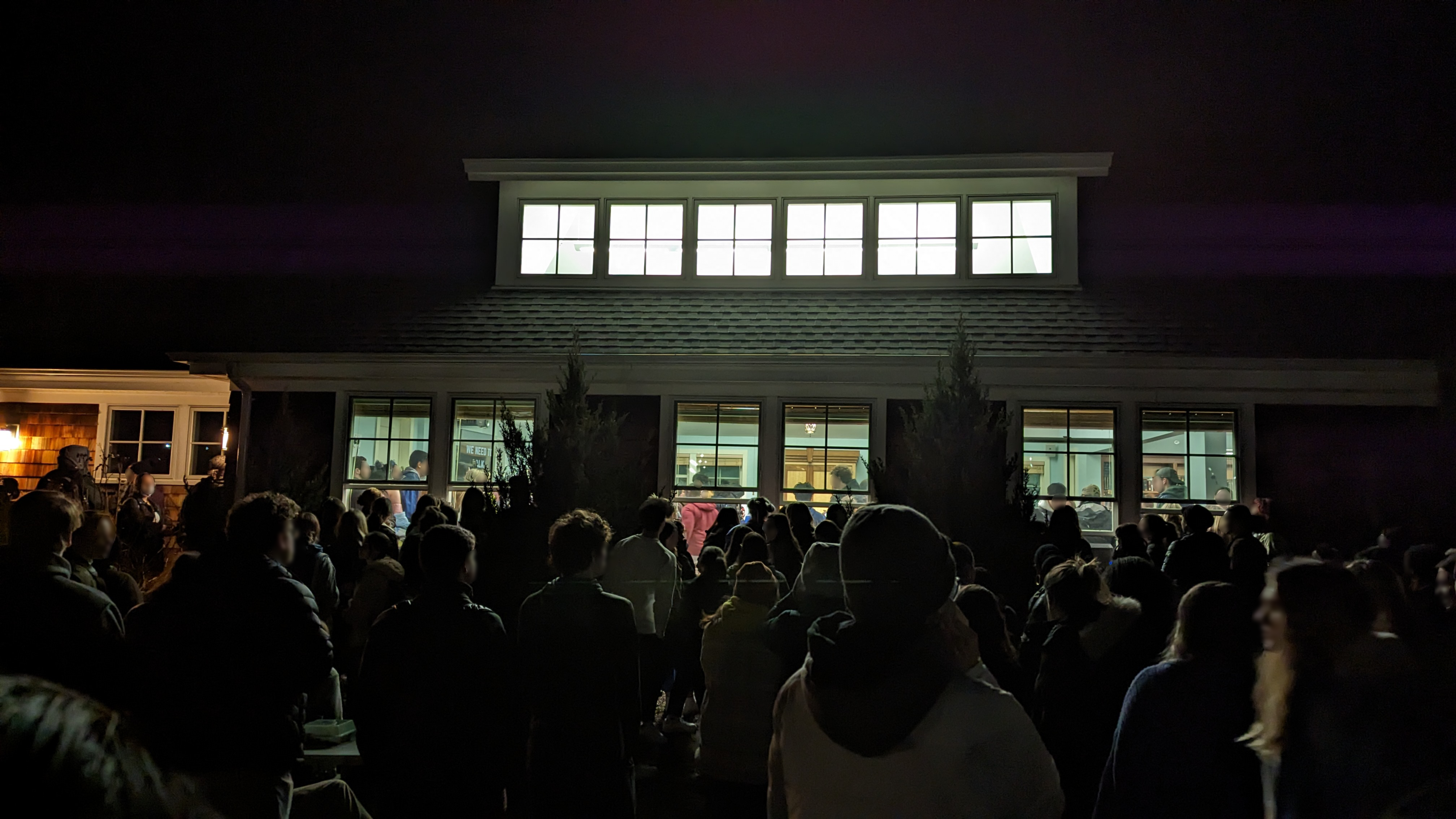
So what now? A new SGA committee, accurately titled the Committee on Student Representation Reformation (CSRR), has taken the job of finding a solution to the problem, and imagining a new system of representation. This past Thursday, the Committee held an open forum to present an idea for a new system, and to gain feedback on the proposal from the General Assembly and club leadership.
Some of the things that we are committed to maintaining or keeping in mind are, first, the general number of people in the General Assembly, as to not diminish or overly-increase the amount of representation the student body has, and to attain as much diversity of representation as possible. In order to do this, we focused on matching the club-centered culture of campus– taking the old house-centered model into consideration, we strived to find a modern equivalent that would build trust between students and representatives. Also, a primary objective of the new system is diminishing the amount of stress and workload placed onto the Executive Board, by connecting representatives more directly with the E-Board positions, and making committee work stronger and more structured.
This below map is what we presented as a preliminary idea– keep in mind, we received a lot of feedback, explored further below, that will almost definitely change most of this:
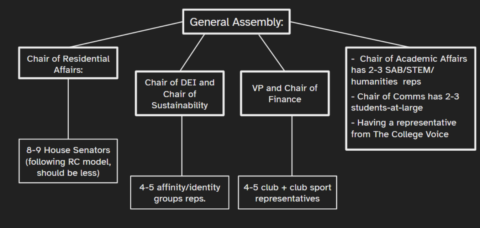
Representatives from clubs could, from one proposal, be elected in open elections during which anyone from the executive boards of affinity groups, clubs, or club sports, in separate categories, could run to be a representative, and would be responsible for representing the interests of that grouping of student organizations. House senators, in this model, would still exist, but would instead be grouped together based on the current RC model, therefore needing fewer representatives.
We received a lot of extremely useful feedback from the General Assembly and other students in attendance at the open forum. One particular topic of note was deliberations over the issue of best representing affinity and identity groups, and how to ensure that elections did not turn into competitions for representation, or unfairly favor certain groups over others. Accounting for fatigue experienced by affinity and identity group leadership was also discussed, and one suggestion was that the representatives be volunteer-based. It was also brought up that there should be far more than three to five representatives from all affinity/identity groups, and different solutions were offered on how to possibly organize larger meetings for representatives.
Though the issue of how these elections could be held was not resolved, some proposed solutions included having internal nominations before a general election, similar to how non-elected E-Board positions have been appointed previously through, more or less, a vote of confidence. Another note of concern was on whether these elections would be whole-school or solely open to the people involved in those clubs and organizations, and if there were multiple rounds of elections, making sure that these elections happened in a timely manner, possibly including the summertime, to ensure that SGA can begin work quickly after the academic year starts.
Another issue of note was on the value of keeping the House Senator position. Voices in its favor pointed out that having an equivalent representative position to RCs would be extremely useful in reporting physical issues with dorms, and also that it would be smart to keep representatives for students not involved in clubs, in addition to whole-student-body representatives. In terms of staffing committees, we envisioned that representatives from any area would be free to also attend other committees under other E-Board members, besides ones that wouldn’t require additional membership– and also encouraged that more committees should be open to all students-at-large as well.
When discussing whether or not House Senators should keep sending emails in this new system, though, voices spoke in favor of increasing the responsibilities and role of class council and class presidents through communications. One suggestion was that class presidents send out emails to students with SGA updates, which would be a positive responsibility for class presidents, though these emails would be going out to hundreds of students at once. Relatedly, some advocated for abolishing the House Senator position altogether, and creating new positions with students-at-large serving as representatives under the class presidents, and strengthening the class council model.
Other issues brought up included: enshrining first-year representation, encouraging more in-depth campaigning and information about individuals given during elections, and building in representation from organizations like GSP, SVPA, ORSP, and REP.
The Committee will continue to meet this semester and next, in order to develop the new system further. More open forums and opportunities for feedback are planned for next semester, but in the meantime, please, please take advantage of the multiple channels available to you for feedback. If you have been provided with the feedback form link, feel free to respond there, or otherwise, email me at mandres@conncoll.edu, reach out to your House Senator, or write a response or proposal here in The College Voice any time.