Courtesy of Sean Elliot
Camel of the Edition is a series that seeks to highlight extraordinary Connecticut College athletes who have stood out from the herd due to their recent performances or as a leader on campus or on their team.
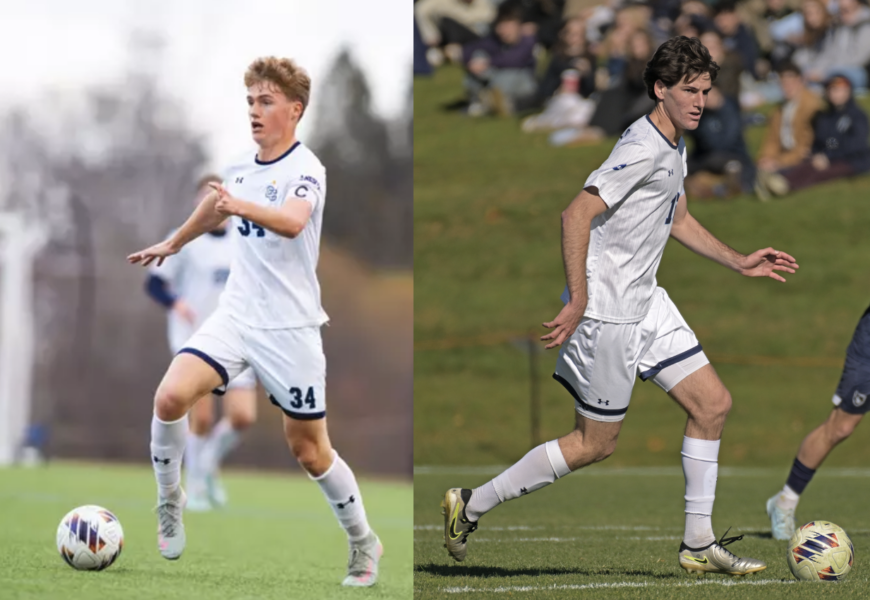
Max Haberman ‘27 and Sam Brockelman ‘26 have been integral members of the Connecticut College men’s soccer team who have made it to the NCAA DIII National Championship in 2024 and NESCAC Championship in 2025. Haberman, a junior captain from San Diego, California, has appeared in every match for the Camels since his arrival and was recently honored as a member of the All-NESCAC First Team and as NESCAC Defensive Player of the Year. Brockelman, a senior captain from Topsfield, Massachusetts, did not appear in a single match his junior year due to a serious hip injury. This year, he overcame this injury to appear in all but one of the Camels’ matches during his senior fall. Both played key roles as midfield partners in the Camels’ system as the team made it to the finals of the NESCAC Championship and the Sweet Sixteen of the NCAA DIII Men’s Soccer National Tournament.
Recently, The College Voice caught up with Haberman and Brockelman to talk about how they excel in their roles as midfielders, how Haberman has managed to appear in every match since his arrival, how Brockelman came back from a serious injury, and what the Camels hope to accomplish next season.
Could you both please introduce yourself?
MH: My name is Max Haberman, he/him pronouns. I am a Quantitative Economics and Econometrics major, Finance and Hispanic Studies minor. I am a junior captain and member of the Student Athletic Advisory Committee (SAAC).
SB: My name is Sam Brockelman, I am a senior at Connecticut College. I am pursuing a double major in economics and Hispanic Studies and am a part of the Entrepreneurship Pathway. I have been involved on campus in a variety of ways including as a member of the Student Athletic Advisory Committee (SAAC), a macroeconomics tutor, a Team Impact fellow, and a CONNections Student Ambassador. I also spent four years on the men’s soccer team as a midfielder and was elected captain for my senior season.
Explain your journey in sports. How did you end up choosing soccer?
MH: I started playing soccer when I was four or five and tried one year of other sports but my dad is very into soccer, so I was drawn towards soccer more. After a few years, I was pretty good at soccer so I just stuck with it.
SB: I grew up playing a ton of sports, including baseball, basketball, tennis, swimming, soccer, and more. When I was a freshman in high school, I played soccer in the fall, basketball in the winter, and tennis in the spring. When I went into my sophomore year, I spoke with my parents about my dreams to play soccer at the collegiate level and we decided that I would stop playing basketball to focus a bit more on soccer while still playing tennis in the spring. For most of my soccer career, I have played in the midfield because I enjoy being the engine of the team.
When did you realize you wanted to play soccer in college?
MH: Going into my freshman year of high school, I was definitely interested in soccer but I was not sure at what level, so I started with DIII first. By the time my junior year rolled around I was pretty sure I would play at the DIII level and went from there.
SB: I knew from an early age that I always wanted to play college athletics. When I was a freshman in high school, it was clear that soccer was my strongest sport and I loved to play, so my parents backed me [up] and supported my decision to go all in on playing college soccer when I was 15.
What was your recruitment process like and how did you end up choosing Conn?
MH: I started looking at the NESCAC pretty seriously and was in communication with [Coach] Reuben [Burk] and [Coach] Andrew [Storton] a lot and their communication and belief in me really drew me to Conn. I saw how [meticulous] they were and [how] they definitely took the time to know me as a person rather than just a player. I was a late bloomer in terms of my soccer ability and Reuben emphasized that I could be a key contributor to the team. I also visited the school during my spring year and met a few guys on the team. I liked the guys I met and it seemed like a good spot for me.
SB: My recruitment process was fairly straightforward in the sense that I knew I wanted to be at a college and play on a team that emphasized strong academics, a solidified team culture, and small classroom sizes. I looked at a lot of DIII schools and specifically a lot of NESCAC schools. I went to an ID camp at Conn College in the summer before my senior year and the coaching staff liked what they saw. A month or two later, I received a call from my coach, Reuben Burk, and he offered me a spot on the team. Everyone’s journey through the recruiting process is different and it can be quite stressful. Looking back, I am so grateful it all worked out the way it did and I ended up committing to play for this program.
Both of you play as midfielders. Max, in Conn’s system, you serve as the pivot of the midfield, playing behind the other midfields and serving as the link between the defense and midfield. While Sam, you play higher up, but serve as an equally important link for the defense and offense. The midfield role is difficult to play with a combination of fitness, creativity, positioning, communication, spatial awareness, passing ability, defending, and offensive prowess required to excel and link the team’s play from the defense to the offense. How have you two worked to improve at these skills and excel in the game, knowing the important role you play?
MH: A very important aspect is soccer IQ. I pride myself on knowing how to control the game offensively and defensively, speeding or slowing down the game offensively based on how the game is going. Defensively, trying to block balls and intercept passes is crucial. I’d definitely say soccer IQ and understanding the game are the most important aspects. Physicality and endurance are also important because being fit and able to run a lot is important to being successful in the role.
SB: The midfield is a key part of any team and it is true that it requires a certain type of attitude. I learned quickly when I came into the program as a freshman that, as a midfielder, you have to be willing to do it all. In other words, you have to be committed to improving your defending, fitness, vision, communication, passing, and leadership skills. These are skills that I have seen improve over my four years through the help of my teammates and coaching staff. I picked up a lot from my teammates, both in terms of tangible skills and tricks, as well as from their attitudes, effort levels, and willingness to learn. I can honestly say I would not be the player I became without the help of my coaches and the ability to learn from such great teammates.
Sam, as a first-year, the men’s soccer team had won the DIII National Championship the prior year and returned many key contributors and fifth-year seniors. However, the team finished 3-5-2 in NESCAC play, lost in the NESCAC Championship, and failed to make the NCAA National Championship. Personally, you only played five matches before not playing again after October. What was this season like for you as a first year?
SB: My first year of college soccer was a wake-up call. As a team, we struggled to get results despite grinding, fighting, and playing some quality soccer at times. It was incredibly frustrating for us as a group because we knew the quality we had and felt like we were not playing to our full potential. Personally, it was a difficult experience for me not seeing much playing time on a struggling team. However, it was such a great lesson in resilience for me because I decided that no matter how much I played, I would give my best effort in training every day. I learned a lot about myself, going from thinking that I was “the man” in high school to seeing very little game time. I am so grateful I had that experience because it made me realize that everything in sports and in life is earned, not given.
Max, as a first-year, you made an immediate impact, appearing in all 21 of the team’s matches as the men’s soccer team went undefeated in conference play, finishing 5-0-5, winning the NESCAC regular season crown and making a deep run to the elite eight of the NCAA national championship. Sam, you made a big jump–-appearing in 16 games, starting 13, and scoring two goals and one assist. What was this experience like?
MH: Coming in from high school, I played center back and defense a lot. But at Conn, I also played a lot of center back, right back, and in the midfield. I played more of a utility role on the team. I understood, even though I wasn’t starting every game, I was getting impact minutes which made me an experienced player [allowing me to] adapt to the physicality of the NESCAC. Playing as a freshman in a physically competitive league like the NESCAC was difficult so playing a lot set me up for success. I’d say for club and high school, the style of soccer is more possession-oriented, but teams are trying to play the right way, in my opinion. But in college, there is a lot more of attacking the ball and kicking the ball up. Everyone’s also more athletic, bigger, stronger, faster. My height and my endurance helped me the most
Sam, the following season, the men’s soccer team went undefeated in conference play, finishing 5-0-5, winning the NESCAC regular season crown, and making a deep run to the elite eight of the NCAA national championship. On a personal level, you made a big jump — appearing in 16 games, starting 13, and scoring two goals and one assist. What sparked this shift in results compared to the prior season?
SB: Our team had a great season my sophomore year and the work started all the way back in January. We did so much work in the off-season between lifting, training, running, meetings, film review, etc., and it truly paid off. Additionally, we had a lot of quality first-years come into the program and add a lot of quality to an already deep roster. Young players contributing and stepping up as first-years and sophomores, as well as excellent leadership and buy-in from the juniors and seniors, were a great recipe for success. Personally, I worked hard in the offseason to improve my physical fitness, strength, and technical ability. Through the work I put in, I felt like my confidence grew, and when I came in for my sophomore season, I was prepared to contribute to a team competing for a NESCAC championship and national championship.
Last season your team won the NESCAC Championship and made it all the way to the DIII National Championship. Max, you were a key contributor starting every match while Sam, you did not appear in a single match due to injury. What was the experience like and what made the team so successful?
MH: Last year, we had a really special group of seniors and we had six guys come back for a fifth year. That leadership and confidence that they had really impacted the confidence of the team. Last year, I really got a step up playing in the midfield and [my teammates] gave me a lot of confidence in addition to the coaching staff. Winning the NESCAC championship and making the national championship is an experience that I’ll never forget.
SB: That season was amazing for the team and difficult for me personally. For the team, it was such a special year for so many reasons and being a part of the first NESCAC championship in program history was so special. We felt like we could have done even better in the regular season but the team remained optimistic. When the postseason rolled around, it felt like every game, a new player stepped up and provided us with an important goal, assist, save, tackle, block, interception, etc. Our team has always been full of players who step up in important games and the postseason run we had is a perfect example. For me, it was frustrating not being able to contribute and dealing with all of the emotions that having surgery on my hip brought. It was important for me to still support the team as much as I could from the sidelines, so during practice and games, I tried to be the best leader and teammate I could. Personally, I’m a big believer that a team’s success depends on far more than just the players on the field and I reminded myself that just because I am not playing does not mean I can’t have a positive impact on the team’s success.
Sam, this season as a senior, you returned to play your first match in over a year and earned a starting role in the team, playing in 20 games and starting 16. What was this experience like and was it difficult to play soccer again at such a competitive level, having gone so long without playing?
SB: Stepping back out onto the field for the first time made me so grateful for all the work I put in to come back and for all the support others gave me along the way. While it took some time and a lot of work to feel like “myself” again on the field, especially having not played competitively in a year, I was able to regain my confidence with the help of my family, my teammates, and coaches. Without those who helped me, I would not have been able to come back and contribute the way that I did after [hip] surgery…After starting off seeing little time, I kept the faith that as I regained my confidence, I would be able to contribute more. After a tough weekend double header early in the season with a tie to Colby and a loss to Tufts, I started the next game against Middlebury and the team got a massive result with their first NESCAC win and against a quality opponent. After that game, I could feel the trust from my teammates and my coaching staff shift and I started every game of the season after that. I know I probably sound like a broken record, but it was through the help of guys around me that I was able to grow into the season and contribute so much to our team’s success.
Max, you have appeared in every match the men’s soccer team has played during your career here, including starting every match this season and last season. How have you managed to be so healthy and consistent for the team?
MH: I’d say recovery and knowing your body. After every game on Saturday, we join up as a team and do a recovery session, which is imperative to my success. Also preparing yourself at a very high level during the summer is super important. Preseason is so demanding, so not preparing leaves you bound to become injured. I also think there is a lot of luck involved in not getting injured. So I would say that luck and my preparation for recovery are my reasons.
Both of you served as one of the four team captains this year. What was this experience like and how did you work to prepare the team for success?
MH: In the offseason last year, all of our juniors were abroad except for one, so I had a leadership role immediately and stepped up. Ruben gave me the opportunity to be a captain, seeing all the work that I put in. It was definitely a big difference being a sophomore with no responsibility to a junior captain with 13 incoming freshmen to help acclimate. I think my ability to lead the team improved as the season went on and the results came. The four captains realized that we weren’t doing the best job we could as captains so we all met together and talked about ways we could improve. Personally, I was a bit too negative. Coming in, I played summer league with a bunch of Division I players and the level is different here, so having to adjust to the level was difficult. I really tried to work with everyone and be positive and encouraging, which really helped us a lot. I’m one of the better players on the team and I know a lot of my teammates look up to me, so having the realization that I could help everyone and trying to motivate everyone garnered more confidence on the team.
SB: As a captain, I wanted to contribute as much as possible to our team’s success. After starting off seeing little time, I kept the faith that, as I regained my confidence, I would be able to contribute more. After a tough weekend double-header early in the season with a tie to Colby and a loss to Tufts, I started the next game against Middlebury and the team got a massive result with their first NESCAC win and against a quality opponent. After that game, I could feel the trust from my teammates and my coaching staff shift and I started every game of the season after that. I know I probably sound like a broken record, but it was through the help of guys around me that I was able to grow into the season and contribute so much to our team’s success.
Max, you were named NESCAC Men’s Soccer Defensive Player of the Year despite playing midfield. Were you surprised by this and what did this honor mean to you?
MH: I was a little surprised because I consider myself more of an offensive-minded defensive midfielder but it meant a lot that not only my coaches saw the work I put in but also other coaches. I was expecting to make the all-conference team, but NESCAC defensive player of the year wasn’t on my mind and I hope that level of continuity continues on.
Max, what have you done the past two summers to prepare for the fall season?
MH: Going into my sophomore year, I was hurt for the majority of the summer, so once I got healthy, I really gave it [my] all to give my best level on the field. I did this by doing all of the summer workout packet workouts and conditioning. The past year, I played USL League Two, which was the top summer league, so this upped my level because I’m playing against the best players in Division I. I was able to bring this to my game and I was able to dominate both sides of the ball.
Max, what will you do this upcoming spring and summer to prepare for your senior season and what goals do you have?
MH: I’m going abroad to Madrid in the spring so I definitely want to take in the Spanish culture. I will also try to play not just pickup ball with other soccer players abroad but also more seriously in leagues. I think gaining this experience will help me a lot tactically because I think Spanish soccer is the pinnacle of soccer due to the way they play the game. I will also definitely try to play USL 2 during the summer, which will help prepare me. I’d love to make the All-NESCAC first team as an individual. For team goals, I think my class as seniors has the ability to take over the league, win the NESCAC regular season and postseason titles, and win the national title. We’re returning all of our 5 All-NESCAC selections, so I really think we have the ability to take over Division III soccer.
Sam, as a senior of the soccer program at Conn how has the team changed over the years and do you have any particular highlights?
SB: One of the things that I am most proud of is how every year, the team has come together as a family and cared about each guy on the team. Additionally, I feel like our team’s culture has improved year after year because the older guys have been great leaders and role models and the young guys coming in each year have always embraced the work ethic, effort, and attitude that we expect on our team.
Sam, what do you hope for the future of the team when you all have graduated? Is there anything you would change about college soccer/the team?
SB: I hope the team continues to embrace the culture that has been built and improve upon it. College soccer is not easy and it is not for everyone, so my hope is that the future of the program is a team full of guys who do the extra work, support others, and buy into all the necessary elements of building a great team and culture. Although it was far from perfect, I would not change a thing about my college soccer experience, and I am lucky to have had such an amazing four years playing for Connecticut College. Go Camels!
Sam, what are your plans going forward following college?
SB: After college, I will be moving to New York City and working in the reinsurance industry for OdysseyRe.
Is there anything else you guys would like to add or people you would like to shoutout?
MH: Shoutout to my teammates. It’s a family and as much as I like the soccer part, I will always remember my teammates and the family we created.
SB: I would like to give a huge shoutout to all my teammates throughout my four years and an even bigger shoutout to my parents for always being there for me and supporting me throughout my athletic career and soccer journey. I could not have done it without you.