Courtesy of Colin Llyod
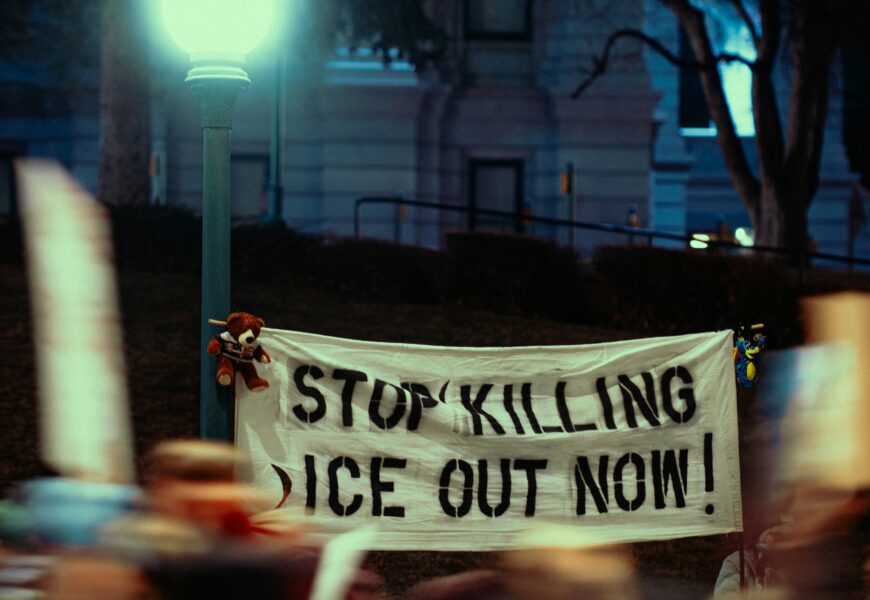
Past the overt, well-documented violence, life in the Twin Cities has undergone significant change since the beginning of Immigration and Customs Enforcement’s Operation Metro Surge. The actions of federal immigration officials circulating in the media — the brutal killings, violent abductions, and brazen violations of constitutional rights — do not exist in a vacuum. The very presence of ICE, not to mention the violence they have perpetrated, has grown to infect all aspects of everyday life in the Minneapolis–St. Paul metropolitan area.
Operation Metro Surge has had a quieting effect on the Twin Cities. There seem to be fewer people out than usual, not to mention fewer people of color. My evening shift at a popular clothing store was uncharacteristically quiet the night of Renee Good’s death at the hands of federal agents. The entire mall, which would usually see a light wave of shoppers and people making returns on Wednesday evenings, was eerily silent.
Even on days that were relatively “uneventful,” there were fewer cars on the road, fewer people patronizing businesses, and fewer employees present at those businesses. The silence has been filled with a sense of hypervigilance and unease. ICE vehicles are hidden in plain sight. Some are the traditional Ford Explorers, made to look like local undercover cop cars, but lack the dark license plate labeled “Police” to prove it. The vast majority of Homeland Security (DHS) vehicles, however, are normal cars that don’t cause teenage speeders to do a double-take. No matter the make or model, tinted windows, multiple male passengers, and obscured or absent license plates are all causes for suspicion. Yet the characteristic big, black SUVs driven by many federal agents are also the vehicle of choice for hockey moms. Drivers have begun doing the unthinkable: making direct eye contact with one another at stoplights to make these important distinctions.
While there is a fair share of darting eyes, plenty of eyes aren’t seen at all. Due to the inclination of ICE officers to make indiscriminate arrests with nothing more than skin color as a motive, people have gone underground in fear of being seen in the wrong place at the wrong time. Some people only go out at night, others once a week, and many simply don’t leave their homes anymore. More than ever, people are participating in mutual aid, picking up groceries for neighbors and arranging carpool schedules to drive children to and from community schools each day. Even if the threat of ICE doesn’t loom large over you, it looms large over others around you.
Though I haven’t seen ICE abduct anyone, I have seen ICE. They drive up and down busy thoroughfares on patrol. I have observed the uptick in abandoned cars left over from arrests. They are on the sides of roads and highways, many still turned on with their hazards still blinking. They have taken people from the places in my community I frequent —Target, Chipotle, the strip mall where I get my hair cut, etc. — on multiple separate occasions. We have had to discuss at my job what we were supposed to do if ICE came in; what if they came into the mall? What if they came into our store? What did the company want us to do? What did we want to do?
Once, I drove past ICE abducting someone and didn’t even notice. I was in the car with my brother, navigating a tight stretch of highway near the airport where it is not uncommon to encounter bad drivers and inexplicable traffic jams. As I concentrated on the road to avoid cars indiscriminately slowing down near an off-ramp, I neglected to notice the reason for the slowdown. It had been reported that ICE had begun stopping people as they exited the highway. My brother and I had heard about it, and as we passed the interchange, he told me that on that exit, ICE was arresting someone.
The biggest unspoken horror of Operation Metro Surge is that so much of what is going on is meant to be unseen, and to a certain extent, it is working. While some people are scared into hiding, other people don’t even notice what is going on around them. We see less and less of our neighbors and feel the unease and fear in our communities. Some only begin to see the everyday effects of ICE when they can’t get an Uber or when their housekeeper cancels on them. You may see an ICE vehicle if you look out for it, but more likely than not, you will pass right by it without a second thought. You might be on the lookout for ICE activity that manifests the way it does in the videos on social media and the nightly news, but in reality, the majority of ICE activity is so quick and quiet that you can drive right past it without batting an eye.
They don’t want you to see what is happening. They want to inundate our communities and rip them to shreds with as little pushback as possible. But even if we fail to see Operation Metro Surge, we can feel its far-reaching effects on everyday life, and we are near, if not already at, a breaking point.