
Courtesy of conncoll.edu
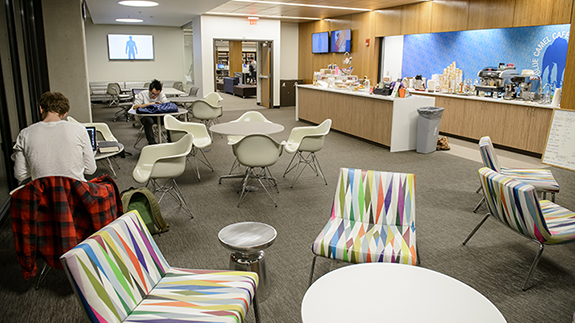
On Monday, February 9, Connecticut College announced management of the library cafe space currently leased by Blue Camel Cafe will transition from longtime Blue Camel Cafe owner Lorelai Frantz to the student-run Conn Coffee organization. As a result, current Conn Coffee location Coffee Grounds will transform into a community space, reducing the total number of coffee shops on campus from three to two. These changes mark a drastic change in dining culture on campus, as Blue Camel Cafe has historically provided independently catered food in addition to beverage.
Originally located in the Lyman Allyn Art Museum, the Blue Camel Cafe was founded in 2004 by Carol Adams, owner of Ashlawn Farm Coffee in Lyme, CT. Adams started the Cafe in conjunction with Frantz, who eventually took over the entire operation. “I provided the physical setup and Lorelei owned the business, but eventually she bought me out and made the entire undertaking her own,” explained Adams. “For all of the years there, from the beginnings of the kiosk in the basement to the full-scale cafe that exists now, she has lovingly brewed Ashlawn Farm Coffee, and we have maintained a strong working relationship as well as friendship.”
Adams received the news from Frantz, who herself was not informed of the College’s decision to decline to renew the lease until February 6th. “I was a little surprised,” Frantz shared. “I knew it was certainly a possibility but being so late in the semester I really thought they were going to renew.” Moreover, Connecticut College gave little indication that Frantz’s tenure as owner of the Blue Camel Cafe would be coming to an end. “During the fall semester I did try and find out [whether my contract would be renewed] but could not get any straight answers,” disclosed the Blue Camel Cafe owner. “I think this was their plan all along and don’t understand why they would wait so long to let me know.”
Despite persistent campus rumors that the College reached a pre-determined decision to not renew Lorelai’s contract in 2024 (sparked by the spread of a 2024 FAQ document regarding the decision to sign a dining contract with Chartwells), Connecticut College confirmed the decision to end Frantz’s contract was not made when the College signed this agreement. “At that time, there was no definitive decision to not renew Lorelai’s contract,” emphasized Dean of Students Victor Arcelus.
The resolution is set to have a major effect on Frantz’s livelihood. “I will no longer have a business. I am the sole supporter of my family,” revealed Frantz. “My husband is 68 and an amputee. He is unable to work. I have had custody of my 14 year old grandson since he was 3. I have a mortgage…I am going to have to find a job. This will not be an easy time for us.” Still, Frantz will not attempt to open a coffee shop elsewhere. “I thought about it but decided I don’t want to start over,” Frantz confessed.
Conn Coffee shop managers too were similarly unaware of shifts on the horizon. In an interview with “The College Voice,” Conn Coffee manager Iman Shaikh revealed that “We [the managers] were informed [of the changes] at a manager meeting with Jeannette Williams and Dean Arcelus. We had no idea what we were going into…They basically told us the plan for next year and made sure our meeting took place at the same time as another administrative meeting with Lorelai.”
Student employees predict difficulties in operations as compared to those conducted within both the current Blue Camel and Coffee Grounds facilities. “Right now all of our baking is done here in Coffee Grounds because we have a really big kitchen,” stated Shaikh. “The Coffee Closet kitchen is a lot smaller so it will be a lot harder for them to bake in the closet kitchen. Blue Camel also doesn’t have the adequate refrigeration system behind the bar.”
However, Conn Coffee hopes to continue to serve independently sourced food in spite of potential production and licensing challenges. Blue Camel Cafe currently serves mac and cheese, bagels, and soup, among other fare. In commenting on Conn Coffee’s current food license, Shaikh explained that: “To my understanding it’s a difference in types of food… Like the difference between providing mac and cheese and [providing] muffins.” Conn Coffee may therefore be unable to serve foods such as mac and cheese and soups under their current licensure when operating in the Blue Camel space next year.
Though Chartwells caters a majority of campus events due to contractual benefits, Conn Coffee hopes to continue to abstain from collaboration with Chartwells. “We don’t really like to associate with Chartwells. Dean Arcelus in an ideal world would have us work together…” speculated Shaikh. “We operate outside of Chartwells and don’t really collaborate with them. We would do all our in house baking still and split the baking collaboratively with Coffee Closet and the new Blue Camel location.”
Dean Arcelus emphasizes the decision itself has nothing to do with the College’s relationship with Chartwells, and that Chartwells did not come up in conversation preceding the termination of Frantz’s lease. Per an FAQ document sent to the campus community, “This transition is not related to the Chartwells contract or other vendor agreements. The Chartwells contract neither prevents Blue Camel from continuing to operate as it has nor from transitioning to a student-run coffee shop.”
Arcelus is optimistic the move will at last provide students with a longstanding request—a communal kitchen. “Creating a space for a community kitchen has been a high priority for many many years,” divulged Arcelus. “I have heard enthusiasm from students about the notion of having a community kitchen.” Though the kitchen is currently a concept rather than a definitive plan, Arcelus clarified that Dean Nobert will be working with a group of students in the fall semester on what the space should be going forward. At the SGA Open Forum, Arcelus briefly also mentioned Connecticut College ideally intends to renovate residence halls over upcoming years to include kitchens although nothing has been formally announced or finalized.
Nevertheless, students and faculty alike admit to mixed feelings surrounding the gain of a communal kitchen at the expense of Coffee Grounds. As one Conn Coffee baker professed “I am not looking forward to seeing the kitchen turned into a community kitchen in the future because I love baking there, and the CG kitchen is a perfect space for the Conn Coffee bakers.” Moreover, Professor of Art History and director of the Lyman Allyn when the original cafe was established, Christopher Steiner mentions that “in [the email from Areclus], there’s a lot of language about experiential learning, and about turning this new venture into a living lab for students to learn about the food industry and culinary industry… that sounds a lot like an academic curriculum, and normally, all academic curriculums have to be approved by the faculty…If this has an educational component to it, the faculty were not consulted.”
Both Conn Coffee managers and Connecticut College administrators also appreciate the financial ramifications of the transition. “Going from three coffee shops to two coffee shops, and moving students into the one that is in the library, I think, gives them a solid platform to build on in this merged entity that they’ve created of Conn coffee,” ventured Arecelus. Conn Coffee appears to concur with this statement. “I understand [this decision] from an administrative/business standpoint. I understand where Dean Arcelus is coming from,” Shaikh mused. “He mentioned that Blue Camel gets a lot of foot traffic from professors and students…I think the alternative would be that all the coffee shops would close so it’s nice that this is an option we could pursue and hopefully it works out.”
Still, some are more skeptical of this cost-benefit model. “You have to do, like, commercial grade ovens, you have to do fire suppression systems, you have insurance, you’re gonna have inspections from the health department. I don’t see how that saves money,” surmised Steiner.
Such conflicting feelings seem to resonate with the campus community on a broader scale. The collective student body appears sad to see Lorelai go, as do faculty and staff. Anecdotes and farewells shared surrounding Frantz expressed sentiments of appreciation for her warm demeanor, consistent quality standards, and facilitation of an open space for students and faculty to coexist. “I’m grateful for the contributions that Lorelei has made to our campus over the years that she has been here,” expressed Arcelus. Steiner added that “Lorelei knows everybody’s name, and is extremely professional and manages the space exceedingly well,” while Adams asserted that “Lorelei is clearly doing something right and she adores the community she has created in that space! She’s a fantastic mentor to her student staff, and for the students who hang out there, she seems to be basically their ‘home away from home’ mom.”
For her part, Frantz is grateful for the years of support she has enjoyed from the Connecticut College community. Frantz hopes those at Connecticut College know: “I will be forever grateful to Carol at Ashlawn Farm Coffee and the entire Connecticut College community. My son was killed in an accident in 2003. [I] quit my job, basically just shut down. Carol the owner of Ashlawn was called by Lee Histle in 2004 inquiring about adding a cafe to Shain Library. She convinced me to give it a try and it changed my life…The students gave me a reason to show up and were so caring and kind to me. It has been a wonderful opportunity.”






[…] letter is attached below. For more information on this situation, please read The College Voice’s article on this […]