Courtesy of Sean Elliot
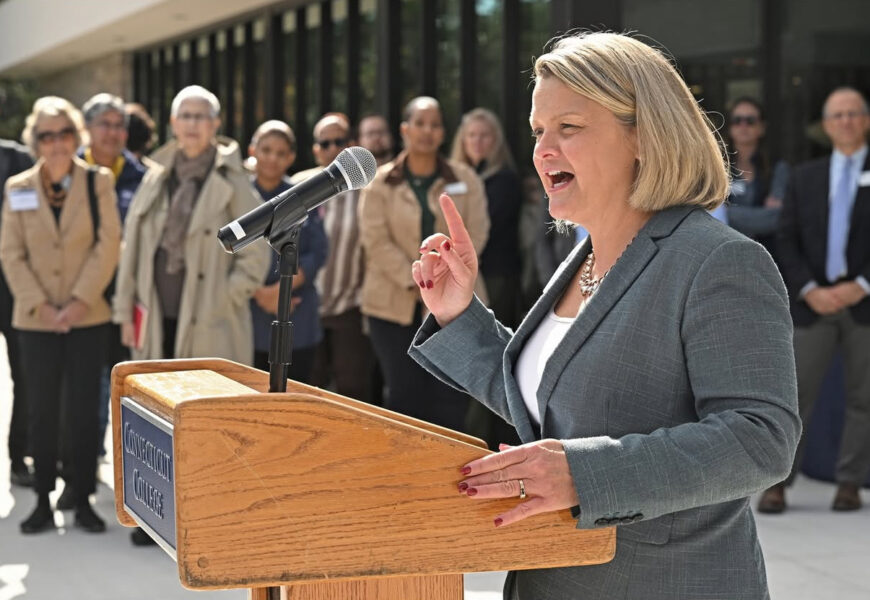
From the halls of Congress to student office hours in New London, Connecticut College’s President, Andrea Chapdelaine, is making student voices a centerpiece of higher education advocacy — and calling on the campus community to do the same.
In a recent conversation, the president reflected on what it means to fight for students at the national level, the federal policy shifts that could soon reshape college life, and why the work, though difficult, is always worth it.
Advocacy Begins With Listening
Before stepping into any national forum, the president says the real work starts on campus.
“Advocacy begins with listening,” President Chapdelaine said. “I spend time with students, faculty and staff to understand their experience and concerns. My conversations on campus shape how I set priorities and how I represent the College beyond New London.”
That on-the-ground perspective then travels to Washington, D.C., where the president represents Conn through the National Association of Independent Colleges and Universities (NAICU), including service on its accountability committee — a body focused on government oversight and ensuring that tax dollars, including financial aid and research funding, are used responsibly. Recent federal regulations have raised pressing questions about institutional independence, making that work more urgent than ever.
“My role is to make sure policymakers understand how federal decisions affect real students — our students,” the president said. “That includes protecting access to financial aid, ensuring fair and lawful civil rights processes, and preserving the academic independence that allows colleges to serve students well.”
Conn also benefits from close relationships with local, state, and federal representatives, including two Conn alumni currently serving as congressional staff.
A First-Generation Graduate Fighting for Opportunity
For the president, this advocacy is deeply personal. As a proud first-generation college graduate, President Chapdelaine never takes for granted the doors that higher education opens.
“When I advocate nationally, I am thinking about students who are balancing work and classes, navigating financial uncertainty, or wondering how policy changes might affect their future,” the president said. “My responsibility is to help ensure that opportunity remains real, not theoretical, for them.”
Student voices play a direct role in shaping that advocacy. The president reads student commentary, hosts office hours, and meets regularly with student leaders — carrying those perspectives into national conversations.
“Policy debates in Washington can feel abstract, but they have real consequences for students’ daily lives,” the president said.
One of the presidency’s most rewarding moments came from helping secure a meaningful Pell Grant increase after years of stagnation. “It is still not where it needs to be,” President Chapdelaine acknowledged, “but even a modest increase matters. You take the wins, and you continue the work.”
Three Policy Areas to Watch
Looking ahead, the president identified three federal policy areas that students should pay close attention to in the coming years.
Federal student aid tops the list. Even minor adjustments to Pell Grants, loan limits, or repayment structures can have major consequences for affordability and graduates’ long-term financial stability.
Civil rights enforcement is the second area of concern. With increased federal scrutiny around Title IX and Title VI processes, campus climate, and institutional compliance, colleges are navigating a complex landscape. “Colleges must uphold both free expression and anti-discrimination laws,” the president noted, “and clarity in federal guidance will matter for students.”
Finally, changes to accreditation and oversight could affect everything from curriculum and student support services to the fundamental independence that defines the value of a liberal arts education.
A Call to Students: Use Your Voice
Despite the many pressures facing higher education today — financial, political, and social — President Chapdelaine expressed deep optimism, pointing to the energy and commitment of the Conn community as the reason the work remains meaningful.
And when it comes to students? The message is clear: get involved.
“Keep using your voice — in student government, in campus forums and in the everyday spaces where community is built,” the president said. “Ask questions, share what you’re experiencing and help shape solutions alongside faculty and staff.”
The president also encouraged students to deepen their understanding of how federal and state policy decisions affect their institution. “Civic engagement and informed dialogue are part of sustaining a healthy democracy and a strong higher education system.”
At the end of the day, the president said, students are the reason the hard work of leading a college matters at all.
“We are transforming lives here at Conn — how can that not be worth the work?”