Courtesy of Theo Andres ’27
In case this is the first you’re hearing, for the past semester and a half, SGA’s Committee on Student Representation Reformation has been working on doing just that: reevaluating the way SGA is run, and developing a new system of representation that will make student government more equitable, more efficient, and more representative of campus culture. The current House Senator system has been in place since 1988, and better reflected a campus where students dined and socialized within their houses. As is evident by the growing number of houses with no representative or connection to SGA, it can unfortunately no longer equitably represent Conn’s student population.
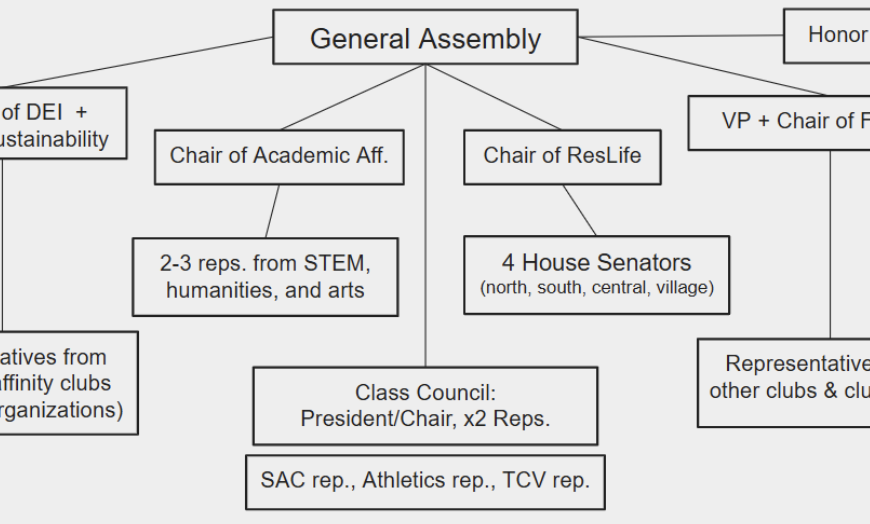
Some issues that the committee have been keeping in mind concern incorporating the club-centered campus culture, ensuring representation for students not in clubs, alleviating the workload for SGA Executive Board members, and ensuring information accuracy and transparency. To do this, the committee has proposed gaining representatives from different corners of campus and strengthening the role of Class Council. This map represents the current idea for a proposed system:
Notable changes in the chart above include the diminished role of House Senators. In the current proposed plan, it is hoped that House Senators could instead work more directly with the Chair of Residential Affairs and with ResLife staff. Students would also receive information from their Class Presidents, instead of House Senators, and all students would be represented by their President and two class-year representatives that would make up Class Council.
To ensure multiple layers of representation, the Chair of Academic Affairs would also meet with representatives from the different general academic divisions, STEM, Humanities, and Arts. As is the focus of the new system, all clubs would designate representatives who would coordinate with SGA Chairs. In the current system, there are roughly the same number of people serving on General Assembly as there would be if every house had a Senator, though the proposed number varies, based on how exactly clubs would be represented in General Assembly– for those unaware, General Assembly is the body of representatives that meets Thursday nights, where SGA Chairs, House Senators, Class Presidents, and other representatives meet to discuss and vote on issues.
Some points of discussion both in the recent Open Forum and in General Assembly concern the exact function of this club representation. Though many agreed that clubs should be able to internally nominate their own SGA representatives, different ideas for systems have circulated: should SGA Chairs meet directly with club representatives, outside of General Assembly? There are a lot of clubs on campus, and these meetings might be too large– should club representatives elect ‘middle-men’ leaders, then, who would meet with Chairs? Or, are there other ways that clubs could be represented in SGA, as in, for identity and affinity groups, through DRS organizations? It was also proposed that representatives from other clubs and club sports might not need or want to meet with SGA chairs as frequently, and that club representatives might not need to be present at General Assembly meetings.
Other questions on who would serve on the General Assembly, included the issue of House Senators, and whether or not it would be necessary to have them present, as they would no longer be sending out emails. A question made particularly relevant this year and last by the resignations of our previous two Chairs of DEI is what exactly to do with this position– though a co-chair resolution is currently moving through SGA, imagining exactly what two Chairs of DEI would look like, and how their responsibilities might shift in a new system to alleviate the stress on that position, is a priority of the committee.
Centering club culture within SGA has the potential to make SGA far more integrated into student’s lives, and to make campus issues and decisions more equitably decided and announced. With decisions and discussions in SGA happening on this larger scale, initiatives and ideas for how to improve our campus and student life would have far more traction and power, and we could avoid burn-out for members of SGA and other student leaders on campus.
A survey will soon hit student’s inboxes, to gauge the campus’ thoughts on some specific portions of the new system that SGA has been hard at work discussing. For any new system to be passed and put into effect, the student body would have to vote to approve it. As all students will be voting, the committee encourages all students to get involved, ask questions, and propose ideas– students should email me at mandres@conncoll.edu, reach out to their House Senators, or write a response or proposal here in The College Voice any time.