Courtesy of The New York Public Library
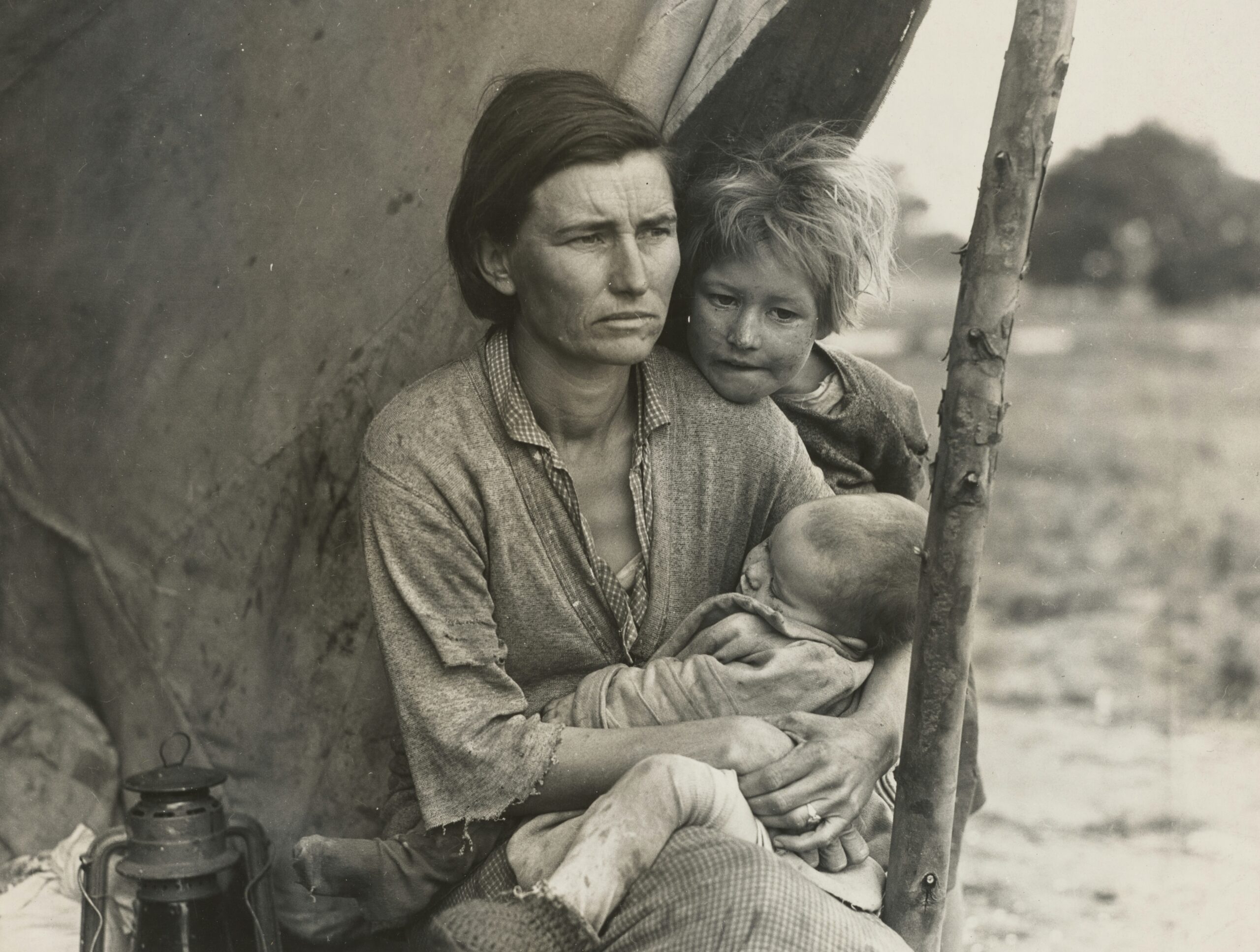
“Migrant Mother” is an iconic image most of us have seen, whether in passing, in published articles, or in history or English class. Taken by legendary photographer Dorothea Lange, the Lyman Allyn Art museum in association with art2art Circulating Exhibitions presents ‘DOROTHEA LANGE: Life work’, a collection of 50 photographs spanning Lange’s dynamic multi-decade career and legacy.
Lange is known for her documentation of American history, particularly during the Dust Bowl and Great Depression eras. Even at her start back in the 1930s, her early work consists of tragedy in rural farm working communities and families in the US in association with her employment with the Resettlement Administration and Farm Security Administration. Her work exposed the hardships of rural life in America, used to raise awareness and assistance supporting President Franklin Delano Roosevelt’s New Deal Programs.
The collection consists of a balanced mix of her landscape and subject-focused work. These were a part of her featured “Three Mormon Towns” project, documenting Utah’s culture of Mormonism. This summer long project in collaboration with Ansel Adams and Life Magazine yielded visions of old and new, quiet towns and loud highways, children in the sun and wrinkled elders in the homes, sprouting grasses and dry, barren dirt fields.
Some of the first works that stood out to me were her images of rolling clouds and luminescent skies, evoking themes of vastness and religion. In ‘Road to Zion National Park, Utah, 1953’,
The still, slow rhythmic composition of this image supplemented by its godly title encompasses 1950s Utah and the religious and political landscape of this US region. The photo offers a vast spatial perspective and a deep depth of field, overlooking rural Utah and into the hills. Highlighting the road and the sky, Lange shows the connection between road, sky, man and the force of God.
In contrast to the previous photo section, her works in the following section “World Travels” show a tapestry of different cultures and places. From the wider US to Latin America, Asia, and North Africa, Lange devoted her final years as a photographer to widening her horizons. This work was also created in collaboration with her husband Paul Taylor, in association with the land reform movement with the State Department and Ford Foundation.
A cumulative photo of her work and its intentions in my opinion is put best in her 1956 work titled ‘U.S. Highway #40, California’. It depicts a car crash that seems to have just occurred, smoke still surrounding the destroyed sprinkling of vehicles in the grassy foreground. Above is a tow truck with a number of newer cars passing by the disaster below. The narrative of newness surpassing tragedy applies to all of Lange’s work, and her focus on representing underrepresented and impoverished communities and issues.