Courtesy of Kevin Lieue ’26
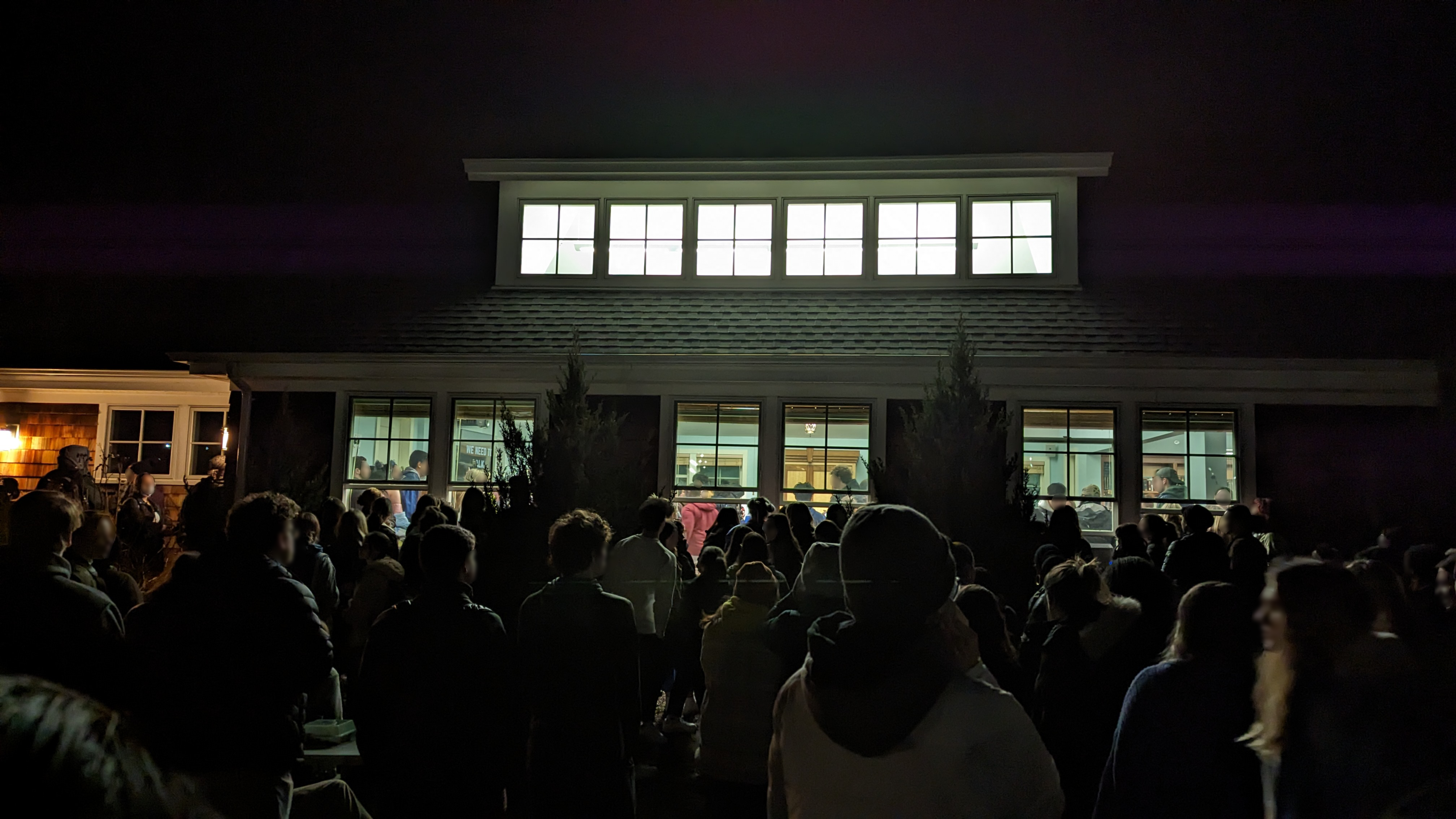
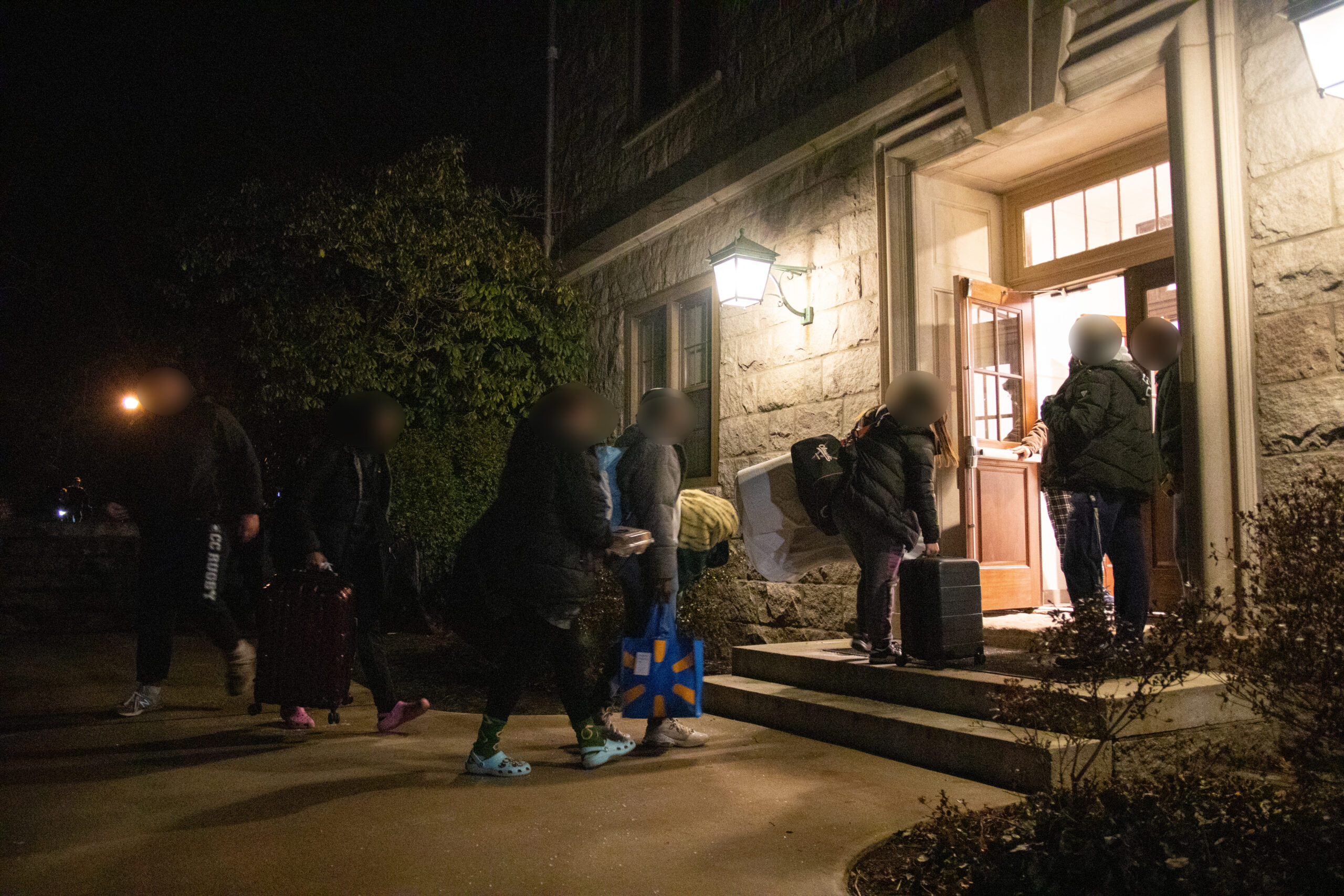
From March 26–28, 2026, the Ammerman Center for Arts and Technology hosted its annual symposium at Connecticut College under the theme “All Too Human.” Across three days, students, faculty, and visiting artists explored the intersections of art, science, and technology through lightning talks, workshops, and collaborative discussions that pushed participants to rethink how human experience can shape creative practice.
A highlight of the symposium was the keynote delivered by Katerina Cizek, a Peabody- and Emmy-winning documentarian and lead of the Co-Creation Studio at the MIT Open Documentary Lab. Her work centers on collaborative storytelling and community-driven media, themes that resonated strongly with the symposium’s focus on shared creation and interdisciplinary exploration. Her perspective framed the weekend’s events around the idea that technology can be used not just to produce media, but to reimagine how stories are made and who gets to participate in that process.
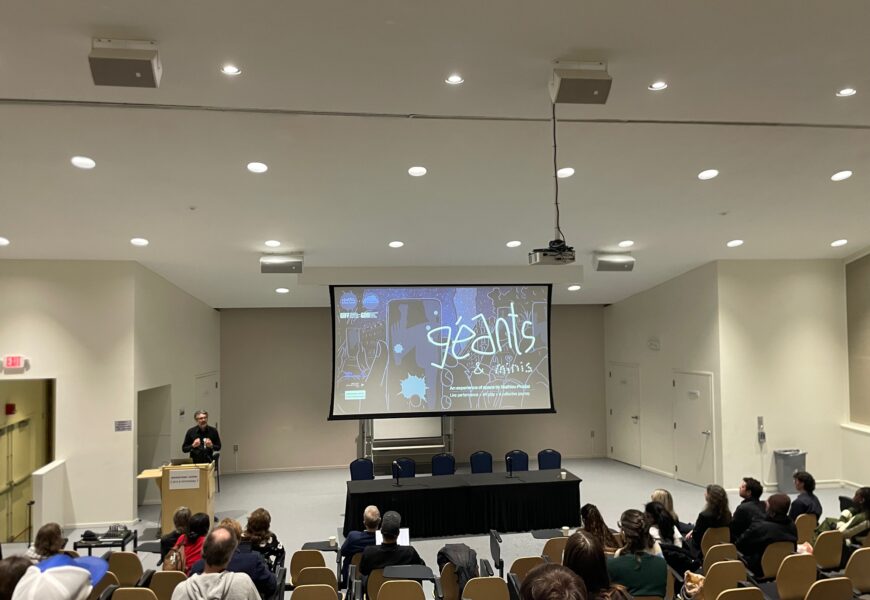
The symposium also revisited the work of commissioned artists from the previous year. Tansy Xiao developed LUCA (Last Universal Common Ancestor), a live interaction between musicians, dancers, and virtual environments that explored forms of intelligence beyond human dominance. Mathieu Pradat workshopped Giants and Minis, a massively multiplayer mobile game imagining a struggle for cities between those who seek destruction and those who collaborate to preserve them. Both artists returned to reflect on how their projects evolved since their initial commissions, offering insight into how creative work continues to grow long after its first presentation.
One of the central events I attended was the Lightning Talks held in Oliva Hall at the Cummings Art Center. Speakers, including Jonah Brucker-Cohen, Rachelle Beaudoin, Kaeti MacNeil, and Peijing Mou, shared their projects and creative processes. Each presentation offered a different perspective on how technology can be used not just as a tool, but as a medium for exploring deeply human questions. Listening to their work gave me new ways of thinking about how ideas can take shape across disciplines.
I also participated in two workshops that stood out for how interactive and thought-provoking they were. In “The Body as User Interface,” participants worked together to design a system that used the human body itself as the basis for interaction, rather than relying on traditional devices. The activity pushed us to think creatively and collaboratively, reimagining how we understand both technology and embodiment. Hearing other people’s ideas made the experience even more meaningful; many of the concepts they proposed were things I would never have thought of on my own.
The second workshop centered on futuristic reproductive technologies, including possibilities such as male pregnancy and parthenogenesis, and examined them from scientific, ethical, and social perspectives. The conversation challenged participants to think beyond what is currently possible and to consider how emerging technologies could reshape fundamental aspects of human life.
What stood out most to me throughout the symposium was how accessible it was to students from all fields. The Ammerman Symposium is not limited to those who identify strictly as artists or technologists. It is a space where anyone can find inspiration, discover new ideas, and connect different interests in unexpected ways. I wish more students knew that they do not need a specific background to benefit from attending; curiosity is enough.
One faculty member who particularly inspired me was Kaeti MacNeil. Through animation, she was able to make something as abstract as thoughts and emotions visible. Seeing her process and the evolution of her work made me reflect on how I approach my own projects, especially in digital art, and how complex concepts can be expressed visually with intention and experimentation.
My key takeaway from the symposium is the importance of combining science, art, and technology to create meaningful work. The event emphasized that the creative process is just as important as the final result, experimenting, trying new approaches, and allowing ideas to develop over time. It also sparked new ideas for my own projects and encouraged me to think more intentionally about how to visually represent complex concepts.
Ultimately, “All Too Human” was a reminder that innovation often begins with curiosity about what it means to be human, and that the most compelling ideas can emerge when disciplines intersect.