Courtesy of Claire Hlotyak ’27
If a Connecticut College student should find spare time in their day to take a walk through South campus and past Freeman Field, they will eventually hit a slice of New London art history.
The Lyman Allyn Art Museum, opened in 1932, sits on the same plot of land as the College. The Museum was a bequest of Harriet Upson Allyn in honor of her late father. In her will, she left land to build a museum and park for New London, her hometown.
A few years shy of its 100 anniversary, the museum is transforming the grounds into a 12 acre free park, open to the public.
The grounds used to be twice the size of what they are now, but in the 1970s, the government claimed some of it to construct Route 32. For a while, there was not a clear plan for the park’s construction.
Five years ago, the Museum’s board of trustees decided to officially begin construction to “re-realize the grounds and fully put through [Allyn’s] vision,” said Eileen Donovan, Director of Learning and Engagement at the Museum.
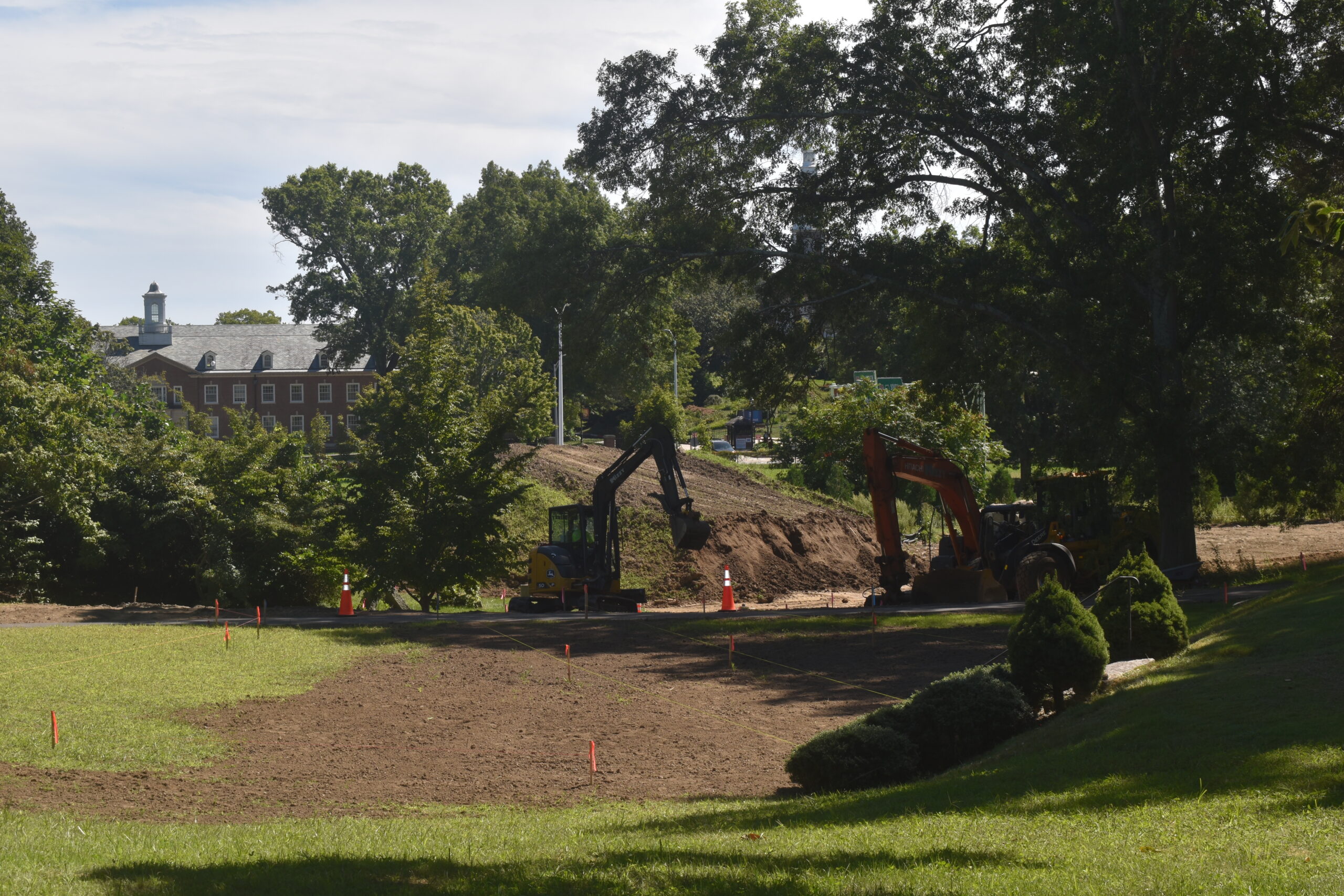
Donovan said they are anticipating a late spring/early summer park launch. In the meantime, the grounds are buzzing with energy and construction.
Some new additions are already completed and open to walk around, including the new filtration pond. The goal for the pond is to collect water runoff from the Quaker Hill neighborhood and the slope of Conn’s campus, where it will sit and allow debris to filter out. Then, the cleaner water will head out to the Long Island Sound, Donovan described.
“In addition to being a lovely looking pond…it is actually an environmental safety measure,” she added.
There are many other changes in the works, including moving the main parking lot to the back of the Museum. The former gravel and dirt lot, which staff referred to as the “dust bowl” will now be a green space. There will also be a native pollinator garden and more pathways for sculptures.
“Unstacking the Deck”
According to the Museums website, a goal of the park is to “unstack the deck” in the region by making green spaces more accessible to marginalized groups that have been “denied the many positive outcomes of parks…such as improved mental and physical health…and greater community connectedness.”
The park will act as a third space, Donovan said, a popular sociological term referencing a social space to build community that is not home or work. They will increase outdoor programming, including concerts and movie nights in the summer to draw in visitors.
“I see programs as a stepping stone to engagement…part of it is pure visibility,” said Donovan.
Visibility is a hurdle, as people passing by tend to think the Museum is part of Conn College, when it is, in fact, free and open for New London residents. To combat this, a new pedestrian entrance off Williams and Bayonet has been added and is now open.
“We wanted to form a more visible and welcoming connection with the city of New London,” Donovan said.
Funding for the Project
The project has been made possible by private donations and a state grant called the Community Investment fund. The Fund has also supported the Garde Arts Center and the New London Community Recreation Center, Donovan said.
The fund “foster[s] economic development in historically underserved communities across the state,” according to the state website.
New London is a “community surrounded by small towns that are voted best summer tourist destination in the country,” Donovan said. “[The city] was overlooked in a lot of ways, but there is a wonderful arts community [here], and all these other areas of growth are solidifying this place as a positive contributor,” Donovan said.
“[The park] is less about economics and more about community,” said Eileen Cosgriff, Lyman Allyn business manager. “How do we bring people together? How can we help people appreciate the space that we are on?”
[It’s a] very transformative period for New London,” Cosgriff added.
As the work continues throughout the fall, Donovan and Cosgriff invite Conn students to check out the space, and offer suggestions for what students might like to see at the museum. After all, the goal of the park is to build community, Donovan and Cosgriff said.
“Art is so important, but who is the art for if we don’t have a community,” Donovan said.