Courtesy of Elaine Sandoval Carrasco
On a warm Saturday evening this September 12, the Thames River waterfront filled with a crowd that had come to watch a story its own city center still bears the memory of: the night in 1781 that Benedict Arnold, the Continental Army’s most reviled defector, ordered his own former countrymen’s homes and warehouses to be torched.
The commemoration, staged annually by Flock Theatre since its revival in 2013, is part fife-and-drum pageant, part civic memory ritual, and part small-town party.
The burning draws crowds well beyond New London’s own limits, and this year it drew me, a junior at Connecticut College, along with a knot of my classmates who’d heard the salute rockets from downtown and followed the sound.
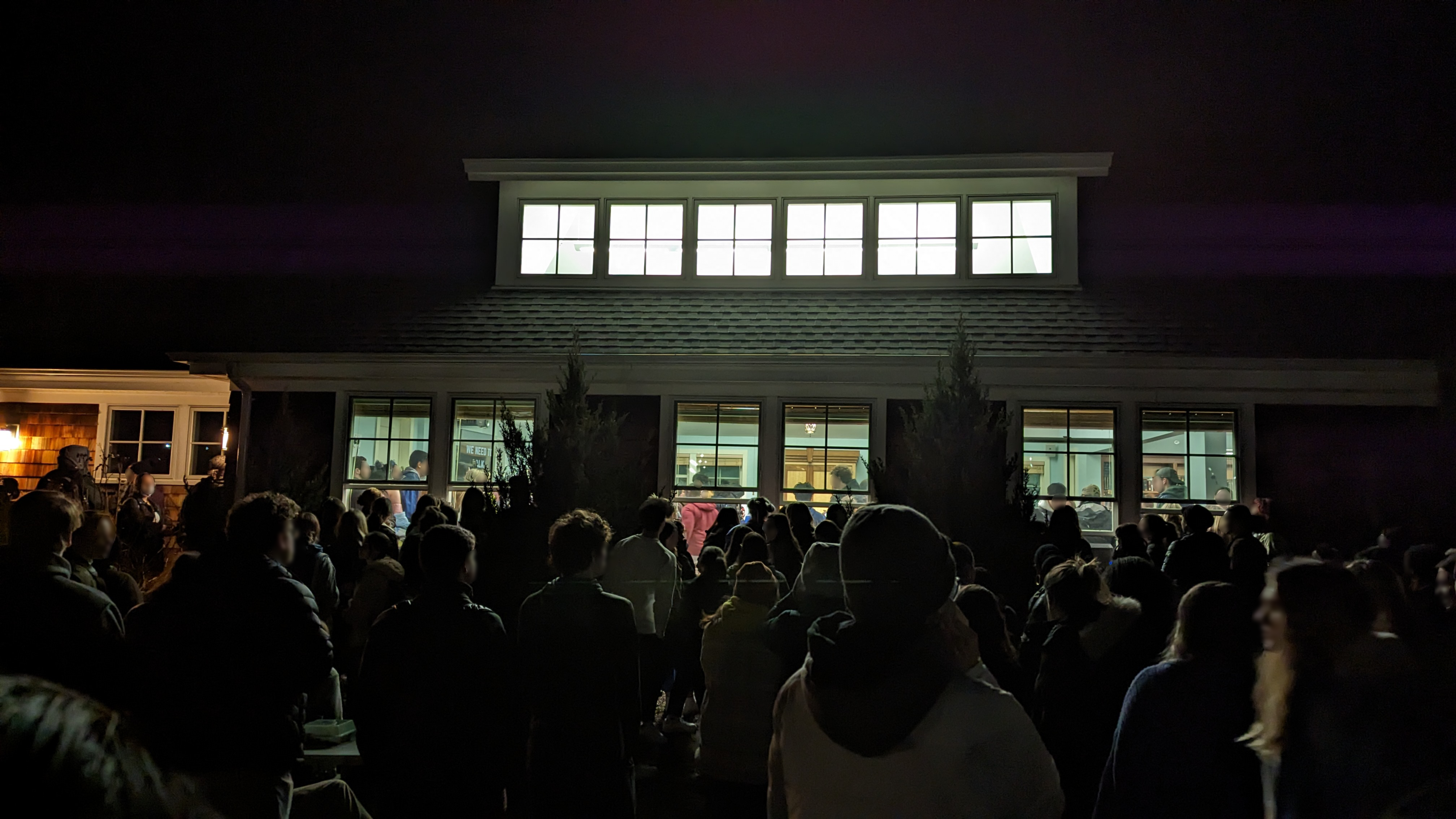
A loud boom went off almost exactly at 7:30 p.m., the traditional signal that the march down Bank Street was underway. What followed looked less like a scripted historical reenactment than a spontaneous civic eruption: people spilled out of the bars and restaurants lining the street, a wedding party abandoned its reception venue mid-celebration, and dozens of Connecticut College students in college gear filmed the procession on their phones as it wound toward Waterfront Park.
American flags lined the waterfront in numbers befitting a Fourth of July celebration, and Connecticut Governor Ned Lamont attended the festivities, drawing an audibly impressed reaction from the crowd.
The procession itself is designed to unsettle before it entertains: an effigy of Arnold, rigged to show two faces, is wheeled through the streets on a handcart, trailed by a stilt-walking devil figure costumed as a British redcoat.
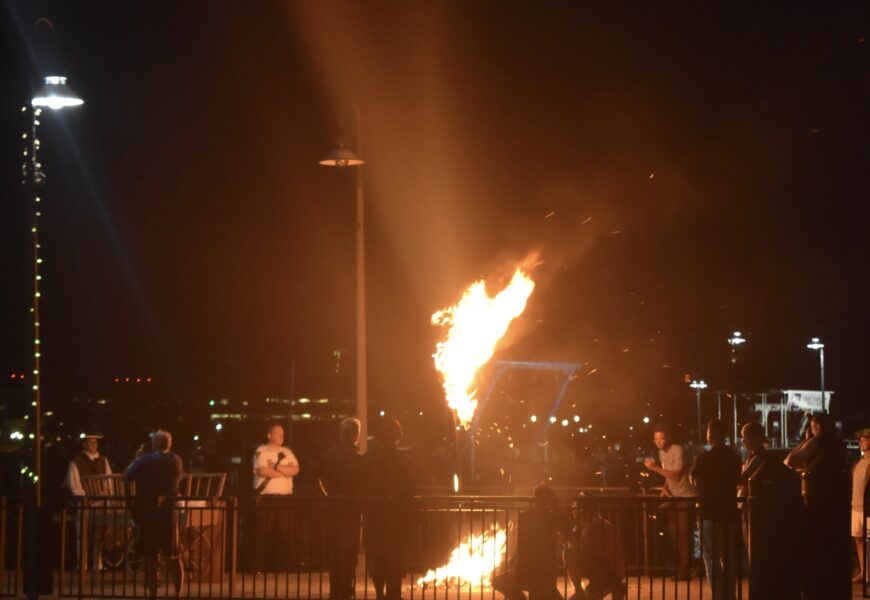
By the time the march reached the waterfront, the crowd’s mood had shifted from curiosity to something closer to old-fashioned civic fury. Chants of “burn him” rose up before the effigy was even doused, and the crowd, egged on for a bit more spectacle first, broke into “USA, USA” patriotic chanting before organizers finally set Arnold alight.
Fire crews stood ready and moved in once the blaze had run its course. A drone show over the river closed out the night.
It is worth remembering, watching that fire, exactly what New London is commemorating. On September 6, 1781, more than a year after his plot to hand West Point over to the British had collapsed, Arnold, a Norwich native who had once fought valiantly for the Continental cause at Ticonderoga, Quebec, and Saratoga, led roughly 1,700 British, Hessian, and Loyalist troops in a raid meant to punish New London for its success as a privateering port.
His men marched through the town, setting fire to homes, wharves, and warehouses while a separate detachment stormed Fort Griswold across the river in Groton. There, outnumbered militia and civilians who tried to surrender were massacred.
More than 140 structures burned, and New London and Groton were left largely leveled. According to New London County Historical Society’s Executive Director, Edward Baker, a month later, the rallying cry “Remember New London” spurred American troops on at the siege of Yorktown, where Cornwallis surrendered, with, as local histories he mentioned noted, Arnold and Cornwallis eventually crossing the Atlantic home on the very same ship.
That history is precisely why the ritual persists. New London’s version of the burning was observed for the better part of a century before fading out around the Civil War. Flock Theatre’s 2013 revival gives the city, one whose downtown still carries the physical and psychological scars of 1781, a yearly occasion to process that inheritance publicly rather than let it sit quietly in a historical marker.
According to Baker, Arnold’s name is still invoked, half-jokingly and half-seriously, whenever New London faces disaster or upheaval, from the hurricane of 1938 to more recent fights over redevelopment and eminent domain downtown.
For Connecticut College, the festival forces a different relationship with the city outside the campus gates: a reminder that New London has a rich history, a place with its own particular, blood-soaked founding trauma, one it has chosen, deliberately, to keep re-enacting rather than forget, and that serves as an opportunity for students to find belonging in the city.
By the time the drones finished their display over the Thames and the crowd began drifting back toward downtown, the fire on the waterfront had already burned down, likely similar to the fires of September 1781 eventually did. This time, New London was still standing.