On a mostly cloudy fall afternoon in 2023, the sun broke through just long enough for Sean Elliot to get the shot. A senior student sat in profile, threading a needle through the base of a marigold blossom, part of a chain being built for Día de los Muertos. Down the line, other students worked at the same task. The light caught her in a golden rim as it slipped past the clouds. “The colors are brilliant, and the composition is as close to perfect as any photograph I’ve ever taken,” Elliot says. It’s still one of his favorites, though, he admits, it’s never made it off his hard drive and onto his wall. “I just don’t do a lot of printing.”
That photo, of a Hispanic student organization gathering at the sprout garden, captures exactly what Elliot has spent his career chasing: a real moment, unposed, unstaged, found rather than made.
Elliot didn’t set out to be a photographer. As a sophomore in high school, he wanted to take a creative writing class; he “fancied himself a writer”, but the class was full, so he landed in basic photography instead. He wasn’t particularly excited about it until his teacher showed the class a documentary on Dorothea Lange, the photographer who documented the Great Depression for the Farm Security Administration. Lange’s work, and that of photographers like Roy Stryker, who sent journalists out to record the era as it happened, showed Elliot that photography could be more than landscapes. He joined his high school’s student news, shadowed a local newspaper photographer, and by 16 had what he calls an epiphany: this was what he wanted to do.
It’s what he did for 30 years, almost all of them at The Day in New London, where he built a career as a photojournalist and picked up a working familiarity with Connecticut College along the way, covering stories on campus for the paper. When the newspaper photography field started shrinking, and a photographer position opened at Conn in the fall of 2022, the transition made sense. “This was a good place to keep doing the photography that I love,” he says.
That love has always meant one specific approach. “I would say documentary photojournalism,” Elliot says of his style. “I focus entirely on capturing moments as they happen candidly, without any influence, as best as I can manage. That really hasn’t changed in 30 years.” His kit reflects the same instinct toward consistency: two Nikon Z9 bodies, one paired with a 24-70mm lens and the other with a 70-200mm, so he can swing between wide and telephoto without missing a beat, plus an ultra-wide and a super-telephoto for field sports. He’s shot Nikon for more than 40 years, since a job at a camera store in Eugene, Oregon, and even when starting fresh at Conn gave him a reason to reconsider Sony or Canon, he stuck with what he knew. “I figured it was better not to try to reinvent the wheel.”
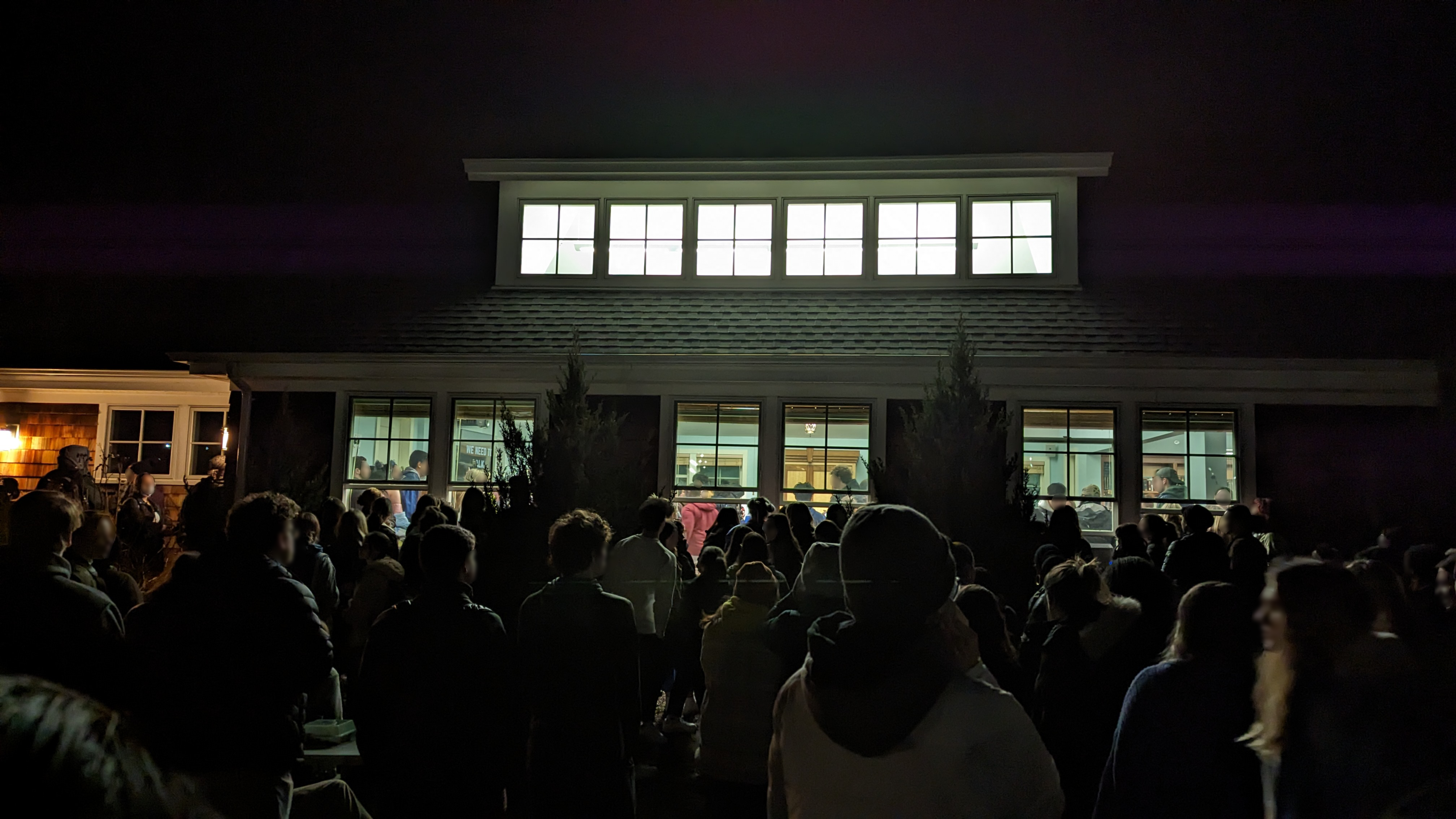
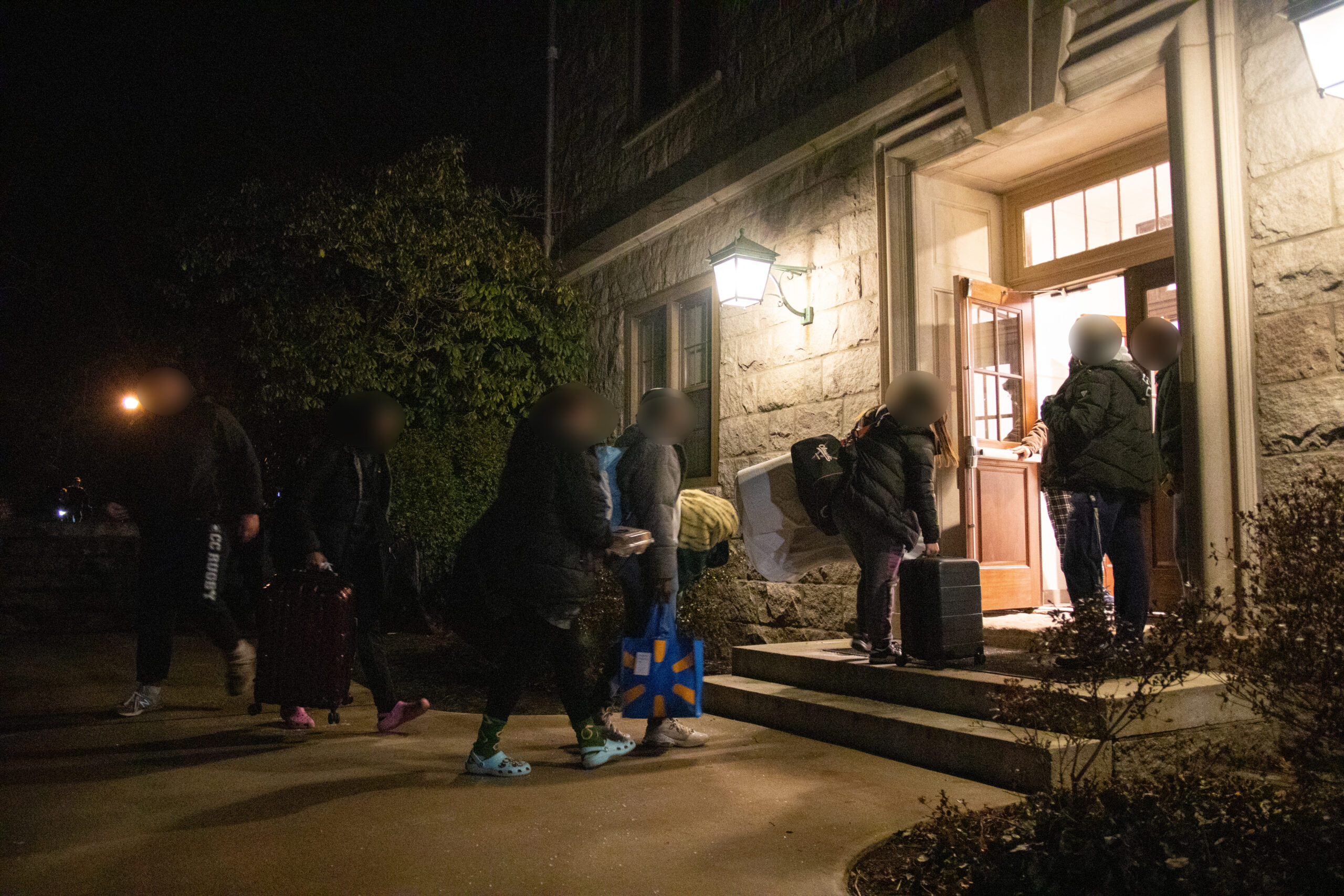
Not every assignment has come easily. In the winter of 2023, when campus erupted in protest, Elliot found himself on the sidelines of the biggest story happening around him. Marketing sensitivities kept him from photographing much of it, even as photojournalists from his old newspaper and other outlets showed up to cover what he couldn’t. “That was very challenging to me, as someone who had spent 30 years as a photojournalist,” he says.
It’s a tension he’s made peace with, mostly. “I’m not a photojournalist anymore, I’m a marketing photographer,” he says. “But I firmly believe what sells Conn best is Conn being real, and what I do is document Conn being real.” He doesn’t direct an a cappella group on what to do for a good shot; he shows up and photographs them performing, genuinely. He doesn’t stage the marigold chain; he documents it, and lets the light and the moment do the rest.
His advice to students who want to pick up a camera seriously is characteristically blunt: take a lot of pictures, most of them bad. “It’s not enough to walk in and say, ‘okay, I need a picture of this, I took a picture of it, I’m done,'” he says. “You’ve got to really dig in deep and connect with the subject.” Thirty years and thousands of frames later, he’s still chasing the same thing: not the picture he plans, but the one he finds.