Courtesy of Loey Felipe
What do you call it when the love you have for your whole country and its people forces you to expose yourself to the whole world? Showing your troubled and complicated past to all and then asking to grow exponentially (y=e^x). To take the reins of your battered and shattered country, caused by their fear of each other, and say that “diversity is a strength”. Establishing a new government, becoming president, and gaining enough legitimacy to find yourself shaking hands with the president of the United States, so that by the time your term is over; Syria can stand on its own. It’s called being Ahmed al-Sharaa.
Days after the Assad regime collapsed, al-Sharaa held a meeting with Turkish representatives, which was the first official diplomatic visit to Syria following the coup. During this meeting, he met with a US Assistant Secretary, removing the bounty on his head. Now he was able to shift his focus to national and domestic security. Dissolving and merging the many military factions of Syria, and successfully doing so, the Kurdish-led Syrian Democratic Forces (SDF) rejected this merge because one national army meant they could not operate autonomously. The German and French ministers were the first EU members to visit Damascus after the inception of the new government. Shortly after, al-Sharaa held the Syrian Revolution Victory Conference, where he was named de facto leader and officially the president of Syria, announcing the creation of a transitional constitution and his outline of government. Al-Sharaa would then make multiple presidential trips around Syria, most notably his visit to the Daraa region known as the “cradle of the revolution,” coinciding with Eid al-Adha.
On 13 March, al-Sharaa signed Syria’s constitutional declaration, establishing a five-year transitional period and a presidential system with executive power vested in the president. It enshrined Islamic law, which many feared, but in an interview with CNN al-Sharaa said that “We are talking about something that aligns with the traditions and nature of the region.” This is true when looking at the empires that ruled before it. His first few months in office would not be smooth domestically. Clashes between minorities and pro-Assad fighters could be seen around the country. He announced the formation of an independent national committee of seven judges to investigate the events and violations. In January of 2026, SDF forces targeted a Syrian government soldier, sparking another fight. After declaring a ceasefire, al-Sharaa recognized the Syrian Kurds as an essential part of the nation, declared Kurdish a national language, and made Newroz a national holiday.
Al-Sharaa understood the importance of international relations and the positive effects of allies like America, China, and Russia. Al-Sharaa would spend time visiting world leaders and their capitals to build legitimacy with Türkiye, Saudi Arabia, the United Kingdom, Germany, France, Brazil, and the United States of America. During these meetings, Syria showed its willingness to engage by discussing matters such as integrating refugees back into Syria, modernizing ports, and strengthening trade relations, unlike the previous presidency. Syria is expected to have an 11% increase in GDP by 2026 and has experienced a 111% increase in tourism. The Syrian pound has appreciated, and inflation has dropped significantly to an estimated 11.5%, down from over 72% previously; direct result is that Visa payments are now being accepted. It has raised its share of national oil production from roughly 20% to 88%. Since December 2024, more than 2 million internally displaced Syrians and 1.8 million refugees have voluntarily returned home.
Most recently, protests have erupted in Syria over a 40% increase in fuel prices. The timing is especially bad: the country’s largest refinery is offline for maintenance, and many Syrians live below the poverty line, so any rise in the cost of living is devastating. People are rightfully scared. Years ago, citizens were met with violence from the government, but during this reconstruction, the government has taken a very different approach, and people are being allowed to express themselves as they wish. Taxi drivers and farmers who can’t afford fuel can’t work, so all they can do is protest and show their anger. Syria produces about 102,000 barrels of oil a day but needs about 325,000 for domestic use, so it depends on imports.
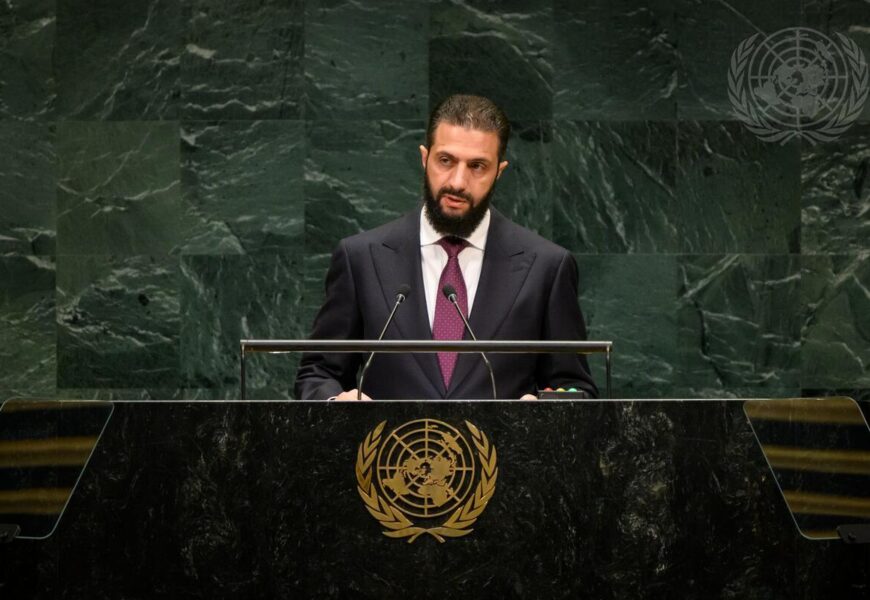
During his high-profile visit to the United Nations General Assembly, al-Sharaa highlighted that over 100 states have engaged with Syria and Damascus has hosted more than 60 diplomatic missions since last year, celebrating the repeal of the Caesar Act, the lifting of EU sanctions, and the country’s removal from the state sponsors of terrorism list. On the sidelines of the UNGA, al-Sharaa conducted an extensive diplomatic blitz, meeting with UN Secretary-General António Guterres, French President Emmanuel Macron, and attending a group meeting with U.S. President Donald Trump to discuss regional security. He attended a meeting with the Syrian-American Council focused on community diaspora engagement and future reconstruction efforts. At the UNGA, al-Sharaa strongly denounced Israel for executing over 500 airstrikes and 1,200 land incursions into Syrian territory. Warning that these actions threaten the country’s fragile post-war recovery, he firmly rejected Israeli sovereignty over the Golan Heights, labeling it unconditionally Syrian territory and demanding a full military withdrawal.
So far, al-Sharaa and his cabinet have done a very good job of uplifting Syria from a horrific civil war. None can deny the progress Syria has made but can still see the fragile state of the country. Two out of al=Sharaa’s five year term are over, and he is committed to having Syria maintain its legitimacy no matter who holds the chair to office. The next three years will test whether he can turn diplomatic wins into everyday stability for people who still can’t afford to fill a gas tank. If he manages that, Syria’s recovery becomes a story other broken states might actually try to copy.