Courtesy of Sean Elliot
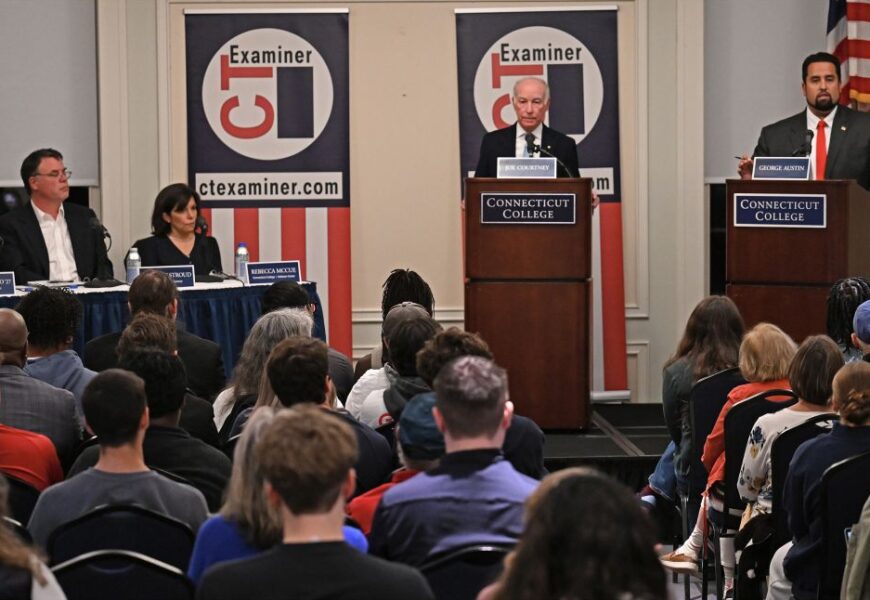
NEW LONDON, Conn. — In Connecticut’s 2nd Congressional District on Monday, October 26th, a debate took place between the two men vying to represent its over 700,000 residents in Washington: Incumbent Rep. Joe Courtney (D-Vernon) and Republican George Austin, the owner of a construction business and a first-time candidate for office.
The debate, hosted by Connecticut College in partnership with the CT Examiner, was held in the Blaustein Humanities Center, where the two candidates debated everything from immigration enforcement to the high cost of higher education; the latter being particularly pertinent to an audience made up of many Conn students.
Affordability in the forefront
In his opening remarks, Congressman Courtney began by acknowledging the top concern of voters this midterm election cycle.
“The price of gas, groceries, and healthcare has gone through the roof.”
As for why that is, he pointed to President Trump’s “illegal, unauthorized war in Iran,” as well as H.R. 1, also known as the ‘One Big Beautiful Bill Act,’ passed by congressional Republicans last summer.
Austin, in his opening statement, stayed in that same vein — but offered different reasons for the economic strain people are feeling. He argued that residents of the 2nd District are “over-taxed” and “over-legislated,” in addition to facing pressure from “the housing crisis,” as well as “everyday living expenses.”
“I’m running for generational change,” he told the audience, and promised to, if elected, exit office after ten years — if his legislative goals don’t materialize.
Courtney criticized President Trump’s approach to tariffs. He said “it’s added $3 billion of new costs to manufacturing,” citing a report from the Connecticut Business & Industry Association.
“The Republican majority has refused to exercise their article one check and balance.”
Courtney also spoke to the rising cost of healthcare, partly a result of enhanced Affordable Care Act subsidies being allowed to expire last year, as well as Medicaid cuts in the Big Beautiful Bill.
“100,000 on Husky,” Connecticut’s Medicaid and children’s health insurance program, “are going to lose their healthcare coverage starting in January,” he said, as a result of the cuts.
He also called for a restoration of the ACA subsidies to bring down costs.
The “excursion” (war) in Iran
Following their debate, both candidates took questions from The College Voice, including those about the ongoing war with Iran that the U.S. initiated back in February alongside Israel. Courtney advocates for passage of the war powers resolution, to prevent the president from continuing military action in Iran without authorization from the Congress.
“If it passes, it basically causes cessation of military activities. And that will allow, in my opinion, the space to actually go back to the Islamabad memorandum, which was the ceasefire in June, when the strait [of Hormuz] opened for about a month.”
He says the U.S. should push for a ceasefire to get the strait reopened and lower oil prices, but that “we can’t let other countries, like Israel, dictate the terms of it.”
Austin, asked if he’d support the war powers resolution to bring about an end to military action in Iran, told TCV that “I think that — I would honestly need a little bit more to read into it, to have some insight.” When asked, more broadly, if he’d support any additional funding for the war, Austin said, “The one-word answer is ‘no.’ But, the question is, ‘How do you get there?’ … Do I want us out of there? Yes. Do I want to spend money there? No. Do I want to get out of there at a loss? After having lost money, and after all this? No, we have to get something out of it.”
Was this ever a competitive race?
The Cook Political Report, renowned for its election forecasting experience, rates CT-2 a D+4 district, meaning it typically votes four points to the left of the country as a whole. While this is the least Democratic of Connecticut’s five U.S. House districts, Courtney tends to win by margins that exceed the district’s single-digit partisan lean.
What added to the difficulty of Austin’s climb was the national environment, one that afforded Democrats an advantage this year, as the party in power typically loses seats during midterm elections.
Heading into Election Day, Cook rated the contest as ‘Solid D,’ for Democratic, meaning it was not viewed as competitive or likely to be close. Courtney won reelection with around 62.5% of the vote to Austin’s 37.5%, a margin of about 25 percentage points, according to unofficial results.